Languages
Friday, September 25, 2026



News and Views from the Global South
Food and Agriculture

Food and People
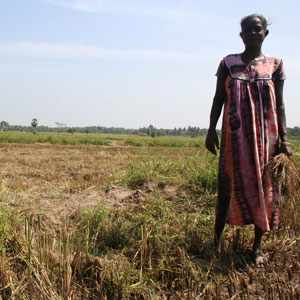
People require food, with more people requiring more food and less people requiring less food. Despite that self-evident relationship, most governments appear reluctant to accept the intimate link between the supplies of food and the numbers of people and continue calling for the further growth of their populations.
Give Edible Insects a Chance as an Alternative High-Quality Protein Source, say Scientists
Growing up in Samoya Village of Bungoma County in the Western part of Kenya, Elvis Wanjala has fond childhood memories of the rainy season, chasing and catching black-bellied winged termites in the rain.
The Sun Illuminates the Nights of Rural Families in El Salvador
After working on the family farm, Carlos Salama comes home and plugs his cell phone into a socket via a solar-powered electrical system, a rarity in this rural village in southern El Salvador.
Bringing Seeds of Hope to Farmers
Amidst a backdrop of rising food insecurity worldwide and a global food supply chain crisis, many countries are attempting to increase the level of food self-production. One improved input for farming which is receiving renewed attention is improved seed. The two most populous countries in the world, China and India, have recently made ground-breaking moves to improve their competitive position by developing new seeds which will improve their food production and increase resilience to climate change. So far, in 2022, new regulations on using biotechnology (genetic modification and gene editing) have been put in place by both countries to ultimately allow smallholder farmers to benefit from these new seeds.
UN Aims at People-Centered Governance in a Post-Pandemic World
The recently disseminated Zero Draft Ministerial Declaration of the High-Level Political Forum on Sustainable Development (HLPF)-- the main UN event to track the member states’ progress to achieve the Agenda 2030 slated to be held in the first half of July-- is a disappointment.
Two Months after the Start of the War, Food Insecurity Continues to Grow
Two months after the start of the war, on 24 February, the data on the substantial increase in the cost of food products, the rise in prices and shortages of fertilizers, the destruction of land and plantations in Ukraine, the sanctions, the difficulties with the transport of cereals from the world’s main granary, represented by Russia and Ukraine, and the massive migrations, especially from rural areas, are just a few aspects that confirm the pessimism that had been generated after the outbreak of the conflict.
Big Business Depletes Nature, Big Business Supplants Nature with Synthetic Food
In case you were not aware, please know that humanity used to cultivate more than 6.000 plant species for food, but now instead fewer than 200 of these species make major contributions to food production. Out of these, only 9% account for 66% of total crop production.
Boosting Food Security and Education in Schools in Brazil
"I like lettuce, but not tomatoes and cucumbers," said nine-year-old Paulo Henrique da Silva de Jesus, a third grader at the João Baptista Caffaro Municipal School in the southeastern Brazilian city of Itaboraí.
Indigenous Women in Mexico Take United Stance Against Inequality
Every other Tuesday at 5:00 p.m. sharp, a group of 26 Mexican women meet for an hour to discuss the progress of their work and immediate tasks. Anyone who arrives late must pay a fine of about 25 cents on the dollar.
Rising Food Prices: Global Risks & Vulnerabilities
The breakout of the conflict in Ukraine and the following imposition of heavy Western sanctions on Russia are causing sharp price increases in food and energy commodities —of which both Ukraine and Russia represent key exporters — as well as disruptions to global supply chains, impacting the post-pandemic economic recovery.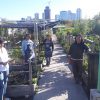
Women in Argentina Cultivate Dignity in Cooperative Vegetable Garden
The space consists of just 300 square meters full of green where there is an agro-ecological vegetable garden and nursery, which are the work and dream of 14 women. Behind it can be seen the imposing silhouettes of the high rises that are a symbol of the most modern and sought-after part of Argentina's capital city.
Kenyan Community Project Saving Forests, Saving Livelihoods
Despite an abundance of fisheries reserves along Kwale County’s lush coastline located on the south coast of Kenya, fishers can no longer cast a net just past the coral reef and expect an abundant crab or prawn harvest.
War in Ukraine & Rise in Arms Spending Undermine Development Aid to the World’s Poor
The unprecedented flow of arms to Ukraine, and the rising miliary spending by European nations to strengthen their defenses, are threatening to undermine development aid to the world’s poorer nations.
Food Systems Should Deliver Benefits in terms of Climate, Health and Society
Which country do you think best recognises the potential for changes to food systems to reduce emissions? Presumably a developed country, where agriculture is predominantly intensive, heavily subsidised and fuelled by fertilisers and irrigation, and where high consumption of animal proteins is the norm?
School Meal Programs Getting Back on Track in Central America, Despite Hurdles
A group of preschool students enthusiastically planted cucumbers and other vegetables in their small school garden in southern El Salvador, a sign that school feeding programs are being revived as the world emerges from the COVID-19 pandemic.
Traditional, Time-Tested Methods and a Modern App Helps Beat Climate Change
Even as erratic weather and extremely high temperatures increase pest infestation and affect harvests, a combination of traditional methods, integrated pest management through intercropping and multilayering is helping farmers in Ahmednagar and Aurangabad districts of Maharashtra, India.
How a Massive Climate Project Can Help Win Peace for Ukraine – And Help African Job + Food Crises
How would the late Archbishop Desmond Tutu have reacted to the Russian Invasion of Ukraine? Differently than you might think. The invasion of Ukraine is a mass human tragedy. It is killing Ukrainians, exposing families to violent atrocities, and has driven a refugee crisis of over 4 million people and counting. The war in Ukraine has also reawakened our fear of global war - even nuclear war - and the importance we place on global peace.
Perils of Hunger, Food Insecurity in Southern Africa- Challenges & Opportunities
Food systems are under severe stress around the world now. The thresholds of tolerance are already exceeding limits with millions facing acute food and water scarcity throughout all continents. Over a quarter of Africa’s population are facing hunger and food insecurity. Conflict, droughts, flooding, rising unemployment, inequality, economic crises, and the impacts of Covid-19 pandemic have been ravaging the Continent on an unprecedented scale.
Indian Agriculture Towards 2030
India began its journey as an independent nation in 1947 with fresh memory of the Bengal Famine of 1943 which claimed 1.5 to 3 million lives. Against this backdrop, the First Five Year Plan (1951-56) prioritized agriculture which, however, shifted to heavily industrialization in the second Plan.
School Feeding Is Now the World’s Largest Social Safety Net
When Canada and Nepal are used in the same sentence it’s usually because the former is supporting development efforts in the latter. Not when it comes to feeding children at school.
Turning Agro-industrial Waste into Energy in Argentina
Three giant concrete cylinders with inflated membrane roofs are a strange sight in the industrial park of Zárate, a world of factories 90 kilometers from Buenos Aires that heavy trucks drive in and out of all day long. They are the heart of a plant that is about to start producing energy from agro-industrial waste, for the first time in Argentina.« Previous Page — Next Page »


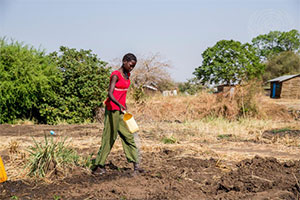 Farming on the Outskirts of Juba. Credit: UN Photo/JC McIlwaine
Promoting human and planetary health is a central focus of the United Nations, as laid out in the 2030 Sustainable Development Goals (SDGs). World hunger and unsustainable farming practices continue to be pressing concerns for the world. According to the 2025 State of Food Security and Nutrition in the World report by the Food and Agriculture Organization (FAO), 673 million people faced hunger in 2024. There are stark regional disparities, with the FAO projecting that 60% of the world population facing hunger will reside in Africa by 2030. Globally, the prevalence of food insecurity has remained consistently higher for women than men.
Sustainable and efficient national food systems are essential in preserving health, education, environmental well-being, peace, economy, and security. However, creating sustainable food systems can be a challenging endeavor, as food production takes a heavy toll on the environment. The agricultural sector accounts for a significant portion of greenhouse gases. Finding safe, sustainable, and ethical strategies to feed the world is crucial in ensuring planetary longevity. A recent initiative from 2023, the EU Regulation on Deforestation-free Products (EUDR), seeks to advocate for sustainable food systems. The main driver of deforestation is the expansion of agricultural land used to produce commodities like cattle, wood, cocoa, coffee, etc. The EUDR is part of the 2020 European Green New Deal and the EU Biodiversity Strategy for 2030 and aims to limit Europe’s consumption of products linked with deforestation by requiring that companies prove that their products are deforestation-free. Despite aiming to achieve major strides in sustainability, policies such as EUDR also raise socioeconomic concerns for targeted countries. Many emerging Latin American economies are impacted by the policy, and have raised the question of how developing countries can grapple with the tensions between economic development and advancing sustainability.
IPS has been at the forefront of providing compelling and insightful stories on communities facing hunger as well as the cost of food production. IPS uses statistics from FAO, the World Food Programme (WFP) and the International Fund for Agricultural Development (IFAD) to bring relevant and hard-hitting facts to readers. This gathering of information and data from such organizations helps bring the best stories from IPS journalists working in the different regions in consultation with experts on the ground.

The Week with IPS

NEXT STOP - SDGs
Tracking global progress towards a sustainable world
Tracking global progress towards a sustainable world