Languages
Sunday, November 8, 2026



News and Views from the Global South
Humanitarian Emergencies

Least Developed Countries Still Face Significant Challenges
Since the establishment of the Least Developed Countries (LDCs) category in 1971, the international community has worked hand in hand to support its most vulnerable members.
Water Woes Put a Damper on Myanmar’s Surging Economy
The central plains of Myanmar, bordered by mountains on the west and east, include the only semi-arid region in South East Asia – the Dry Zone, home to some 10 million people. This 13 percent of Myanmar’s territory sums up the challenges that the country faces with respect to water security: an uneven geographical and seasonal distribution of this natural resource, the increasing unpredictability of rain patterns due to climate change, and a lack of water management strategies to cope with extreme weather conditions.
Humanitarian Summit, The Big Fiasco
The World Humanitarian Summit (WHS) held in Istanbul on May 23-24, managed to send a strong wake-up call to the world about the unprecedented human suffering now in course, but failed to achieve the objective of attracting the massive funds needed to alleviate the humanitarian drama, as none of the leaders of the Group 7 of the richest countries nor of the five permanent members of the UN Security Council attended, with the exception of the German Chancellor Angela Merkel.
Water Security Critical for World Fastest-Growing Economy
Lack of water management and limited access to data risk hindering Myanmar’s economic growth, making water security a top priority of the new government.
Economic Interests Harming Global Health: WHO Chief
Putting economic interests over public health is leading the world towards three slow-motion health disasters, Margaret Chan, Director-General of the World Health Organization’s warned the world’s health ministers on Monday.
Humanitarian Summit: Too Big to Fail?
With a line up of heads of state or government telling all what they did to alleviate human suffering and promising to do more, along with leaders of civil society and humanitarian organisations denouncing lack of honest political will to act while governments continue spending trillions of dollars in weapons, the two-day World Humanitarian Summit kicked off today May 23 in Istanbul.
Bangladesh’s Urban Slums Swell with Climate Migrants
Abdul Aziz, 35, arrived in the capital Dhaka in 2006 after losing all his belongings to the mighty Meghna River. Once, he and his family had lived happily in the village of Dokkhin Rajapur in Bhola, a coastal district of Bangladesh. Aziz had a beautiful house and large amount of arable land.
Humanitarian Summit Aims to Mobilise Up to 30 Billion Dollars
The two-day World Humanitarian Summit (WHS), opening today May 23 in Istanbul, aims at mobilising between 20 and 30 billion dollars to face the on-gowing, worst-ever humanitarian crises, said Stephen O’Brien, UN Under-Secretary-General for Humanitarian Affairs andEmergency Relief Coordinator.What do Aid Organisations Want from the Humanitarian Summit
The UN World Humanitarian Summit takes place in Istanbul, 23-24 May. So what hopes do the humanitarian organisations, which deliver aid on the ground, have for the outcomes?
Africa: Resolved to Address African Problems Using African Solutions
The African Union (AU) representing 54 countries and home to 1,2 billion inhabitants, will be in Istanbul to participate in the May 23-24, 2016, first-ever World Humanitarian Summit (WHS) with two key demands—that the international humanitarian system be redefined, and a strong, firm own commitment to itself, to the continent and its people, anchoring on the primacy of the states.
Humanitarian Summit Must Address Weapons Shipments Too
Boats carrying refugees and boats carrying aid supplies will be on the agenda at the World Humanitarian Summit this week, but advocates say discussing the free flow of shipments carrying bombs and guns might be even more critical.The Heavens Poured and Atlas Shrugged
Sri Lankan parliamentarians appear to have been moved to unseemly mirth regarding the floodwaters which devastated the country this week, causing more than sixty three officially reported deaths and thousands more missing, with even greater numbers rendered homeless and destitute.
When Emergencies Last for Decades
For the millions of people whose lives have been uprooted by conflict and natural disasters the average amount of time before they can return home is now 17 years.
Refugees Bring Economic Benefits to Cities
Refugees are now more likely to live in cities than in refugee camps, bringing with them planning challenges but also opportunities for economic growth.
‘We Cannot Keep Jumping from Crisis to Crisis’
“We cannot keep jumping from crisis to crisis. We have to invest in long-term development that helps people cope with shocks so that they can continue to grow enough food for their communities and not require emergency aid.”
Climate Change Compounds Humanitarian Crises in Global South
As the Global South works to overcome a history of weak institutions, armed conflict and poverty-driven forced exodus, key causes of its humanitarian crises, developing countries now have to also fight to keep global warming from compounding their problems.
Now 1 in 2 World’s Refugees Live in Urban Areas
It is true that millions of refugees, especially in Africa and the Middle East, reside in camps. But in all they represent only one-quarter of the total number of refugees. Meanwhile, more than 1 in 2 of all the world’s refugees live in slums or in informal settlements and on the fringes of cities, in overcrowded neighbourhoods and in areas prone to flooding, sanitation hazards and diseases.
A Precarious Fate for Climate Migrants in India
After the sea swallowed up her home and family in the Bangladeshi coastal district of Bhola along the Bay of Bengal, farmer Sanjeela Sheikh was heartbroken. Stripped of all her belongings, her fields swamped and her loved ones dead, she contemplated suicide.
A Latin American Humanitarian Emergency Invisible to the World
“This is a humanitarian crisis,” said Bertha Zúñiga Cáceres, referring to the generalised violence in Mexico and in Honduras and other countries of Central America, which has claimed hundreds of thousands of lives and is a product of transnational crime, but is invisible to the international community.
Humanitarian Situation in Yemen Seriously Deteriorating
The humanitarian crisis in Yemen is very seriously deteriorating, said Office of the Coordination for Humanitarian Affairs’ (OCHA) Operations Director John Ging.
A Refugee Crisis with No End in Sight
"We don't want charity, we want a long-term solution."« Previous Page — Next Page »





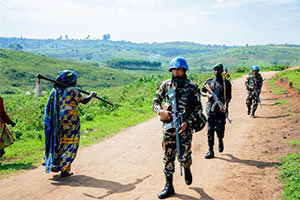 MONUSCO Peacekeepers and FARDC Soldiers Patrol Fataki Area. Credit: UN Photo/Jorkim Jotham Pituwa
Conflict, human rights violations, natural disasters, and famine have been at the forefront of concerns for humanitarian organizations. The escalation of humanitarian crises has led to over 239 million people in need of humanitarian assistance at the start of 2026, as estimated by OCHA’s Global Humanitarian Overview. The 2025 humanitarian appeal received only $12 billion, the lowest funding in over a decade, which has left 24 million fewer people reached in comparison to 2024. Conflict has remained the primary driver of crisis.
Humanitarian emergencies massively impact progress towards the Sustainable Development Goals (SDGs), adversely affecting economic development, inequality, education, planetary well-being, and poverty. Millions of people are faced with reduced access to essential services, including shelter, food, healthcare, and access to clean drinking water. UN Organizations such as UNHCR and the United Nations Children’s Fund (UNICEF) are committed to providing direct relief to affected communities when state governments cannot.
The United Nations 2024 Summit of the Future discussed measures that will be taken to reduce global inequality and promote peacekeeping efforts around the world. The recent UN Climate Change Conference (COP30) in Belém, Brazil, agreed to mobilize $1.3 trillion annually for climate action by 2035, operationalize the loss and damage fund, and triple adaptation finance. However, a fossil fuel transition commitment was not secured, despite climate change and the greenhouse effect being major contributors to humanitarian crises worldwide.
Countries across the world have also rallied to end humanitarian crises, as witnessed in conflicts such as Palestine and Ukraine. IPS is committed to providing relevant and in-depth reports of humanitarian emergencies around the world and their implications.

The Week with IPS

NEXT STOP - SDGs
Tracking global progress towards a sustainable world
Tracking global progress towards a sustainable world