Languages
Monday, November 9, 2026



News and Views from the Global South
Humanitarian Emergencies

Worldwide Displacement at the Highest Level Ever Recorded
A horrific year of war, humanitarian crises, human rights violations and persecution has caused a sharp rise in global forced displacement.
Pope Could Upstage World Leaders at U.N. Summit in September
Judging by his recent public pronouncements - including on reproductive health, biodiversity, the creation of a Palestinian state, the political legitimacy of Cuba and now climate change – Pope Francis may upstage more than 150 world leaders when he addresses the United Nations, come September.
New Approaches to Managing Disaster Focus on Resilience
Natural disasters have become a fact of life for millions around the world, and the future forecast is only getting worse.
Opinion: No Place to Hide in Addis
My colleagues just got back from Munich, where we held a summit bringing together over 250 young volunteers from across Europe. These youngsters campaigned in the run-up to and at the doorstep of the G7 Summit in Schloss Elmau, as one of the key moments in a year brimming with opportunities to tackle extreme poverty.
South Sudan Again Tops Fragile States Index
For the second year in a row, South Sudan has been designated as the most fragile nation in the world, plagued by intensifying internal conflict that has displaced more than two million of its people.
Donor Conference to Tackle Nepal Reconstruction
The 7.8 magnitude earthquake that shook Nepal in April, and the numerous aftershocks that followed, left the country with losses amounting to a third of its economy.
Could Peacekeeping Wives Deter Sexual Abuse in U.N. Overseas Operations?
Back in November 2007, about 108 military personnel from an Asian country, serving with the U.N. peacekeeping mission in Haiti, were deported home after being accused of sexual exploitation and sexual abuse of minors.
Opinion: We Have a Moral Imperative to Act on Climate Change
My country, the Philippines, is one of the most vulnerable to the impacts of climate change. Even though we are among those countries that hardly contributed emissions and benefited least from burning fossil fuels, we find ourselves at the frontline of the climate crisis.
World’s Nuke Arsenal Declines Haltingly While Modernisation Rises Rapidly
The world’s stockpile of nuclear weapons, held by nine states, just got a little smaller.
Rights Groups Call for Durable Solution for Europe’s Migrants
Human rights groups are calling for a sustainable solution to the migrant crisis in Europe, especially following the dismantling of refugee camps in Paris and Calais, France, over the past two weeks.
Opinion: Cli-Fi Film from Philippines Packs a Punch
I live on a crowded, subtropical island nation in the Western Pacific, on the opposite side of the "Pacific Pond" from North America. And just south of Taiwan is the many-splendored island nation of the Philippines. We are neighbours. You can fly there in one hour, it's that close.
Israel, Hamas Escape U.N.’s List of Shame on Attacks on Children
Secretary-General Ban Ki-moon, reportedly under heavy pressure from the United States and Israel, has decided not to blacklist the Jewish state in an annex to a new U.N. report on children victimised in armed conflicts.Opinion: Minsk Agreements, the Only Path to Peace in Ukraine
The “U.N. Report on the human rights situation in Ukraine”, which was referred to in an Inter Press Service (IPS) article of Jun. 2, does not, in my view, reflect many salient points.
Fishing and Farming in Gaza is a Deadly Business
Three Palestinian fishermen were injured last week after Israeli naval forces opened fire on fishing boats off the coast of al-Sudaniyya in the northern Gaza Strip, bringing to 15 the number of farmers and fishermen shot and injured by Israeli security forces recently as they attempted to earn a living.
Exodus in the Bay of Bengal
For a while it went unnoticed: a boatload of migrants here, a vessel full of refugees there. But since 2012, the complex and unregulated movement of human beings through South and Southeast Asia– and the fate of those who put their lives in the hands of smugglers and at the mercy of the high seas – is becoming bleaker with each passing day.
The U.N. at 70: A Time for Reflection and Reform
Seventy years since its inception, the United Nations remains at the core of the multilateral system. The world body, together with the Bretton Woods institutions, was conceived in the mid-1940s by the architects of the postwar order with the central aim of saving succeeding generations from the scourge of war on the one hand, and the need to reconstruct and revive the global economy on the other.
8.2 Million Iraqis In Need of Emergency Humanitarian Assistance
As fighting drags on between Iraqi armed forces and the Islamic State in Iraq and the Levant (ISIL), millions of refugees caught between the warring groups are in dire need of humanitarian assistance.
U.N. Sets Up Independent Panel to Probe Sexual Abuses in CAR
The United Nations, which came under heavy fire for its failure to act swiftly on charges of sexual abuse by French troops in the Central African Republic (CAR) last year, has decided to set up an External Independent Review (EIR) to probe these allegations.
Leaked Internal Documents Show U.N. Ignored Child Abuse
Leaked United Nations documents show high-level staff knew of abuses by soldiers in the Central African Republic and failed to act, all while planning the removal of U.N. whistleblower Anders Kompass.
Relief Organisation Urges Mandatory Funding for Humanitarian Appeals
The United Nations is not only overwhelmed by a spreading humanitarian crisis, largely in Africa and the Middle East, but also remains hamstrung by a severe shortfall in funds, mostly from Western donors.
U.N. Security Council Takes “Historic” Stand on Killings of Journalists
When war breaks out, most non-combatants run the other way. But a handful of courageous reporters see it as their duty to tell the world what's happening on the ground. And many pay a high price.« Previous Page — Next Page »





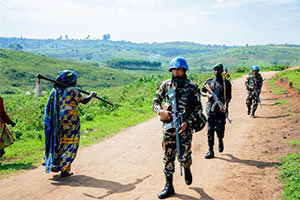 MONUSCO Peacekeepers and FARDC Soldiers Patrol Fataki Area. Credit: UN Photo/Jorkim Jotham Pituwa
Conflict, human rights violations, natural disasters, and famine have been at the forefront of concerns for humanitarian organizations. The escalation of humanitarian crises has led to over 239 million people in need of humanitarian assistance at the start of 2026, as estimated by OCHA’s Global Humanitarian Overview. The 2025 humanitarian appeal received only $12 billion, the lowest funding in over a decade, which has left 24 million fewer people reached in comparison to 2024. Conflict has remained the primary driver of crisis.
Humanitarian emergencies massively impact progress towards the Sustainable Development Goals (SDGs), adversely affecting economic development, inequality, education, planetary well-being, and poverty. Millions of people are faced with reduced access to essential services, including shelter, food, healthcare, and access to clean drinking water. UN Organizations such as UNHCR and the United Nations Children’s Fund (UNICEF) are committed to providing direct relief to affected communities when state governments cannot.
The United Nations 2024 Summit of the Future discussed measures that will be taken to reduce global inequality and promote peacekeeping efforts around the world. The recent UN Climate Change Conference (COP30) in Belém, Brazil, agreed to mobilize $1.3 trillion annually for climate action by 2035, operationalize the loss and damage fund, and triple adaptation finance. However, a fossil fuel transition commitment was not secured, despite climate change and the greenhouse effect being major contributors to humanitarian crises worldwide.
Countries across the world have also rallied to end humanitarian crises, as witnessed in conflicts such as Palestine and Ukraine. IPS is committed to providing relevant and in-depth reports of humanitarian emergencies around the world and their implications.

The Week with IPS

NEXT STOP - SDGs
Tracking global progress towards a sustainable world
Tracking global progress towards a sustainable world