Languages
Thursday, November 12, 2026



News and Views from the Global South
Development & Aid

New COVID-19 testing equipment deployed in Tonga
Last week, the Tonga Laboratory Services completed the installation of a 4 module GeneXpert testing equipment used for diagnosis of COVID-19 infection and to increase SARS-coV-2 testing capacity.
Education Cannot Wait Develops Groundbreaking Curriculum for Crisis-Affected Adolescents – Derived from Viktor Frankl’s Seminal Work ‘Man’s Search for Meaning’
Education Cannot Wait (ECW) – the United Nations global fund for education in emergencies – is developing a curriculum derived from the seminal work of world-renowned psychiatrist and Holocaust survivor Viktor Frankl’s “Man’s Search for Meaning”, and its related branch of psychotherapy, Logotherapy. The curriculum, which has been preliminary field-tested in Uganda, aims to fully tap into the resilience of girls and boys living in crisis settings.
“We Need to Act Now” — as Sub-Saharan Africa Faces Third Wave of Covid-19
Sub-Saharan Africa is in the grips of a third wave of COVID-19 infections that threatens to be even more brutal than the two that came before.UN Food Systems Summit Releases Potential Solutions for Local, Regional and Global Action
The UN Food Systems Summit has revealed the 15 action areas with more than 50 solution clusters that will inspire discussions at the Pre-Summit in Rome from July 26-28.
Climate Change: Your Choices Matter
Life is a series of choices. And choices have consequences. When it comes to climate change, some choices have bigger consequences than others, and there's a startling takeaway: your next "big" decision will play a meaningful role in our collective ability to reach Net-Zero by 2050.
Does a New ‘Gold Standard’ Really Protect Miners?
Many products these days come with the promise that workers and communities all along their supply line are protected from abuse under a particular standard or code of conduct. Since the United Nations adopted the Guiding Principles for Business and Human Rights a decade ago, a plethora of such certification systems have emerged, including for mining and connected industries ranging from cars to jewelry and electronics.
With a Little Help, Local Communities Rack up Record Success with Heritage Rice Grains
Madhuri Roy left the famous Kamakhya temple in Guwahati, Assam. She had sought the goddess’s blessings for the safe delivery of her youngest daughter's baby, which was due in a few weeks. Shanty shops lined the temple outside and Roy’s eyes fell on a stack of black rice packets. All through her daughter’s pregnancy she had craved her childhood favourite black rice pudding. But during the country’s COVID-19 lockdown Roy could not procure it even though Meghalaya, her Himalayan home state, grew it.
Myths, Lobbies Block International Tax Cooperation
Too many have swallowed the myth that lowering corporate income tax (CIT) is necessary to attract foreign direct investment (FDI) for growth. Although contradicted by their own research, this lie has long been promoted by influential international economic institutions.
Acceleration Rights Plan for Gender Equality Mooted at Equality Forum
As the global gathering for gender equality, the Generation Equality Forum, kicks off in Paris on June 30, 2020, IPS conducted an exclusive interview with Katja Iversen.
Why Pacific Island Nations, like the Federated States of Micronesia, need Climate Change Finance for Food Security Now
Robby Nena is one of the many farmers and fishermen on the frontline of climate change in the Federated States of Micronesia (FSM), where coastal flooding and erosion, variable and heavy rainfall, increased temperature, droughts and other extreme weather events are becoming all too common.
Universal Civil Registration and Vital Statistics Are Critical for Truth, Trust and COVID Recovery in Asia and the Pacific
With health systems at a breaking point, hospitals at capacity and desperate family members searching for oxygen for loved ones, the devastating second wave of COVID-19 that has swept across South Asia has felt ¬surreal. Official figures have indicated record-breaking daily coronavirus cases and deaths, not only in South Asia, but across the entire Asia-Pacific region during the latest surge. As devastating as it has been, the truth is we may never know how many people have died during the pandemic.
To Build Back Better from the Pandemic, We Must Overhaul the Way We Deal with Development Finance
Over the past 18 months, the impacts of the coronavirus pandemic have transformed our lives and prompted a period of deep reflection as a global community. In some sense, we are only now starting to understand our vulnerabilities, and in particular, how deeply exposed and interconnected we are as people, communities and as countries.
Weaponizing Science in Global Food Policy
In July, the United Nations will convene “Science Days”, a high-profile event in preparation for the UN Food Systems Summit later this year. Over the course of two days, the world will be treated to a parade of Zoom sessions aimed at “highlighting the centrality of science, technology and innovation for food systems transformation.”
“The Creation of a Palestinian State Is Inescapable”
Every Israeli will sooner than later realize that the creation of a Palestinian state is the only way by which Israel can protect its democracy, independence, national security and national Jewish identity. Denying Palestinian statehood defies Israel’s existence as we know it.
Southeast Asia and Food Price Inflation: Double Whammy
In 2020, Southeast Asian countries were already facing varied challenges that affected the region’s food supplies and prices. The onset of the Covid-19 pandemic later in the year exacerbated the region’s food insecurity and poverty. Southeast Asian countries need to take a hard look at food security, even as the double challenges — climate change and the Covid-19 pandemic — continue to fester.
Latin America Vastly Underspends on Green Post-Pandemic Recovery
Latin America is investing too little in a green recovery from the Covid-19 pandemic, with only 2.2% of the region's stimulus funds spent on environmentally sustainable projects last year, according to a new platform developed by Oxford University and the UN.
Global Herd Immunity Remains Out of Reach Because of Inequitable Vaccine Distribution – 99% of People in Poor Countries Are Unvaccinated
In the race between infection and injection, injection has lost. Public health experts estimate that approximately 70% of the world’s 7.9 billion people must be fully vaccinated to end the COVID-19 pandemic. As of June 21, 2021, 10.04% of the global population had been fully vaccinated, nearly all of them in rich countries.
COVID-19 as Instigator of Bigotry, Chauvinism and Megalomania
By the end of April 2019, a government campaign to vaccinate more than 40 million children under five against polio in Pakistan was suspended after a series of attacks on health workers and police. On 23 April, a police officer protecting polio workers was gunned down in Bannu, the same day a polio worker was in Lahore seriously wounded by a father “protecting his child from vaccination”, these incidents were followed by the murder of another police and a health worker under his protection. Health workers were also seriously wounded in the districts of Sindh, Balochistan and Punjab. Afghanistan and Pakistan are the only countries where polio remains, in all other nations of the world vaccination campaigns have eliminated the disease. In April this year, three female polio vaccine providers were killed in Afghanistan.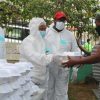
A Time for Systemic Solutions in Latin America & the Caribbean
The first wave of COVID-19 never ended in Latin America and the Caribbean (LAC). Since the region became a hotspot for the pandemic in June 2020, successive waves have continued to build upon the first.
130 Countries Promise to Protect and Invest in Health Care Workers
One hundred and thirty countries have signed a statement recognising the efforts of health care workers, first responders and essential workers during the COVID-19 pandemic – "one of the greatest global challenges in the history of the United Nations".
Water Harvesting Strengthens Food Security in Central America
At the school in El Guarumal, a remote village in eastern El Salvador, the children no longer have to walk several kilometers along winding paths to fetch water from wells; they now "harvest" it from the rain that falls on the roofs of their classrooms.« Previous Page — Next Page »





 2026 High-level Political Forum on Sustainable Development. Credit: UN Photo/Eskinder Debebe
In 2015, the United Nations and its Member States adopted the Sustainable Development Goals (SDGs) in an effort to make the world a more sustainable and peaceful place for future generations. Progress on the 17 SDGs has been uneven, and inequality persists across the globe. 10 years after adoption, the 2025 UN SDGs Report revealed that only 35% of the SDG targets are on track, with more than half moving too slowly, and 18% moving backwards from the 2015 baseline. Poverty remains one of the world’s most pressing issues, with hunger, violence, and inequality impeding the opportunities for all people to achieve success. In September 2024, the United Nations Summit of the Future introduced a new goal: to eradicate global poverty by 2030, ensure universal rights to basic services, and increase the overall standard of living in terms of industrialization, economic well-being, citizen health, and literacy. Furthermore, recent shifts in United States foreign aid policy – notably, major budget cuts to USAID and the termination of thousands of development programmes– have severely threatened vital lifelines of financial aid to impoverished communities around the world. Additionally, the United States’ withdrawal from the Paris Climate Agreement has undercut international efforts at sustainable development. With the upcoming 2030 deadline, the UN Secretary-General has called for urgent multilateralism across six priority areas: food systems, energy, digital connectivity, education, jobs and social protection, and climate and biodiversity. IPS sheds light on marginalized communities that struggle on a daily basis to survive and have their stories heard and respected.
Updated by Yilan Batista and Shuli Wong August 2026

The Week with IPS

NEXT STOP - SDGs
Tracking global progress towards a sustainable world
Tracking global progress towards a sustainable world
