Languages
Friday, October 9, 2026



News and Views from the Global South
Population

A World of 8 Billion, Yes, But Only a Few Are Seen as Human Beings
Far-right Brazilian president, Jair Messias Bolsonaro, was quoted a year ago or so as saying to a small group of indogenous people that they “now look a bit more like humans.”
UN Predicts 68 Percent of World’s Population will be Living in Urban Areas by 2050
When we think of urbanization we often end up referring to the increasing number of megalopolises that are sprawling around the world. Yet less thoughts are given on the fact that the future patterns of urbanization will be centered on secondary cities or semi urban spaces, now becoming extensions of these gigantic cities.
Rights Groups Question ‘Pregnancy Register’ for Polish Women
Women’s rights groups fear a new legal provision in Poland requiring doctors to collect records on all pregnancies could create what they have described as a ‘pregnancy register’ to monitor whether women are having abortions.
Mobilizing Against Hunger in Brazil, Where It Affects 33.1 Million People
A campaign against hunger, a problem that affects 15.5 percent of the Brazilian population, seeks to mobilize society once again in search of urgent solutions, inspired by a mass movement that took off in the country in 1993.
Androids in Human Populations
It is time for countries, especially those with slow growing and ageing human populations, to welcome androids, i.e., humanoid robots with human-like appearance and behavior, including speech, sight, hearing, mobility, and artificial intelligence.
The Digital Divide, a Pending Issue in Chile’s Educational System
A Chilean government plan seeks to ensure connectivity in remote areas, in a first step to address a deep digital divide among the country's inhabitants that includes a lack of access to technology and digital education deficits, exposed by the COVID-19 pandemic.
Why Aren’t More Women Angry?
Why aren’t more women angry about their subordination, discrimination, and unequal treatment in the 21st century? Of course, some of the world’s women are angry, but they are comparatively few.
Countering Hate Speech Through Media: A Young Caribbean Woman’s Perspective
Hate speech is a phenomenon that can be defined as threatening speech or writing expressing prejudice towards a specific group, primarily based on race, religion, or sexual orientation.
Small-Scale Fishers in Central America Demand Social Security Policies
At the pier, Salvadoran fisherman Nicolás Ayala checked the pocket of his pants to make sure he was carrying the hypertension pills he must take when he is at sea on a 24-hour shift. He smiled because he hadn’t forgotten them.
Elder Abuse: Human Rights Have an Expiration Date
1 in 6 people over 60 years of age –nearly 141 million people globally– suffers from abuse, according to World Health Organization (WHO) estimates.
Meaningful Dialogue Amplifies Youth Issues, Leads to Change
Young people are often the first to rebuild their communities. However, youths' diverse challenges cannot be addressed without meaningful dialogue, says Klaus Beck, Regional Director of UNFPA APRO ai.
Poor Families Clash over Water with Real Estate Consortium in El Salvador
Alex Leiva woke up at 4:00 a.m. to perform a key task for his family’s survival in the Salvadoran village where he lives: filling several barrels with the water that falls from the tap only at that early hour every other day.
COVID and Discrimination Aggravated Maternal Mortality in Latin America
Brazil had the dubious distinction of champion of maternal mortality in Latin America during the COVID-19 pandemic, with a 77 percent increase in such deaths between 2019 and 2021.
Illegal Immigration Dilemma
Illegal immigration in the 21st century poses a serious dilemma for the world. Governments in virtually every region of the globe appear to be at a loss on how to address the two central dimensions of the dilemma.
Floods Drive Urban Solutions in Brazilian Metropolis
"We do everything through parties, we don't want power, we don't want to take over the role of the State, but we don't just protest and complain," said Itamar de Paula Santos, a member of the United Community Council for Ribeiro de Abreu (Comupra), in this southeastern Brazilian city.
Undocumented Migration Puts Pressure on New Chilean Government for Solutions
The pressure of the influx of migrants, especially Venezuelans, has reached a critical level in northern Chile, and is felt as far as the capital itself, forcing the government that took office in March to create a special interministerial group this month to propose solutions that respect their human rights.
No Climate Transition Without Securing Land Rights
The landmark land tenure decision by parties to the UN Convention to Combat Desertification (UNCCD) in 2019 offers a blueprint for upcoming climate negotiations in Sharm El Sheikh in November.
One Hundred Years On, Argentine State Acknowledges Indigenous Massacre in Trial
It’s a strange trial, with no defendants. The purpose is not to hand down a conviction, but to bring visibility to an atrocious event that occurred almost a hundred years ago in northern Argentina and was concealed by the State for decades with singular success: the massacre by security forces of hundreds of indigenous people who were protesting labor mistreatment and discrimination.
Most Maternal Deaths Are Preventable: How To Improve Outcomes in South Africa
The past 20 years have seen a significant decline in maternal mortality rates from 342 deaths to 211 per 100,000 globally . But every day, more than 800 women around the world die from complications of pregnancy and childbirth, up to 42 days after delivery. Most of these deaths are preventable.
Food and People
People require food, with more people requiring more food and less people requiring less food. Despite that self-evident relationship, most governments appear reluctant to accept the intimate link between the supplies of food and the numbers of people and continue calling for the further growth of their populations.
Earth Day to Earth Disaster
Since the first Earth Day observed on 22 April 1970, world conditions have worsened greatly across three critically interrelated global dimensions that portend a disastrous future for life on planet Earth.« Previous Page — Next Page »





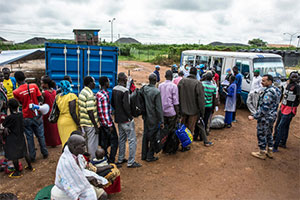 One Thousand Internally Displaced Persons (IDPs) Relocated from Tomping Camp in South Sudan. Credit: UN Photo/Isaac Billy
It took hundreds of thousands of years for the world’s human population to cross one billion in 1804. Approximately 200 years later, the population has multiplied sevenfold. In 2023, the global population crossed 8 billion, and is expected to reach 9 billion before 2050. With the planet more crowded than ever, it is essential to keep track of population trends, urbanization, migration, and reproduction across the world.
Life expectancy has seen significant strides in the past century, largely due to economic development and increased standards of living. On the contrary, trends in global fertility are shifting, with certain regions in Africa and Asia reporting higher rates, while parts of Europe and North America report stagnant or lower rates. This is in part due to differences in sexual and reproductive healthcare, as well as societal and economic conditions around the world. For example, child marriage is prevalent in certain societies, where childbearing is also considered a familial duty. Meanwhile, stagnating economies frequently experience lower marriage and childbearing rates.
The increase in migration and urban development around the world is also linked to global population trends. By 2050, it is expected that approximately 66 percent of all people will live in cities. Furthermore, global crises such as warfare and natural disasters also prompt transnational migration. Transnational migration is linked to a variety of socioeconomic issues in both host and receiving countries: migrants often leave developing countries with less access to educational and economic opportunities and arrive in developed countries where they are frequently the targets of ethnic, racial, and cultural discrimination, and economic exploitation. Recent crises in Europe and the United States demonstrate the importance of advocating for migrants worldwide. As migrants from the Global South are increasingly stripped of their legal and civic rights in unlawful deportations, or targeted in acts of identity-based violence, it is essential to keep track of population trends and protect the human rights of migrant populations. Climate-related disasters are now a major driver of displacement, with nearly half of all new internal displacements in 2025 being disaster-related.
IPS is devoted to covering issues surrounding population trends, migration, and reproduction through its compelling articles, which use both statistics and human stories to provide readers with robust and informative viewpoints.

The Week with IPS

NEXT STOP - SDGs
Tracking global progress towards a sustainable world
Tracking global progress towards a sustainable world
