Languages
Saturday, October 10, 2026



News and Views from the Global South
Population

Earth Day to Earth Disaster
Since the first Earth Day observed on 22 April 1970, world conditions have worsened greatly across three critically interrelated global dimensions that portend a disastrous future for life on planet Earth.
Unintended Pregnancy Rates Highest in Africa: a Look at the Complex Reasons
The United Nations Population Fund recently released the 2022 State of World Population report. It highlights that almost half of all pregnancies between 2015 and 2019 were unintended. That amounts to roughly 121 million unintended pregnancies each year.
Can Legal Action Alone Put an End to Child Marriage?
On December 22, 2021, the Prohibition of Child Marriage (Amendment) Bill, 2021, which seeks to raise the legal age of marriage for women from 18 to 21, was sent to a parliamentary standing committee for further discussion.
UN Should Aspire to Turn Sports into a Tool for Social Change
The International Day of Sport for Development and Peace, which will be commemorated on April 6, is a day that celebrates the positive effects that sports can have on the society.
Profound Effect of Covid Pandemic on Women and Girls in Asia-Pacific Documented
Women and girls in the Asia-Pacific region were adversely impacted due to COVID-19 pandemic responses – with marginalized women and girls’ access to sexual and reproductive health rights (SRHR) and gender-based violence (GBV) services profoundly affected.
Do we Really Need a World Ranking to Measure Happiness?
The 10th edition of the World Happiness Report was recently published and once again the findings raised an array of mixed emotions with many questioning the real foundations underpinning the most discussed aspect of the Report, the World Happiness Ranking,
Water & Sanitation, a Better Future for Girls & our Planet
At the World Water Forum this week (March 21-26), the international community will raise awareness of the 2 billion people worldwide who lack access to clean water and sanitation. Among them are millions of women and girls, who walk hundreds of miles each year to find water for their families and are blocked from education and economic empowerment also due to poor sanitation services.
Water & Sanitation Crisis Escalates as Yemenis Mark World Water Day
As Yemen enters its 8th year of an escalating conflict, 21.7 million of my fellow Yemenis are forced to rely on humanitarian assistance to survive. The conflict has left a trail of devastation in its wake – the country is in economic freefall, and families face intensified violence, hunger, and disease. As we also mark another World Water Day on March 22, within Women’s History Month, it is a time to reflect on the immense water and sanitation crisis that continues to take countless lives – and how it impacts women and girls so acutely. The destruction of the country’s health and water infrastructure has left Yemen acutely vulnerable to multiple epidemics including malaria, diphtheria, dengue, cholera, and COVID-19.
Zimbabwe Crackdown on NGOs Could Impact Election Observation
Zimbabwe is pressing ahead with a controversial bill that critics say seeks to criminalise the operations of nongovernmental organisations working in the country.
Uganda Recognizes Pregnant Teens’ Right to Education, but Religion, Stigma Lock Out Most
When schools reopened in Uganda in January, Atim’s baby was 3 months old. The 17-year-old wished to go back to classes but she faced a dilemma—whether to disclose to her teachers that she was a lactating mother.
Youths Trailblazing Paths in Sexual and Reproductive Health Ahead of ICFP Family Planning Conference
Travelling in northern Nigeria, Peace Umanah noticed teenage girls with multiple children – they would be walking with one strapped to their back, holding another by hand and with a protruding belly.
Commission on the Status of Women: The Streets Have Already Spoken
The 66th session of the Commission on the Status of Women (CSW) was just launched. Due to the ongoing impacts of the COVID-19 pandemic, the main annual global forum on gender equality is once again taking place in a hybrid format – both at the UN’s New York headquarters, where government delegations will be meeting, and online, where most civil society activity will take place.
International Women’s Day, 2022
How Bangladesh Became a Test Case for Women’s Empowerment
The increased empowerment of rural women in Bangladesh over the past 10 years has been no accident.
A decade ago, not even one in four rural women could be said to be “empowered” across five key metrics, a figure that surprised even those working on the ground with the country’s poorest. By 2015, this had risen to more than two in five, or 41 per cent, with continued gains in recent years.

International Women’s Day, 2022
To Overcome Africa’s Development Crisis, Invest in Strengthening Girls’ Power
It was on a visit to Lesotho that I first heard the derogatory term Mmutla – nocturnal hare. It is a word used in some southern districts to insult adolescent girls who have been forced into sexual exploitation and transactional sexual relations for survival.
International Women’s Day, 2022
Raising up Women as Light in Dark Times
When I was a young girl, a friend and I spent our summers building a treehouse. We built it because our older brothers were building one and wouldn’t allow us to help them. So, we asked our parents to support us through the procurement of basic tools, collected scrap wood from the local hardware store, chose a tree, and then spent day after day puzzling beams and boards together into structure in which only people of our small size could fit.

International Women’s Day, 2022
To be Just, the Energy Transition Must Include & Empower Women
Access to clean energy improves women’s lives in a myriad of ways. It supports access to education and quality healthcare, opens new economic opportunities, and reduces unpaid domestic labour and gender-based violence. Yet too often, the sector as a whole – from industry to policymaking – still fails to include women as energy users, decision-makers and agents of change of the energy transition.

International Women’s Day, 2022
Gender Blind Spots in the Water Sector
UN Women estimates 150 million women and girls are emerging from poverty by 2030, thanks largely to comprehensive education, labor, and social protection strategies and reforms implemented by governments around the world.

International Women’s Day, 2022
Sexual Violence Laws are Failing Adolescents
At Equality Now, we have been on a years-long journey to track and analyze sexual violence laws and their implementation around the world. This work was born after working with survivors of sexual violence for over two decades and observing that women and girls reported similar barriers to justice regardless of where they were from.

International Women’s Day, 2022
Women Demanding Justice & Peace in the Streets of Myanmar
This will be the second International Women’s Day since the brutal coup erupted in Myanmar – and women remain fiercely in the lead in demanding justice and peace in the streets and behind closed doors.

International Women’s Day, 2022
Collective Solutions to Improve Sexual and Reproductive Health Rights in Climate Action
The devastating effects of climate change continue to disproportionately affect women and girls in the poorest regions, who have contributed the least to global warming.

Gender Lens Crucial to Leaving No One Behind (Part 2)
A crucial two-day meeting of Parliamentarians from the Asian, Arab and African regions will put human-rights-based legislative frameworks under the spotlight as the regions work to implement the ICPD Programme of Action.« Previous Page — Next Page »





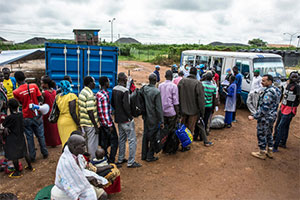 One Thousand Internally Displaced Persons (IDPs) Relocated from Tomping Camp in South Sudan. Credit: UN Photo/Isaac Billy
It took hundreds of thousands of years for the world’s human population to cross one billion in 1804. Approximately 200 years later, the population has multiplied sevenfold. In 2023, the global population crossed 8 billion, and is expected to reach 9 billion before 2050. With the planet more crowded than ever, it is essential to keep track of population trends, urbanization, migration, and reproduction across the world.
Life expectancy has seen significant strides in the past century, largely due to economic development and increased standards of living. On the contrary, trends in global fertility are shifting, with certain regions in Africa and Asia reporting higher rates, while parts of Europe and North America report stagnant or lower rates. This is in part due to differences in sexual and reproductive healthcare, as well as societal and economic conditions around the world. For example, child marriage is prevalent in certain societies, where childbearing is also considered a familial duty. Meanwhile, stagnating economies frequently experience lower marriage and childbearing rates.
The increase in migration and urban development around the world is also linked to global population trends. By 2050, it is expected that approximately 66 percent of all people will live in cities. Furthermore, global crises such as warfare and natural disasters also prompt transnational migration. Transnational migration is linked to a variety of socioeconomic issues in both host and receiving countries: migrants often leave developing countries with less access to educational and economic opportunities and arrive in developed countries where they are frequently the targets of ethnic, racial, and cultural discrimination, and economic exploitation. Recent crises in Europe and the United States demonstrate the importance of advocating for migrants worldwide. As migrants from the Global South are increasingly stripped of their legal and civic rights in unlawful deportations, or targeted in acts of identity-based violence, it is essential to keep track of population trends and protect the human rights of migrant populations. Climate-related disasters are now a major driver of displacement, with nearly half of all new internal displacements in 2025 being disaster-related.
IPS is devoted to covering issues surrounding population trends, migration, and reproduction through its compelling articles, which use both statistics and human stories to provide readers with robust and informative viewpoints.

The Week with IPS

NEXT STOP - SDGs
Tracking global progress towards a sustainable world
Tracking global progress towards a sustainable world
