Languages
Friday, October 16, 2026



News and Views from the Global South
Population

Gender Lens Crucial to Leaving No One Behind (Part 1)
Parliamentarians' leadership in a post-COVID-19 recovery is crucial to achieving the International Conference on Population and Development (ICPD) agenda. The involvement of lawmakers in ensuring a more equal, just, and sustainable society will come under the spotlight during a two-day inter-regional meeting organized by the Asian Population and Development Association (APDA) and the Forum of Arab Parliamentarians on Population and Development (FAPPD,) and supported by UNFPA ASRO in early March 2022.
Caring for The Old
With the unprecedented ageing of populations worldwide, countries are struggling with the critical questions of who should be responsible for caring for the old and what should be the extent of care provided to women and men in old age.
Israel’s Glorious and Gloomy Reality
No people have ever risen from the ashes of near-extinction to form a country and achieve the height of development in every walk of life like Israel. These magnificent accomplishments are now tragically marred with domestically charged struggles which ominously undermine its very existence.
APDA, AFPPD Celebrate Forty Years of Championing Population and Development Agenda
 The Asian Population and Development Association (APDA) has been ahead of the international community in addressing population and development issues, says the former Japanese Prime Minister and Chair of APDA Yasuo Fukuda.
Agricultural Power, Waning Industry Dictate Brazil’s Future
With its accelerated growth agriculture has emerged as a key sector of Brazil's economy, but it is failing on its own to spread prosperity and reduce poverty and inequality, with industry in decline.
Debunking Demographic Denialism
Demographic denialism is increasingly appearing in countries across the globe. Various government officials, politicians, business leaders, media commentators and others are blatantly denying demographic realities and likely future trends and advancing falsehoods.
Battle for Palestine: & the Day When David Felled Goliath with a Stone
When Israeli Ambassador Gilat Erdan made an unusual presentation before the Security Council last week displaying a large rock, which he claimed, was hurled at Israeli vehicles in the Occupied Territories, a reporter at a UN press conference asked whether Palestinians will be given the right of reply--- by displaying in the Security Council chamber an Uzi sub- machine gun or a bulldozer deployed by Israeli armed forces against civilian demonstrations.
Community Organization and Solidarity in Peru Tackle Hunger in Pandemic
It's nine o'clock in the morning and Mauricia Rodríguez is already peeling garlic to season the day's lunch at the Network of Organized Women of Villa Torreblanca, one of more than 2,400 solidarity-based soup kitchens that have emerged in the Peruvian capital in response to the worsening poverty caused by the partial or total halt of economic activities in the country due to COVID-19.
Mali must not Be a New Site for Clashes Between Global Powers
Last week, I was delighted to speak to the United Nations Security Council. In the ten years that my country has been experiencing conflict, violence, and instability, dozens of conferences and other international summits have been held without ever really making room for those who are mobilized on a daily basis for more social justice, the defense of human rights and achieving Malian peace.
Population Ageing: An Inescapable Future
The ageing of human populations is an inescapable demographic future. That evolving and universal future is increasingly challenging governments and the public, who are by and large ill prepared for that certain future.
Severe Water Stress, Absolute Scarcity for 2 to 4 Billion Humans by 2025
Now it comes to the scary water crises, as it is estimated that, globally, over two billion people live in countries that experience high water stress.
America Faces a Fateful Crossroad in 2022
When my assistant handed me copy expressing my greetings and good wishes for 2022 for approval, I paused, thinking, “is that all I can say, just hope for a better, brighter new year?”
Rural Women in Peru Seed Water Today to Harvest It Tomorrow
"When I was a little girl we didn't suffer from water shortages like we do now. Today we are experiencing more droughts, our water sources are drying up and we cannot sit idly by," Kely Quispe, a small farmer from the community of Huasao, located half an hour from Cuzco, the capital of Peru's ancient Inca empire, told IPS.
Doubling Adaptation Finance can be an Opportunity for the World’s Poorest
Amid several disappointments of the 2021 UN climate conference in Glasgow, one sign of hope was the agreement on financing for adaptation to climate change. Developed countries agreed to double adaptation finance for poorer nations by 2025, from 2019 levels.
Homeless Camps, a Reflection of Growing Inequality in Chile
Camps made up of thousands of tents and shacks have mushroomed in Chile due to the failure of housing policies and official subsidies for the sector, aggravated by the rise in poverty, the covid-19 pandemic and the massive influx of immigrants.
Climate Crisis Exacerbates Urban Inequality in Latin America
The Brazilian megalopolis of São Paulo recorded 932 flooded premises on Feb. 10, 2020. The Mexican city of Tula de Allende was under water for 48 hours in September 2021. In Lima it almost never rains, but the rivers in the Peruvian capital overflowed in 2017 and left several outlying municipalities covered with mud.
Future Fertility Fantasies
Many low fertility countries are having future fertility fantasies. It’s time for them to end those fantasies and prepare for a future of below replacement fertility with demographic ageing and without immigration declining populations.
APDA Young Leaders Devise Solutions for the Future
Whether you look at society, the environment, or technology – the world is changing rapidly. Global organizations strive to adapt to this change. The United Nations, for example, has developed the Sustainable Development Goals as a blueprint for human development.
Poor Communities on the Salvadoran Coast Face Constant Threat of Eviction
Small farmer Francisco Martínez pushed his son’s wheelchair to another part of the courtyard of their house, located in a small coastal community in El Salvador, before saying sadly: "It would be a great injustice if they kicked us out of here."
African Network Fosters Unity, Fights Gender Discrimination & Advances Sustainable Development
The widespread 21-month-old lockdown, triggered by the corona virus pandemic, had a destructive impact on the global economy, claimed over 5.2 million lives, destabilized governments and radically changed lifestyles worldwide.
Global Solutions Needed for Pandemics, So All Can Live in Dignity
COVID-19 highlighted significant gaps in the world’s ability to deal with pandemics, and it’s crucial these are addressed to mitigate the impacts of future global health problems, Masato Kanda, Japan’s Vice Minister of Finance for International Affairs, told a recent online meeting of parliamentarians.« Previous Page — Next Page »





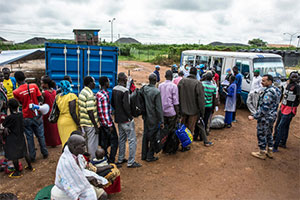 One Thousand Internally Displaced Persons (IDPs) Relocated from Tomping Camp in South Sudan. Credit: UN Photo/Isaac Billy
It took hundreds of thousands of years for the world’s human population to cross one billion in 1804. Approximately 200 years later, the population has multiplied sevenfold. In 2023, the global population crossed 8 billion, and is expected to reach 9 billion before 2050. With the planet more crowded than ever, it is essential to keep track of population trends, urbanization, migration, and reproduction across the world.
Life expectancy has seen significant strides in the past century, largely due to economic development and increased standards of living. On the contrary, trends in global fertility are shifting, with certain regions in Africa and Asia reporting higher rates, while parts of Europe and North America report stagnant or lower rates. This is in part due to differences in sexual and reproductive healthcare, as well as societal and economic conditions around the world. For example, child marriage is prevalent in certain societies, where childbearing is also considered a familial duty. Meanwhile, stagnating economies frequently experience lower marriage and childbearing rates.
The increase in migration and urban development around the world is also linked to global population trends. By 2050, it is expected that approximately 66 percent of all people will live in cities. Furthermore, global crises such as warfare and natural disasters also prompt transnational migration. Transnational migration is linked to a variety of socioeconomic issues in both host and receiving countries: migrants often leave developing countries with less access to educational and economic opportunities and arrive in developed countries where they are frequently the targets of ethnic, racial, and cultural discrimination, and economic exploitation. Recent crises in Europe and the United States demonstrate the importance of advocating for migrants worldwide. As migrants from the Global South are increasingly stripped of their legal and civic rights in unlawful deportations, or targeted in acts of identity-based violence, it is essential to keep track of population trends and protect the human rights of migrant populations. Climate-related disasters are now a major driver of displacement, with nearly half of all new internal displacements in 2025 being disaster-related.
IPS is devoted to covering issues surrounding population trends, migration, and reproduction through its compelling articles, which use both statistics and human stories to provide readers with robust and informative viewpoints.

The Week with IPS

NEXT STOP - SDGs
Tracking global progress towards a sustainable world
Tracking global progress towards a sustainable world
