Languages
Tuesday, October 13, 2026



News and Views from the Global South
Population

Child Slavery Refuses to Disappear in Latin America
Child labour has been substantially reduced in Latin America, but 5.7 million children below the legal minimum age are still working and a large proportion of them work in precarious, high-risk conditions or are unpaid, which constitute new forms of slave labour.
“Green Development Has to Be Equal for All”
IPS caught up with Dr. Frank Rijsberman, director-general of the Global Green Growth Institute (GGGI), at the end of the flagship side event of the GGGI during the 51st Annual Meeting of the Asian Development Bank (ADB) in Manila on May 4, 2018, which featured the Belt and Road Initiative (BRI) and its potential to create sustainable infrastructure and promote green growth pathways.
To Have Children or Not: The Importance of Finding a Balance
While the world’s population has changed dramatically over the last 50 years, little is still understood about fertility transition and the reasons behind it. Over the last half a century, the global fertility rate has halved, reaching a level of 2.5 births per woman.
From the Syrian War to Argentina – Or How to Start a New Life
Fares al Badwan moved to Buenos Aires alone, from Syria, in 2011. He was 17 years old then and the armed conflict in his country had just broken out. Since then he has managed to bring over his whole family and today he cannot imagine living outside of Argentina. "I like the people here. No one makes you feel like a foreigner," he said.
Africa’s Millennials Using Technology to Drive Change
When some 276 teenage girls were kidnapped from their boarding school in northeastern Nigeria in April 2014, Oby Ezekwesili, a civil society activist and former World Bank vice president, was disheartened by the lacklustre response of her government and local television stations.
Women Farmers in Peru Bring Healthy Meals to Local Schools
Getting children and adolescents to replace junk food with nutritious local organic foods is the aim of a group of women farmers in a rural area of Piura, on Peru’s north coast, as they struggle to overcome the impact of the El Niño climate phenomenon.
From Declaration to Action: Improving Immunization in Africa
Inviolate Akinyi, a 46-year-old grandmother, is certain that her grand-daughter needs to get all her vaccines for her to grow up healthy and strong. She uses a mix of private and public clinics in Kibera, one of the largest informal settlement in Nairobi, to get the 15-month-old the shots she needs.
The Nowhere People: Rohingyas in India
A devastating fire in a shanty at Kalindi Kunj, a New Delhi suburb, that gutted the homes of 226 Rohingya refugees from Myanmar, including 100 women and 50 children, has trained a spotlight on India's ad hoc policy on international migrants.
African Youth Demand a Seat at the Table
A new wave is sweeping across Africa. Elections on the continent are increasingly yielding younger leadership than ever before. From presidents to ministers and governors, senators to members of parliament, Africa’s young people are demanding a seat at the political table.
Drowning for Progress in Cambodia
Suddenly the road ends. The cart track disappears under the water. A vast lake stretches out in front of me. I have to transfer from a motorbike to a canoe. "Tuk laang," my guide says coolly. "The water is rising."
Africa Lags Behind in Bridging Inequalities
“If you wish to move mountains tomorrow, you must start by lifting stones today”—so goes an African proverb, crystallising the solutions to the continent’s socio-economic inequalities.
Is There Data Privacy & Protection to Poor Customers?
Research increasingly demonstrates that poor customers, just like other customers, value their privacy and care deeply about the protection of their personal data. But what do providers think about obtaining, using, storing and sharing personally identifiable information?
Premarital Sex: Increasing Worldwide
Premarital sex, defined as voluntary sexual intercourse between unmarried persons, is increasing worldwide. While traditional values, religious instructions and the laws of some countries continue to prescribe abstinence until marriage, the rapid societal changes that have occurred across all regions during the past half-century have resulted in the growing prevalence and acceptability of premarital sex.
How Citizen Power Ignited Seoul’s Energy Innovations
In a bid to reduce its nuclear energy dependence, Seoul embarked on a massive energy reduction initiative—shaped by citizen participation—in 2012.
Solving Japan’s Fertility Crisis
While much of the global discussion for decades has been focused on overpopulation and its consequences, less can be said of the risks of low fertility and an ageing population—risks that are currently threatening the future of Japan.
Pakistan Needs Global Climate Funds to Combat Shifting Weather Patterns
As shifting weather patterns and extreme climates become the norm, access to climate funds are deemed essential for developing countries, such as Pakistan, that are facing the brunt of climate change.
New Platform Will Support Youth Projects on Water and Climate
Young people around the globe with good ideas on how to deal with water and climate challenges now have a platform to show their projects to the world and attract funding and other contributions to realise their dreams.
Ending TB Epidemic Among Youth: Key to Achieving SDGs
A good education for every child is an urgent global imperative, but what if entering schools puts children at serious health risks? Tuberculosis (TB), the single biggest infectious disease killer, poses a major risk for young people in countries with high prevalence of TB, and schools are among the places where they are most likely to catch it.
Is Desalination an Answer to the Water Crisis?
On World Water Day, March 22, universal access to clean water continues to be a privilege, when it should be a right. Experts predict that by 2030 the global water demand will exceed supply by 40%.
Restoring U.S. Aid Crucial to Avoid a Water Catastrophe in Gaza
World Water Day (March 22) could not come at a more critical time for the people of Gaza who are facing a humanitarian catastrophe The recent decision by the United States to reduce funding for the United Nations Relief and Works Agency for Palestine Refugees in the Near East (UNRWA), jeopardizes its role as a critical source of clean drinking water when Gaza’s supplies slow to a drip.
Why You Should Care About the Water Crisis
For the past weeks, many have been anxiously tracking the approach of Cape Town’s Day Zero: the day its taps will run dry. To everyone’s relief, current predictions are that careful conservation may stave off such a catastrophe in the coastal South African city until the rains arrive.« Previous Page — Next Page »





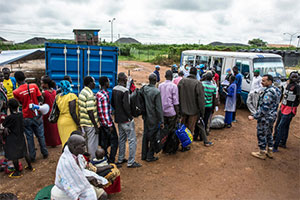 One Thousand Internally Displaced Persons (IDPs) Relocated from Tomping Camp in South Sudan. Credit: UN Photo/Isaac Billy
It took hundreds of thousands of years for the world’s human population to cross one billion in 1804. Approximately 200 years later, the population has multiplied sevenfold. In 2023, the global population crossed 8 billion, and is expected to reach 9 billion before 2050. With the planet more crowded than ever, it is essential to keep track of population trends, urbanization, migration, and reproduction across the world.
Life expectancy has seen significant strides in the past century, largely due to economic development and increased standards of living. On the contrary, trends in global fertility are shifting, with certain regions in Africa and Asia reporting higher rates, while parts of Europe and North America report stagnant or lower rates. This is in part due to differences in sexual and reproductive healthcare, as well as societal and economic conditions around the world. For example, child marriage is prevalent in certain societies, where childbearing is also considered a familial duty. Meanwhile, stagnating economies frequently experience lower marriage and childbearing rates.
The increase in migration and urban development around the world is also linked to global population trends. By 2050, it is expected that approximately 66 percent of all people will live in cities. Furthermore, global crises such as warfare and natural disasters also prompt transnational migration. Transnational migration is linked to a variety of socioeconomic issues in both host and receiving countries: migrants often leave developing countries with less access to educational and economic opportunities and arrive in developed countries where they are frequently the targets of ethnic, racial, and cultural discrimination, and economic exploitation. Recent crises in Europe and the United States demonstrate the importance of advocating for migrants worldwide. As migrants from the Global South are increasingly stripped of their legal and civic rights in unlawful deportations, or targeted in acts of identity-based violence, it is essential to keep track of population trends and protect the human rights of migrant populations. Climate-related disasters are now a major driver of displacement, with nearly half of all new internal displacements in 2025 being disaster-related.
IPS is devoted to covering issues surrounding population trends, migration, and reproduction through its compelling articles, which use both statistics and human stories to provide readers with robust and informative viewpoints.

The Week with IPS

NEXT STOP - SDGs
Tracking global progress towards a sustainable world
Tracking global progress towards a sustainable world
