Languages
Tuesday, October 13, 2026



News and Views from the Global South
Population

Unprecedented Human Migration Cries Out for a Global Response
The world is "basically at odds with itself," International Organisation for Migration (IOM) Director General William Swing said Monday, June 25, describing the critical state of human migration between countries and continents.
Global Campaign Against Mercury Moves to an End Zone
A global campaign to end a longstanding health and environmental hazard-- the use of mercury in dentistry—is steadily moving to a successful conclusion. Providing an update, Charlie Brown, head of the World Alliance for Mercury-Free Dentistry, one of the key campaigners, told IPS that “nation by nation, the world is on the threshold of ending amalgam for children in 2018.”
Senegalese Immigrants Face Police Brutality in Argentina
Senegalese immigrants began to arrive in Argentina in the 1990s and most of them joined the group of street vendors in Buenos Aires and other cities. But in recent months, they have suffered police brutality, denounced as a campaign of racial persecution.
Countries are Using Domestic Laws to Criminalize Health Care
Ambulance drivers attacked, nurses detained, doctors tortured, pharmacists arrested, dentists facing more than a decade in prison—all for delivering healthcare to people considered enemies of the state.
Looking to the Sky for Solutions to Mexico’s Water Scarcity
Twenty-five years ago, Mexican engineer Gustavo Rodriguez decided to collect rainwater to solve the scarcity of water in his home and contribute to the care of natural resources.
Project Population: Addressing Asia’s Ageing Societies
While populations have seen and undergone changes since the beginning of time, one trend in particular is unfolding across the world: less children, older people. In an effort to tackle the complex issue in Asia, government officials are convening to help create a sustainable society where no one is left behind.
Fertility Struggles More Open – and Shared on Social Media
Fertility health is an incredibly personal – and often vulnerable – topic. Fertility, infertility, and fertility preservation have gained increased public interest over the past few years. Infertility is formally defined as the inability to achieve pregnancy after one year of unprotected intercourse.
Ethiopia to Return Land in Bid for Peace with Eritrea
The utterly inconsequential-looking Ethiopian border town of Badme is where war broke out in 1998 between Ethiopia and Eritrea, lasting two years and devastating both countries.
Farmers from Central America and Brazil Join Forces to Live with Drought
Having a seven-litre container with a filter on the dining room table that purifies the collected rainwater, and opening a small valve to fill a cup and quench thirst, is almost revolutionry for Salvadoran peasant farmer Víctor de León.
Nepali Mothers and an Irish Daughter
I am the daughter of a formidable campaigner for women’s reproductive rights in Nepal. Decades ago, when such issues were not part of the playbook for development activists, my mother, a medical doctor, started setting up family planning programs after seeing women die in childbirth, shifting from hospital work into public health.
We Have Told G7 Leaders to Make Gender Inequality & Patriarchy History
For most people, the annual G7 meeting may just seem like an expensive photo-op that doesn’t connect with any concrete change in people’s lives. But for us, appointed by Canadian Prime Minister Justin Trudeau to sit on his G7 Gender Equality Advisory Council, it was a unique opportunity to push for strong commitments for girls’ and women’s rights.
Experts Urge Lawmakers to Focus on Food-Migration Nexus
Lawmakers at the highest levels urgently need a “revolution in thinking” to tackle the twin problem of sustainable food production and migration. Starting with an inaugural event in Brussels, then travelling on to New York and Milan, an international team of experts led by the Barilla Center for Food and Nutrition (BCFN) is urging far-reaching reforms in agricultural and migration policy on an international scale.
Afghan Electorate: Basic Needs Must be met Before Political Progress can be Ensured
After four decades of perpetual conflict, Afghanistan rolls into two consecutive election years – parliamentary this year, presidential the next. But the country and its people are going through even tougher times than usual with continued displacement and a looming hunger crisis.
The Spotlight Initiative: Eliminating Violence & Harmful Practices Against Women & Girls
The numbers are shocking: at least one in three women on the planet has suffered physical or sexual violence, usually at the hands of a family member or intimate partner. More than 700 million women alive today were married as children. Up to 250 million women and girls have undergone female genital mutilation.
Nepal: Where Abortion is Treated as Homicide
Less than thirty years ago the likelihood of a mother dying due to pregnancy or childbirth in Nepal was one of the highest in the world. In 1990 UNICEF estimated that the rate was 901 women or girls out of 100,000 - significantly higher than any of its neighbours.
‘Don’t Try to Be a Superwoman’: An Interview With Michelle Bachelet
Michelle Bachelet ended her second term as president of Chile on March 11, 2018. Her first term, from 2006 to 2010, was marked by an ambitious social and economic agenda advancing women’s rights and better health care. Her cabinet of ministers, for example, was composed of an equal number of men and women, as she vowed to do during her campaign.
Peru’s Poor and Disabled Struggle in the Shadows
Eighty percent of the world’s disabled live in developing nations, according to a report by the United Nations. Their identities, lives and stories are of course varied – but what isn’t is the stigma and lack of resources they face.
Putting Tortillas on Mexico’s Tables Again
Agronomist Irene Salvador decided to learn the process of making corn tortillas in order to preserve and promote this traditional staple food in the Mexican diet, which has lost its presence and nutritional quality.
Digital Revolution Holds Bright Promises for Africa
Internet penetration is creeping up in Africa, bringing the prospect of digital dividends to a continent long marked by digital divides.
Indigenous Peoples Recover Native Languages in Mexico
Ángel Santiago is a Mexican teenager who speaks one of the variations of the Zapotec language that exists in the state of Oaxaca, in the southwest of Mexico. Standing next to the presidential candidate who is the favorite for the July elections, he calls for an educational curriculum that "respects our culture and our languages."
Chile, an Oasis for Haitians that Has Begun to Run Dry
A wave of Haitian migrants has arrived in Chile in recent years, changing the face of low-income neighbourhoods. But this oasis has begun to dry up, thanks to measures adopted by decree by the new government against the first massive immigration of people of African descent in this South American country.« Previous Page — Next Page »





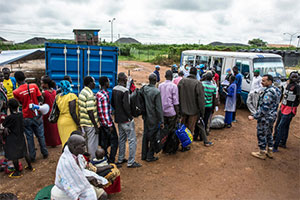 One Thousand Internally Displaced Persons (IDPs) Relocated from Tomping Camp in South Sudan. Credit: UN Photo/Isaac Billy
It took hundreds of thousands of years for the world’s human population to cross one billion in 1804. Approximately 200 years later, the population has multiplied sevenfold. In 2023, the global population crossed 8 billion, and is expected to reach 9 billion before 2050. With the planet more crowded than ever, it is essential to keep track of population trends, urbanization, migration, and reproduction across the world.
Life expectancy has seen significant strides in the past century, largely due to economic development and increased standards of living. On the contrary, trends in global fertility are shifting, with certain regions in Africa and Asia reporting higher rates, while parts of Europe and North America report stagnant or lower rates. This is in part due to differences in sexual and reproductive healthcare, as well as societal and economic conditions around the world. For example, child marriage is prevalent in certain societies, where childbearing is also considered a familial duty. Meanwhile, stagnating economies frequently experience lower marriage and childbearing rates.
The increase in migration and urban development around the world is also linked to global population trends. By 2050, it is expected that approximately 66 percent of all people will live in cities. Furthermore, global crises such as warfare and natural disasters also prompt transnational migration. Transnational migration is linked to a variety of socioeconomic issues in both host and receiving countries: migrants often leave developing countries with less access to educational and economic opportunities and arrive in developed countries where they are frequently the targets of ethnic, racial, and cultural discrimination, and economic exploitation. Recent crises in Europe and the United States demonstrate the importance of advocating for migrants worldwide. As migrants from the Global South are increasingly stripped of their legal and civic rights in unlawful deportations, or targeted in acts of identity-based violence, it is essential to keep track of population trends and protect the human rights of migrant populations. Climate-related disasters are now a major driver of displacement, with nearly half of all new internal displacements in 2025 being disaster-related.
IPS is devoted to covering issues surrounding population trends, migration, and reproduction through its compelling articles, which use both statistics and human stories to provide readers with robust and informative viewpoints.

The Week with IPS

NEXT STOP - SDGs
Tracking global progress towards a sustainable world
Tracking global progress towards a sustainable world
