Languages
Monday, October 12, 2026



News and Views from the Global South
Population

India Fast Becoming a Pillar of Global Growth & Stability
It is with great pleasure and pride that I interact with you this afternoon as India’s Minister of Housing and Urban Affairs, to share some thoughts on India’s extremely ambitious, and arguably the world’s largest planned urbanization programme under the leadership of our Prime Minister, Narendra Modi.
Q&A: Air Pollution Remains Cause for Alarm in Asia
At the start of the year the pollution in Vietnam’s capital, Hanoi, reached six times the World Health Organization’s guideline levels for air quality. Yet the levels, which appear higher than those of South Korea’s capital Seoul—where most people monitor the air pollution levels daily—is not treated with equal concern because of a lack of general awareness. This is despite the fact that air pollution has become the largest cause of premature deaths in Asia.
New York, With 8.5 Million People, Among Cities Heading for a Sustainable Future
New York has long been considered a pioneer – in fashion, art, music, and food, just to name a few. Now this city of 8.5 million is leading a shift in how we tackle today’s toughest global challenges like climate change, education, inequality, and poverty.
Forests and Marine Resources Continue to Shrink
Deforestation and unsustainable farming are depriving the planet of forests, while destructive practices in fishing are limiting the chance to sustainably manage our oceans.
Is Asia Pacific on Track to Meet UN’s Sustainable Development Goals?
Three years into the implementation period of the 2030 Agenda for Sustainable Development, is Asia Pacific on track to meet the Sustainable Development Goals (SDGs)?
Youth Skills: Have We Addressed the Need?
The World Youth Skills Day is being celebrated around the world on 15 July. This day was established on 18 December 2014 by General Assembly resolution A/RES/69/145 which was initiated by Sri Lanka. Following a lengthy consultation process, at the UN and outside, during which some delegations, including some Europeans expressed reservations, the resolution was eventually adopted unanimously. It received solid support from youth delegations from around the world.
Family Planning Is A Human Right
It has been five decades since the international community affirmed the right to family planning but women still remain unable to enjoy this right, which is increasingly under attack around the world.
Age Appropriate Sexuality Education for Youth Key to National Progress
Fifty years ago at the International Conference on Human Rights, family planning was affirmed to be a human right. It is therefore apt that the theme for this year’s World Population Day is a loud reminder of this fundamental right.
Europe Needs to Stop the Criminal Business Behind Immigration
Debating on migration as an emergency is a huge mistake and treating it as such opens the door for illegal and unfair activities, says a migration expert.
From the Soccer Field to the Political Arena
Was your childhood room not adorned with posters of Gerd Müller or Zinedine Zidane? Were Willy Brandt or Mikhail Gorbachev the idols you looked up to in your youth?
The Voice of Argentina’s Slums, Under Threat
Between the dimly-lit, narrow alleyways of Villa 21, only 30 minutes by bus from the centre of the Argentine capital, more than 50,000 people live in poverty. It was there that La Garganta Poderosa (which means powerful throat), the magazine that gave a voice to the "villeros" or slum-dwellers and whose members today feel threatened, emerged in 2010.
Separated Central American Families Suffer Abuse in the United States
After three hours of paperwork, Katy Rodriguez from El Salvador, who was deported from the United States, finally exited the government's immigration facilities together with her young son and embraced family members who were waiting outside.
Declining Birth Rates Not Exclusive to Wealthy Nations
Countries do not have to be economically prosperous to move from a situation of high birth and death rates to low fertility and mortality rates. Education, social security, environments conducive to economic development and good value systems are what promote this, as evidenced by the recorded experiences of Asian countries as far apart as Japan and India.
The ‘Stop Soros’ Bill: Strong Drawback for NGOs in Hungary
On World Refugee Day June 20, the Hungarian Parliament passed the ‘Stop Soros’ bill which is aimed at criminalizing groups who support refugees and other types of undocumented immigrants.
Community Work Among Women Improves Lives in Peru’s Andes Highlands
At more than 3,300 m above sea level, in the department of Cuzco, women are beating infertile soil and frost to grow organic food and revive community work practices that date back to the days of the Inca empire in Peru such as the "ayni" and "minka".
Football, Xenophobia, Racism, Discrimination– & a Few More Things
Football tells us a great deal about identity. Even a budding sports journalist knows that. And it has come to be a meeting point and even an advertising theme. But what we never discuss is the varying forms of this identity that are possible, let alone the consequences, which are sometimes ill-fated.
Breaking the Cycle of Child Labor in Peru
Most laborers in Peru are forced into a vicious cycle by circumstance. Faced with low-paying, high-intensity work, they have no choice but to make their children work as well. Having spent their lives neglecting education for labor, those children in turn grow up with no options for income besides low-paying, high-intensity positions - and so on. But in classrooms across one region, a handful of teachers are trying to break that cycle while the children are still young.
Pelé Beyond Football
Pele’s example has inspired millions of young people to join the ‘beautiful game’ and contribute to building a peaceful and prosperous world fit for all our children.
Solar Energy in Social Housing, a Discarded Solution in Brazil
“Our main challenge is to get the project back on track," agreed the administrators of two affordable housing complexes, where a small solar power plant was installed for social purposes in Juazeiro, a city in northeast Brazil.
West Africa Moves Ahead with Renewable Energy Despite Unpredictable Challenges
The West African nation of Guinea may be a signatory of the Paris Agreement, a global undertaking by countries around the world to reduce climate change, but as it tries to provide electricity to some three quarters of its 12 million people who are without, the commitment is proving a struggle.
The Long and Short of The Digital Revolution
Digital platforms are recasting the relationships between customers, workers, and employers as the silicon chip’s reach permeates almost everything we do—from buying groceries online to finding a partner on a dating website.« Previous Page — Next Page »





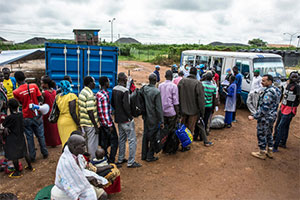 One Thousand Internally Displaced Persons (IDPs) Relocated from Tomping Camp in South Sudan. Credit: UN Photo/Isaac Billy
It took hundreds of thousands of years for the world’s human population to cross one billion in 1804. Approximately 200 years later, the population has multiplied sevenfold. In 2023, the global population crossed 8 billion, and is expected to reach 9 billion before 2050. With the planet more crowded than ever, it is essential to keep track of population trends, urbanization, migration, and reproduction across the world.
Life expectancy has seen significant strides in the past century, largely due to economic development and increased standards of living. On the contrary, trends in global fertility are shifting, with certain regions in Africa and Asia reporting higher rates, while parts of Europe and North America report stagnant or lower rates. This is in part due to differences in sexual and reproductive healthcare, as well as societal and economic conditions around the world. For example, child marriage is prevalent in certain societies, where childbearing is also considered a familial duty. Meanwhile, stagnating economies frequently experience lower marriage and childbearing rates.
The increase in migration and urban development around the world is also linked to global population trends. By 2050, it is expected that approximately 66 percent of all people will live in cities. Furthermore, global crises such as warfare and natural disasters also prompt transnational migration. Transnational migration is linked to a variety of socioeconomic issues in both host and receiving countries: migrants often leave developing countries with less access to educational and economic opportunities and arrive in developed countries where they are frequently the targets of ethnic, racial, and cultural discrimination, and economic exploitation. Recent crises in Europe and the United States demonstrate the importance of advocating for migrants worldwide. As migrants from the Global South are increasingly stripped of their legal and civic rights in unlawful deportations, or targeted in acts of identity-based violence, it is essential to keep track of population trends and protect the human rights of migrant populations. Climate-related disasters are now a major driver of displacement, with nearly half of all new internal displacements in 2025 being disaster-related.
IPS is devoted to covering issues surrounding population trends, migration, and reproduction through its compelling articles, which use both statistics and human stories to provide readers with robust and informative viewpoints.

The Week with IPS

NEXT STOP - SDGs
Tracking global progress towards a sustainable world
Tracking global progress towards a sustainable world
