Languages
Friday, October 9, 2026



News and Views from the Global South
Population

Let Food Be Thy Medicine
When faced with a crisis, our natural reaction is to deal with its immediate threats. Ateka* came to the make-shift clinic with profuse diarrhoea: they diagnosed cholera. The urgent concern in the midst of that humanitarian crisis was to treat the infection and send her home as quickly as possible. But she came back to the treatment centre a few days later – not for cholera, but because she was suffering from severe acute malnutrition. Doctors had saved her life but not restored her health. And there were others too, who like Ateka eventually succumbed to severe malnutrition.
Children and Women with Disabilities, More Likely to Face Discrimination
Children with disabilities are up to four times more likely to experience violence, with girls being the most at risk, according to the United Nations Children’s Fund.
How the Lack of Affordable Vegetables is Creating a Billion-Dollar Obesity Epidemic in South Africa
Every Sunday afternoon, Thembi Majola* cooks a meal of chicken and rice for her mother and herself in their home in Alexandra, an informal settlement adjacent to South Africa’s wealthy economic hub, Sandton.
The Legalization of Abortion in Argentina will Benefit Thousands of Women
We are at an historic moment in Argentina, a turning point in the path of women’s rights.
How the Yanadi, an Oppressed Indigenous People in India, are Reclaiming Their Rights One Village At a Time
Under the blazing midday sun, a tractor moves slowly along a dirt trail in Nacharwari Pallem, a village of the Yanadi indigenous people located some three hours from Chennai city in South India. Atop the tractor, women of the village – 36 in all – sit expectantly, ignoring the heat. Squeals of excitement fill the air as the tractor slowly halts near a stretch of rice fields.
Helping Indigenous Peoples Live Equal Lives
Although indigenous peoples are being increasingly recognised by both rights activists and governmental organisations, they are still being neglected in legal documents and declarations. Indigenous peoples are only mentioned in two of the 17 United Nations’ Sustainable Development Goals (SDGs) and only seen in two of the 230 SDG indicators, says indigenous rights expert Chris Chapman.
Land Degradation: A Triple Threat in Africa
Sustainability, stability, and security—the three overlapping issues are an increasing concern among many especially in Africa where land degradation is displacing citizens and livelihoods.
From Crowdfunding to Development Platforms: 8 Ways to Make Use of a Networked World
Hardly a day goes by in the development world without hearing the term “platform”. Like in the business world, it’s becoming harder for any development organization to provide a single service or product that will make broad impact. Airbnb doesn’t build homes, it creates a network that brings together host and guests.
Slovakia Elevates SDGs to Status of National Priorities
At the High-Level Political Forum, which concluded mid-July, world leaders from 46 countries show-cased their progress in achieving the UN’s 17 Sustainable Development Goals (SDGs), including eradicating extreme poverty and hunger by 2030. All 46 countries produced voluntary national reviews (VNRs) aimed at facilitating the sharing of their experiences, including successes, challenges and lessons learned, with a view to accelerating the implementation of the 2030 SDG Agenda.
Q&A: Leprosy Increases as World Gives Attention to Newer Endemic Diseases
In the first six months of this year, the southern African nation of Mozambique has already registered 300 more cases of leprosy, some 951 cases, than it registered for the whole of 2017.
Global Compact & the Art of Cherry-Picking Refugees
When Secretary-General Antonio Guterres was asked about the legality of the UN’s much-ballyhooed Global Compact for Migration, he was initially evasive in his response. “I’m not a lawyer”, he told reporters July 12, “and I presume that this question might be better asked from a lawyer”.
Eradicating Leprosy in Mozambique, a Complicated Task
It takes Faurito António, 42, from Lalaua district, Nampula Province, two hours to reach his nearest health centre in order to receive the drugs necessary for his treatment of leprosy. António, whose foot has become affected by the muscle weakness that occurs when leprosy goes untreated, says this long walk while ill is the reason why many don’t continue treatment - which can take between six to 12 months.
Latin American Migrants Targeted by Trafficking Networks
The rescue earlier this month of 12 Venezuelan and three Colombian women from a prostitution network that recruits migrants in Peru is an example of the complex web where migration and human trafficking often involve victims of forced labour and sexual exploitation.
No Time to Slow Down While HIV/AIDS is Threatening a New Generation
As the 22nd International AIDS Conference wraps up in Amsterdam, I can’t help but reflect on how far we have come on this journey with the AIDS epidemic.
Educating Girls, The Only Road To Achieve the SDGs
Better and prolonged education can bring down high rates of illiteracy, sexual abuse and early marriage among girls.
Benin – the Launchpad and Home for African Migrants
Last year, Mohamed Keita returned home to Mali after living and working in Libya for six years. Eighteen months ago he was arrested by security forces in Libya as he and other migrants tried to cross the Mediterranean Sea to Europe via a makeshift boat. After spending a traumatising six months in jail, he was transported back to Mali. But as soon as he arrived he immediately knew that it would be difficult for him to stay put.
Bringing Health Microinsurance to Kenyans via Mobile Phone
Households in developing countries spent $148 billion out-of-pocket for healthcare expenses in 2015, and each year 100 million people are pushed into extreme poverty because of the high cost of healthcare.
Half of the Young People from Poor Central American Neighbourhoods Want to Migrate
La Carpio is an island of poverty on the outskirts of Costa Rica's capital, surrounded by the country's most polluted waters – the Torres River - on one side and a massive garbage dump on the other.
HIV-TB Connection: Key to Ending Infections
A group of teenage boys huddle around Michelle in the mangroves behind Joyce Bay, a spot frequented by men who have sex with men (MSM) in Port Moresby, Papua New Guinea (PNG).
Support of Influential World Leaders Not Enough to End Rohingya Crisis
Despite having the strong support of influential global leaders, Bangladesh has "missed" the opportunity to mobilise the world’s superpowers and place pressure on Myanmar to allow for the repatriation of the Rohingya refugees.
How Prison Conditions Fuel the Tuberculosis Epidemic
Dozens of grown men peered from behind the barred doorway of a crammed window-less prison cell, eyes pleading desperately from sweaty faces. Their physical discomfort was so palpable, I could almost feel it. Because of my work, I also knew of at least one serious unseen risk facing them – that of contracting tuberculosis in the cramped, poorly ventilated space.« Previous Page — Next Page »





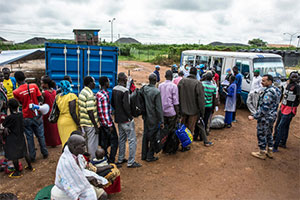 One Thousand Internally Displaced Persons (IDPs) Relocated from Tomping Camp in South Sudan. Credit: UN Photo/Isaac Billy
It took hundreds of thousands of years for the world’s human population to cross one billion in 1804. Approximately 200 years later, the population has multiplied sevenfold. In 2023, the global population crossed 8 billion, and is expected to reach 9 billion before 2050. With the planet more crowded than ever, it is essential to keep track of population trends, urbanization, migration, and reproduction across the world.
Life expectancy has seen significant strides in the past century, largely due to economic development and increased standards of living. On the contrary, trends in global fertility are shifting, with certain regions in Africa and Asia reporting higher rates, while parts of Europe and North America report stagnant or lower rates. This is in part due to differences in sexual and reproductive healthcare, as well as societal and economic conditions around the world. For example, child marriage is prevalent in certain societies, where childbearing is also considered a familial duty. Meanwhile, stagnating economies frequently experience lower marriage and childbearing rates.
The increase in migration and urban development around the world is also linked to global population trends. By 2050, it is expected that approximately 66 percent of all people will live in cities. Furthermore, global crises such as warfare and natural disasters also prompt transnational migration. Transnational migration is linked to a variety of socioeconomic issues in both host and receiving countries: migrants often leave developing countries with less access to educational and economic opportunities and arrive in developed countries where they are frequently the targets of ethnic, racial, and cultural discrimination, and economic exploitation. Recent crises in Europe and the United States demonstrate the importance of advocating for migrants worldwide. As migrants from the Global South are increasingly stripped of their legal and civic rights in unlawful deportations, or targeted in acts of identity-based violence, it is essential to keep track of population trends and protect the human rights of migrant populations. Climate-related disasters are now a major driver of displacement, with nearly half of all new internal displacements in 2025 being disaster-related.
IPS is devoted to covering issues surrounding population trends, migration, and reproduction through its compelling articles, which use both statistics and human stories to provide readers with robust and informative viewpoints.

The Week with IPS

NEXT STOP - SDGs
Tracking global progress towards a sustainable world
Tracking global progress towards a sustainable world
