Languages
Thursday, October 8, 2026



News and Views from the Global South
Population

Crisis Drives Nicaragua to an Economic and Social Precipice
Five months after the outbreak of mass protests in Nicaragua, in addition to the more than 300 deaths, the crisis has had visible consequences in terms of increased poverty and migration, as well as the international isolation of the government and a wave of repression that continues unabated.
Between Drought and Floods, Cuba Seeks to Improve Water Management
If you enjoy a good daily shower and water comes out every time you turn on the taps in your home, you should feel privileged. There are places in the world where this vital resource for life is becoming scarcer by the day and the forecasts for the future are grim.
‘Women Not Speaking at the Same Table as Men’ Means a Widening Digital Gender Gap in Africa
'Think Bigger', urge the colourful posters on the walls of Ideario, an innovation hub in Chamanculo, a modest neighbourhood in Maputo, Mozambique’s capital. The message is right on target for the new female trainees, eager eyes glued to laptop screens as they learn internet and computer skills.
Global Warming Threatens Europe’s Public Health
Climate change and health experts are warning of the growing threat to public health in Europe from global warming as rising temperatures help potentially lethal diseases spread easily across the continent.
South-South Cooperation in a Transformative Era
On 12 September, the international community commemorated the UN Day for South-South Cooperation. This is an important acknowledgement of the contributions of Southern partnerships in addressing the many development challenges that confront the international community, such as poverty, climate change, inequality, contagious diseases and humanitarian crises.
Q&A: Achieving Sustainable Goals: “In the End it is All About People. If People Want, it Will Happen.”
Today just over two billion people live without readily available, safe water supplies at home. And more than half the world’s population, roughly 4.3 billion people, live in areas where demand for water resources outstrips sustainable supplies for at least part of the year.
Q&A: As Water Scarcity Becomes the New Normal How Do We Manage This Scarce Resource?
Growing economies are thirsty economies. And water scarcity has become “the new normal” in many parts of the world, according to Torgny Holmgren executive director of the Stockholm International Water Institute (SIWI).
‘All the Roads Leading to Agadez and Italy are Dangerous’
El Adama Diallo left his home in Senegal on Oct. 28, 2016, with dreams of reaching Europe in his heart and a steely determination that made him take an alternative, dangerous route to get there despite the absence of regular migration papers in his pocket.
Migrants as Messengers Explain the Dangers of Irregular Migration
 Migrants as Messengers is a peer-to-peer messaging campaign by the International Organization for Migration (IOM) where returning migrants share with their communities and families the dangers, trauma and abuse that many experienced while attempting irregular migration.
Climate Change Becomes a Reality Check for the North
“This season, the month of May was particularly hot and dry,” says Leo De Jong, a commercial farmer in Zeewolde, in Flevopolder, the Netherlands. Flevopolder is in the province of Flevoland, the largest site of land reclamation in the world. Here a hectare of land costs up to 100,000 Euros. “At the moment, we are spending between 20,000 and 25,000 Euros per week on irrigation.”
Equality and Territory: the Common Struggle of Indigenous Women in the Andes
"At the age of 18 I was the first female leader in my organisation, my grandfather who was a male chauvinist demanded that I be beaten because I was sitting among men," said Teresita Antazú, an indigenous leader of the Yanesha people in Peru's Amazon region.
New Rules for High Seas Must Include Needs of Poorest Nations
Over-fishing, warming oceans and plastic pollution dominate the headlines when it comes to the state of the seas. Most of the efforts to protect the life of the ocean and the livelihoods of those who depend on it are limited to exclusive economic zones – the band of water up to 200 nautical miles from the coast.
Addressing Bangladesh’s Age-Old Public Transportation System
After the recent student uprising in Bangladesh, and despite increased policing on the streets and amendments to the traffic laws, there has been criticism that things have not changed significantly enough to make the country’s roads safer.
Land, Water and Education, Priorities for Chile’s Mapuche People
The right to land and water, as well as to multicultural education, are the top priority demands of Mapuche leaders working with their communities in the Araucanía region and in Santiago, Chile’s capital.
Damning U.N. Report Outlines Crimes Against Rohingya As Children Suffer from Trauma One Year Later
At 12, Mohammed* is an orphan. He watched his parents being killed by Myanmar government soldiers a year ago. And he is one of an estimated half a million Rohingya children who have survived and been witness to what the United Nations has called genocide.
Fledgling Venture Aims to Make Money from Cutting Food and Packaging Waste
To tackle food waste, Nicholas Lim did not simply spread the word among his friends and family. In an experiment to see if he could make a viable business out of the problem, he co-founded an online platform that allows individuals, eateries and voluntary welfare organisations to order discounted groceries that would otherwise be thrown away.
The Fight for the Right to Abortion Spreads in Latin America Despite Politicians
The Argentine Senate's rejection of a bill to legalise abortion did not stop a Latin American movement, which is on the streets and is expanding in an increasingly coordinated manner among women's organisations in the region with the most restrictive laws and policies against pregnant women's right to choose.
Accessible Public Transportation and Housing, a Need for People with Disabilities in Major Cities
Even though over six billion people—nearly one billion of whom will have disabilities— are expected to live in urban centres by 2050, many of the world’s major urban cities have a long way to go before their infrastructure becomes inclusive for people with disabilities.
Old Age Is a Curse in India
Old age morbidity is a rapidly worsening curse in India. The swift descent of the elderly in India (60 years+) into non-communicable diseases (NCDs e.g. cardiovascular diseases, cancer, chronic respiratory diseases and diabetes) could have disastrous consequences in terms of impoverishment of families, excess mortality, lowering of investment and consequent deceleration of growth.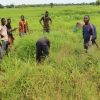
How Ghana’s Rapid Population Growth Could Become an Emergency and Outpace Both Food Production and Economic Growth
Paul Ayormah and his fellow farmers make their way home after hours spent manually weeding a friend’s one-acre maize farm in Ghana’s Eastern Region. “Tomorrow it will be the turn of my maize farm,” he tells IPS.
Let Food Be Thy Medicine
When faced with a crisis, our natural reaction is to deal with its immediate threats. Ateka* came to the make-shift clinic with profuse diarrhoea: they diagnosed cholera. The urgent concern in the midst of that humanitarian crisis was to treat the infection and send her home as quickly as possible. But she came back to the treatment centre a few days later – not for cholera, but because she was suffering from severe acute malnutrition. Doctors had saved her life but not restored her health. And there were others too, who like Ateka eventually succumbed to severe malnutrition.« Previous Page — Next Page »





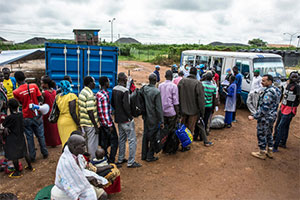 One Thousand Internally Displaced Persons (IDPs) Relocated from Tomping Camp in South Sudan. Credit: UN Photo/Isaac Billy
It took hundreds of thousands of years for the world’s human population to cross one billion in 1804. Approximately 200 years later, the population has multiplied sevenfold. In 2023, the global population crossed 8 billion, and is expected to reach 9 billion before 2050. With the planet more crowded than ever, it is essential to keep track of population trends, urbanization, migration, and reproduction across the world.
Life expectancy has seen significant strides in the past century, largely due to economic development and increased standards of living. On the contrary, trends in global fertility are shifting, with certain regions in Africa and Asia reporting higher rates, while parts of Europe and North America report stagnant or lower rates. This is in part due to differences in sexual and reproductive healthcare, as well as societal and economic conditions around the world. For example, child marriage is prevalent in certain societies, where childbearing is also considered a familial duty. Meanwhile, stagnating economies frequently experience lower marriage and childbearing rates.
The increase in migration and urban development around the world is also linked to global population trends. By 2050, it is expected that approximately 66 percent of all people will live in cities. Furthermore, global crises such as warfare and natural disasters also prompt transnational migration. Transnational migration is linked to a variety of socioeconomic issues in both host and receiving countries: migrants often leave developing countries with less access to educational and economic opportunities and arrive in developed countries where they are frequently the targets of ethnic, racial, and cultural discrimination, and economic exploitation. Recent crises in Europe and the United States demonstrate the importance of advocating for migrants worldwide. As migrants from the Global South are increasingly stripped of their legal and civic rights in unlawful deportations, or targeted in acts of identity-based violence, it is essential to keep track of population trends and protect the human rights of migrant populations. Climate-related disasters are now a major driver of displacement, with nearly half of all new internal displacements in 2025 being disaster-related.
IPS is devoted to covering issues surrounding population trends, migration, and reproduction through its compelling articles, which use both statistics and human stories to provide readers with robust and informative viewpoints.

The Week with IPS

NEXT STOP - SDGs
Tracking global progress towards a sustainable world
Tracking global progress towards a sustainable world
