Languages
Tuesday, October 20, 2026



News and Views from the Global South
Population

Women and Girls, One Third of World’s Drug Users
Women and girls comprise one-third of global drug users yet are only one-fifth of those receiving treatment, a UN-Backed independent expert body warned.
New Maternity Legislation in Cuba Ignores Fathers
A new set of regulations to strengthen the maternity rights of working women and encourage people to have children in Cuba were seen as a positive step but not enough, because they do not include measures to encourage more active participation in child-rearing by men.
Seven Scary Facts About Widening Gender Gap
Women across the globe are facing new threats, which risk dismantling decades of hard-won rights and derailing the effort to end extreme poverty, an international confederation of civil society organisations has revealed ahead of International Women’s Day on March 8.
These Women Cannot Celebrate Their Day
This is a story that one would wish to never have to write—the story of hundreds of millions of life-givers whose production and productivity have systematically been ‘quantified’ in much detailed statistics, but whose abnegation, human suffering and denial of rights are subject to just words.
Humankind’s Ability to Feed Itself, Now in Jeopardy
Mankind’s future ability to feed itself is in jeopardy due to intensifying pressures on natural resources, mounting inequality, and the fallout from a changing climate, warns a new United Nations’ report.
Expansion of Renewable Energies in Mexico Has Victims, Too
The growing number of wind and solar power projects in the southern Mexican state of Yucatán are part of a positive change in Mexico’s energy mix. But affected communities do not see it in the same way, due to the fact that they are not informed or consulted, and because of how the phenomenon changes their lives.
Latin America Is a Leading Influence in the Global Fight Against Hunger
A model for fighting against hunger and malnutrition with a global reach which has been successful within and outside the region has spread worldwide, first from Brazil and then from Latin America, notes a distinction given to the current Director-General of FAO (United Nations Food and Agriculture Organisation), José Graziano da Silva.
No Hidden Figures: Success Stories Can Help Girls’ STEM Careers
What makes a young girl believe she is less intelligent and capable than a boy? And what happens when those children face the ‘hard’ subjects like science, technology, engineering and mathematics (STEM)? A recent study, ‘Gender stereotypes about intellectual ability emerge early and influence children’s interests’ showed that by the age of 6, girls were already less likely than boys to describe their own gender as ‘brilliant’, and less likely to join an activity labelled for ‘very, very smart’ kids.
Innovative Credit Model Holds Out Lifeline to Farmers in Honduras
In this village in southern Honduras, in one of the poorest parts of the country, access to credit is limited, the banking sector is not supportive of agriculture, and nature punishes with recurrent extreme droughts.
It’s Women’s Turn in Rural Development
Josefina Stubbs, from the Dominican Republic, may become the first woman to preside over the International Fund for Agricultural Development (IFAD), which is dedicated to eradicating rural poverty.
We Need a New Social Movement Against Inequality
Oxfam's latest estimate that just eight super-rich people – down from 62 last year and 388 just six years ago - own more wealth than the poorest half of the world population is a clarion call to change the way we think about and try to tackle inequality.
Why Kenya Must Create a Million New Jobs Annually
It is estimated that 3000 Kenyans are born every day, a million a year. With a median age of 18 years, Kenya is witnessing a massive youth bulge, which could either be a demographic dividend, or a disaster.
Riverbank Populations Displaced by Dams in Brazil Miss Old Way of Life
“Now we have internet and TV. Before, we didn't even have electricity, but it was better,” said Lourival de Barros, one of the people displaced by the hydropower plants which have mushroomed aorund Brazil, mainly since the 1970s.
Measures Are Proposed to Address Violence in Mapuche Land in Chile
The lands where the Mapuche indigenous people live in southern Chile are caught up in a spiral of violence, which a presidential commission is setting out to stop with 50 proposals, such as the constitutional recognition of indigenous people and their representation in parliament, in a first shift in the government´s treatment of native peoples.
Protecting the Rights of Women Migrant Workers
International migration is a complex phenomenon dealing with overlapping issues relating to the human rights of migrants, mixed migration flows, international protection, smuggling and trafficking, as well as other push and pull factors affecting migration.
Trump’s Global Gag a Devastating Blow for Women’s Rights
The image of a group of men in suits making decisions about the rights of women is becoming an emblematic sign of the backlash against our human rights, particularly those related to women´s bodily integrity and reproductive and sexual freedoms.
A Crisis of Overweight and Obesity in Latin America and the Caribbean
Obesity and overweight have spread like a wildfire throughout Latin America and the Caribbean, threatening the health, well-being and food and nutritional security of millions of people.
360 Million of 625 Million People Are Overweight in Latin America and Caribbean
In Latin America and the Caribbean 360 million people are overweight, and 140 million are obese, warned the United Nations Food and Agriculture Organisation (FAO) and the Panamerican Health Organisation (PAHO).
Native Seeds Sustain Brazil’s Semi-Arid Northeast
In his 76 years of life, Raimundo Pinheiro de Melo has endured a number of droughts in Brazil’s semi-arid Northeast region. And he remembers every one of them since 1958. “The worst one was in 1982 and 1983, the only time that the river dried up,” said Pinheiro do Melo, who has lived near the river since 1962. “The one in 1993 was also very bad,” he told IPS, because neither Bolsa Familia nor Networking in Brazil’s Semi-Arid Region (ASA) existed yet, which contribute to a less traumatic coexistence with droughts like the current one, which has dragged on for five years.
No More Mass Deaths from Drought in Northeast Brazil
The drought that has plagued Brazil’s semiarid Northeast region since 2012 is already more severe than the 1979-1983 drought, the longest in the 20th century. But prolonged dry spells no longer cause the tragedies of the past.
Agroecology Booming in Argentina
Organic agriculture is rapidly expanding in Argentina, the leading agroecological producer in Latin America and second in the world after Australia, as part of a backlash against a model that has disappointed producers and is starting to worry consumers.« Previous Page — Next Page »





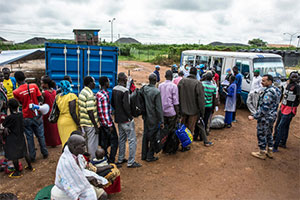 One Thousand Internally Displaced Persons (IDPs) Relocated from Tomping Camp in South Sudan. Credit: UN Photo/Isaac Billy
It took hundreds of thousands of years for the world’s human population to cross one billion in 1804. Approximately 200 years later, the population has multiplied sevenfold. In 2023, the global population crossed 8 billion, and is expected to reach 9 billion before 2050. With the planet more crowded than ever, it is essential to keep track of population trends, urbanization, migration, and reproduction across the world.
Life expectancy has seen significant strides in the past century, largely due to economic development and increased standards of living. On the contrary, trends in global fertility are shifting, with certain regions in Africa and Asia reporting higher rates, while parts of Europe and North America report stagnant or lower rates. This is in part due to differences in sexual and reproductive healthcare, as well as societal and economic conditions around the world. For example, child marriage is prevalent in certain societies, where childbearing is also considered a familial duty. Meanwhile, stagnating economies frequently experience lower marriage and childbearing rates.
The increase in migration and urban development around the world is also linked to global population trends. By 2050, it is expected that approximately 66 percent of all people will live in cities. Furthermore, global crises such as warfare and natural disasters also prompt transnational migration. Transnational migration is linked to a variety of socioeconomic issues in both host and receiving countries: migrants often leave developing countries with less access to educational and economic opportunities and arrive in developed countries where they are frequently the targets of ethnic, racial, and cultural discrimination, and economic exploitation. Recent crises in Europe and the United States demonstrate the importance of advocating for migrants worldwide. As migrants from the Global South are increasingly stripped of their legal and civic rights in unlawful deportations, or targeted in acts of identity-based violence, it is essential to keep track of population trends and protect the human rights of migrant populations. Climate-related disasters are now a major driver of displacement, with nearly half of all new internal displacements in 2025 being disaster-related.
IPS is devoted to covering issues surrounding population trends, migration, and reproduction through its compelling articles, which use both statistics and human stories to provide readers with robust and informative viewpoints.

The Week with IPS

NEXT STOP - SDGs
Tracking global progress towards a sustainable world
Tracking global progress towards a sustainable world
