Languages
Thursday, October 22, 2026



News and Views from the Global South
Population

Feminism Helps Villagers Coexist with Drought in Northeast Brazil
“The vegetable garden changed my life,” said Rita Alexandre da Silva, in the village of Primeiro do Maio where 65 families have obtained land to grow crops since 1999, in this municipality in the state of Rio Grande do Norte, in Northeast Brazil.
Debate Roils India Over Family Planning Method
The Indian government's decision to make injectable contraceptives available to the public for free under the national family planning programme (FPP) has stirred debate about women's choices in the world's largest democracy and second most populous country.
Trump’s Offensive Against Undocumented Migrants Will Fuel Migration Crisis
“Donald Trump will not stop me from getting to the U.S.,” said Juan, a 35-year-old migrant from Nicaragua, referring to the Republican president-elect who will govern that country as of Jan. 20.
SDGs: Making the Universal Agenda Truly Universal
One of the key features of the 2030 Agenda which the United Nations and member states identified in the lead up to the SDG agreement was the principle of universality.
Thriving Rural Communities Is a Recipe for Healthy Cities
As the dust has settled on Habitat III and the summit in Quito, Ecuador, we now have a clear vision and a concrete road map for how to transform our cities into inclusive, safer and more productive environments. The New Urban Agenda comes at a propitious time. Urbanization is growing at a fast pace, particularly in developing countries, where the urban population is expected to double by 2050. In South Asia alone, the urban population grew by 130 million between 2001 and 2011, according to recent World Bank study. Another 250 million are expected to join them by 2030.
Longer, But Less Meaningful Lives?
The last one hundred years life expectancy has increased by about 25 per cent-from near 80 to near 100-in some countries. But, instead of increasing playful childhood, education, work and retirement by 25 per cent, the age of retirement has moved much less than the age at death.
Cities Address a Key Challenge: Infrastructure Needs
“We as mayors have to govern midsize cities as if they were capital cities,” said Héctor Mantilla, city councilor of Floridablanca, the third-largest city in the northern Colombian department of Santander.
320 Million Children in Single-Parent Families
Of the world’s 2.3 billion children 14 percent - or 320 million - are living in single-parent households, most often headed by single mothers. Those children aged 0 to 17 years and their single mothers and single fathers face special challenges, including economic hardships, social stigma and personal difficulties, that require society’s attention and assistance.
Few Families Overcome Forced Displacement by Hydropower Plants in Brazil
The construction of mega-hydropower plants in Brazil has been a tragedy for thousands of families that have been displaced, and a nightmare for the companies that have to relocate them as required by local law.
Gang Violence Drives Internal Displacement in El Salvador
A basketball court in this small town in western El Salvador was turned overnight into a shelter for some two dozen families forced to flee their homes after a recent escalation of gang violence.
Mexico City’s Expansion Creates Tension between Residents and Authorities
People living in neighborhoods affected by the expansion of urban construction suffer a “double displacement”, with changes in their habitat and the driving up of prices in the area, in a process in which “we are not taken into account,” said Natalia Lara, a member of an assembly of local residents in the south of Mexico City.
Population Growth Extremes: Doublers and Decliners
While the world’s population of 7.4 billion is growing at 1.1 percent per year – about half the peak level of the late 1960s – enormous differences in demographic growth among countries are increasingly evident and of mounting concern to countries and the international community.
Muslims in Europe: Can There Be Social Harmony ?
Although 20 million Muslims reside in Western Europe, establishing social harmony between the Muslim community and their European counterparts has proved exceedingly challenging.Much to the dismay of international humanitarian agencies and anti-racism activists,the language of exclusion and prejudice persists.
New Government Inherits Conflict over Peru’s Biggest Mine
Of the 150 socioeconomic conflicts related to the extractive industries that Peru’s new government inherited, one of the highest-profile is the protest by the people living near the biggest mining project in the history of the country: Las Bambas.
When It Comes to Conservation, Size Matters
When the communities living in the Tatamá y Serranía de los Paraguas Natural National Park in the west of Colombia organised in 1996 to defend their land and preserve the ecosystem, they were fighting deforestation, soil degradation and poaching.
Indigenous People Demand Shared Benefits from Forest Conservation
"Why don’t the authorities put themselves in our shoes?” asked Cándido Mezúa, an indigenous man from Panama, with respect to native peoples’ participation in conservation policies and the sharing of benefits from the protection of forests.
Mexico, a Democracy Where People Disappear at the Hands of the State
“Go and tell my dad that they’re holding me here,” Maximiliano Gordillo Martínez told his travelling companion on May 7 at the migration station in Chablé, in the southern Mexican state of Tabasco. It was the last time he was ever seen, and his parents have had no news of him since.
Tracing War Missing Still a Dangerous Quest in Sri Lanka
As Sri Lanka readies to begin the grim task of searching for thousands of war missing, those doing the tracing on the ground say that they still face intimidation and threats while doing their work.
Asia, Looking Beyond the Green Revolution
 More than 2.2 billion people in Asia rely on agriculture for their livelihoods, but the Asian Development Bank warns that stagnant and declining yields of major crops such as rice and wheat can be ultimately linked to declining investments in agriculture. Public investments in agriculture in India, for instance, have been roughly the same since 2004.

Nurturing African Agriculture
While agriculture could be the driving force to lift millions of Africans out of poverty and alleviate hunger, its full potential remains untapped. For example, only between five and seven percent of the continent’s cultivated land is irrigated, leaving farmers vulnerable to climate shocks like the devastating El Nino-driven drought in southern Africa. That's why international agencies like the U.N. Food and Agriculture Organization (FAO) are forging key partnerships to enhance agricultural production, sustainable natural resource management and increased market access. 
Smart Technologies Key to Youth Involvement in Agriculture
She is only 24 and already running her father’s farm with 110 milking cows. Cornelia Flatten sees herself as a farmer for the rest of her life.« Previous Page — Next Page »





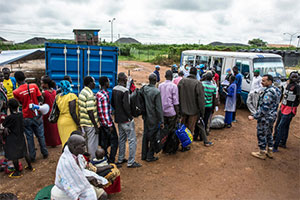 One Thousand Internally Displaced Persons (IDPs) Relocated from Tomping Camp in South Sudan. Credit: UN Photo/Isaac Billy
It took hundreds of thousands of years for the world’s human population to cross one billion in 1804. Approximately 200 years later, the population has multiplied sevenfold. In 2023, the global population crossed 8 billion, and is expected to reach 9 billion before 2050. With the planet more crowded than ever, it is essential to keep track of population trends, urbanization, migration, and reproduction across the world.
Life expectancy has seen significant strides in the past century, largely due to economic development and increased standards of living. On the contrary, trends in global fertility are shifting, with certain regions in Africa and Asia reporting higher rates, while parts of Europe and North America report stagnant or lower rates. This is in part due to differences in sexual and reproductive healthcare, as well as societal and economic conditions around the world. For example, child marriage is prevalent in certain societies, where childbearing is also considered a familial duty. Meanwhile, stagnating economies frequently experience lower marriage and childbearing rates.
The increase in migration and urban development around the world is also linked to global population trends. By 2050, it is expected that approximately 66 percent of all people will live in cities. Furthermore, global crises such as warfare and natural disasters also prompt transnational migration. Transnational migration is linked to a variety of socioeconomic issues in both host and receiving countries: migrants often leave developing countries with less access to educational and economic opportunities and arrive in developed countries where they are frequently the targets of ethnic, racial, and cultural discrimination, and economic exploitation. Recent crises in Europe and the United States demonstrate the importance of advocating for migrants worldwide. As migrants from the Global South are increasingly stripped of their legal and civic rights in unlawful deportations, or targeted in acts of identity-based violence, it is essential to keep track of population trends and protect the human rights of migrant populations. Climate-related disasters are now a major driver of displacement, with nearly half of all new internal displacements in 2025 being disaster-related.
IPS is devoted to covering issues surrounding population trends, migration, and reproduction through its compelling articles, which use both statistics and human stories to provide readers with robust and informative viewpoints.

The Week with IPS

NEXT STOP - SDGs
Tracking global progress towards a sustainable world
Tracking global progress towards a sustainable world
