Languages
Tuesday, October 20, 2026



News and Views from the Global South
Population

Work, What Future? Seven Big Questions Needing Urgent Response
Around the world, profound changes in the nature of work are underway, that’s clear. So it is a fact that the on-going transformations in the world of labour are disrupting the connection between work, personal development and community participation.
“Devastating Consequences” for Women, Girls as U.S. Defunds UN Agency
The U.S. has withdrawn all of its funding to the UN Population Fund (UNFPA), an agency that works on family planning and reproductive health in over 150 countries.
Brazilian Dam Causes Too Much or Too Little Water in Amazon Villages
The Juruna indigenous village of Miratu mourned the death of Jarliel twice: once on October 26, when he drowned in the Xingu River, and the second time when the sacred burial ground was flooded by an unexpected rise in the river that crosses Brazil’s Amazon region.
Costa Rican Town Fears That the Sea Will Steal Its Shiny New Face
Two years have gone by since the new government initiative which subsidises community works changed the face with which the coastal town of Cienaguita, on Costa Rica’s Caribbean coast, looks out to the sea.
Slaves
For over 400 years, more than 15 million men, women and children were the victims of the transatlantic slave trade, one of the darkest chapters in human history. Slavery is, nevertheless, far from being just a chapter of the past—it still there, with estimated 21 million victims of forced labour and extreme exploitation around the world--nearly the equivalent to of the combined population of Scandinavian countries.
New Recipe for School Meals Programmes in Latin America
Sunita Daniel remembers what the school lunch programmes were like in her Caribbean island nation, Saint Lucía, until a couple of years ago: meals made of processed foods and imported products, and little integration with the surrounding communities.
1 in 4 Children Worldwide Facing Extremely Scarce Water by 2040
Warning that as many as 600 million children – one in four worldwide – will be living in areas with extremely scarce water by 2040, the United Nations children's agency has called on governments to take immediate measures to curb the impact on the lives of children.
Menstrual Hygiene Project Keeps Girls in School
Breaking taboos surrounding menstruation, a project to distribute sanitary napkins to girls in one district of Bangladesh has had a positive impact on school dropout rates – and should be replicated in other parts of the country, experts say.
Local Solutions to Rebuild Oldest Cuban City in Hurricane Matthew’s Wake
Clearings with fallen trees in the surrounding forests, houses still covered with tarpaulins and workers repairing the damage on the steep La Farola highway are lingering evidence of the impact of Hurricane Matthew four months ago, in the first city built by the Spanish conquistadors in Cuba.
Climate Breaks All Records: Hottest Year, Lowest Ice, Highest Sea Level
Climate has, once more, broken all records, with the year 2016 making history-highest-ever global temperature, exceptionally low sea ice, unabated sea level rise and ocean heat. And what is even worse-- extreme and unusual trends continue in 2017.
Sanitation ‘Revolution’: A New Pay-Monthly Poop Removal System
Developing countries struggling to cope with huge volumes of human waste may finally get some relief, and a new business opportunity.
Don’t Understand Clouds? But You Should!
Obviously, there are so many issues and phenomena that have been brought up by growing impact of climate change that one would likely not think about. Some of them, however, are essential and would be good to learn about. For instance, the fact that clouds play a "pivotal role" in weather forecasts and warnings.
No Water, No Life – Don’t Waste It!
During the final exams of Spanish official high school of journalists, a student was asked by the panel of professors-examiners: If scientists discover that there is water in Planet Mars, how would you announce this news, what would be your title? The student did not hesitate a second: “There is life in Mars!” The student was graduated with the highest score.
Asia’s Water Politics Near the Boiling Point
In Asia, it likely will not be straightforward water wars.
Three Times as Many Mobile Phones as Toilets in Africa
Though key to good health and economic wellbeing, water and sanitation remain less of a development priority in Africa, where high costs and poor policy implementation constrain getting clean water and flush toilets to millions.
Smiling Towards Development
Previous indications of national prosperity have focused on income, poverty, health and, above all, Gross Domestic Product, but on March 20th, World Happiness Day commemorates what is perhaps becoming the new way to measure welfare: happiness.
Oh Happy Day!
Once a year, there is a day when the seven billion inhabitants of Planet Earth should feel happy or at least are encouraged to do so--the World Happiness Day, which is marked every year on March 20. So far, so good.
UN FARMS to Create One Million Days of Work for Mideast Migrants
The problem is rather complex and often not recognised: in one of the major regions of both origin and destination for migrants and refugees -- the Near East and North of Africa, 10 per cent of rural communities is made up of forcibly displaced persons, while more than 25 per cent of the young rural people plan to emigrate.
A Structural Theory of Aging
Wikipedia has much to offer under "aging". Highly recommended are the 10 points by the world's oldest living man, 114, Walter Breuning.
New Evidence Confirms Risk That Mideast May Become Uninhabitable
New evidence is deepening scientific fears, advanced few years ago, that the Middle East and North Africa risk becoming uninhabitable in a few decades, as accessible fresh water has fallen by two-thirds over the past 40 years.
Khat in the Horn of Africa: A Scourge or Blessing?
Throughout a Sunday afternoon in the Ethiopian capital, Yemeni émigré men in their fifties and sixties arrive at a traditional Yemeni-styled mafraj room clutching bundles of green, leafy stalks: khat.« Previous Page — Next Page »





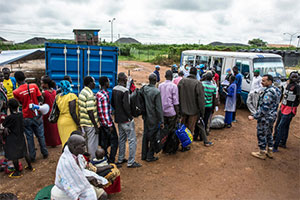 One Thousand Internally Displaced Persons (IDPs) Relocated from Tomping Camp in South Sudan. Credit: UN Photo/Isaac Billy
It took hundreds of thousands of years for the world’s human population to cross one billion in 1804. Approximately 200 years later, the population has multiplied sevenfold. In 2023, the global population crossed 8 billion, and is expected to reach 9 billion before 2050. With the planet more crowded than ever, it is essential to keep track of population trends, urbanization, migration, and reproduction across the world.
Life expectancy has seen significant strides in the past century, largely due to economic development and increased standards of living. On the contrary, trends in global fertility are shifting, with certain regions in Africa and Asia reporting higher rates, while parts of Europe and North America report stagnant or lower rates. This is in part due to differences in sexual and reproductive healthcare, as well as societal and economic conditions around the world. For example, child marriage is prevalent in certain societies, where childbearing is also considered a familial duty. Meanwhile, stagnating economies frequently experience lower marriage and childbearing rates.
The increase in migration and urban development around the world is also linked to global population trends. By 2050, it is expected that approximately 66 percent of all people will live in cities. Furthermore, global crises such as warfare and natural disasters also prompt transnational migration. Transnational migration is linked to a variety of socioeconomic issues in both host and receiving countries: migrants often leave developing countries with less access to educational and economic opportunities and arrive in developed countries where they are frequently the targets of ethnic, racial, and cultural discrimination, and economic exploitation. Recent crises in Europe and the United States demonstrate the importance of advocating for migrants worldwide. As migrants from the Global South are increasingly stripped of their legal and civic rights in unlawful deportations, or targeted in acts of identity-based violence, it is essential to keep track of population trends and protect the human rights of migrant populations. Climate-related disasters are now a major driver of displacement, with nearly half of all new internal displacements in 2025 being disaster-related.
IPS is devoted to covering issues surrounding population trends, migration, and reproduction through its compelling articles, which use both statistics and human stories to provide readers with robust and informative viewpoints.

The Week with IPS

NEXT STOP - SDGs
Tracking global progress towards a sustainable world
Tracking global progress towards a sustainable world
