Languages
Tuesday, October 20, 2026



News and Views from the Global South
Population
How to Produce More Food with Less Damage to Soil, Water, Forests
Massive agriculture intensification is contributing to increased deforestation, water scarcity, soil depletion and the level of greenhouse gas emission, the United Nations warns.
Business Unusual: Valuing Water for a Sustainable Future
Valuing water is more than simply assigning costs to a scare resource - it is an essential step for transforming water governance to meet the needs of a prosperous future.
The ‘Water-Employment-Migration’ Explosive Nexus
Water--everybody talks about it, warns against its growing scarcity, excessive waste, the impact of climate change, the frequent severe droughts and so on. Now, a global action network with over 3,000 partner organisations in 183 countries comes to unveil the dangerous nexus between water, employment and migration, in particular in the Mediterranean region.
Millions of Homes in Mexico Suffer from “Energy Poverty”
Energy poverty afflicts millions of homes in Mexico, with many social, economic and environmental impacts for the country.
Growing Unemployed Youth in Africa a Time Bomb, But…
There are nearly 420 million young Africans between the ages of 15 and 35 today. And it is estimated that within ten years, Africa will be home to one-fifth of all young people worldwide.
Brazil Drives New School Feeding Model in the Region
“I am going back to Panama with many ideas,” said Gilda Montenegro, a nutritionist with the Panamanian Education Ministry, after getting to know the school feeding system in the city of Vitoria, in central-eastern Brazil.
Formalising Informal Trade – Good for African Women?
Women constitute the largest share of informal traders in Africa–about 70 per cent in Southern Africa and more than half in other parts of this vast continent made up of 54 states, home to over 1,200 billion people.
Africa – More than Just Conflicts, Corruption, Disasters
Natural and man-made disasters, armed conflicts, widespread corruption and deep social inequalities have been so far a dramatic source for most news coverage when it comes to Africa, the world's second-largest and second-most-populous continent on Earth, which hosts 54 states spreading over 30 million square kilometres that are home to over 1.2 billion people.
Q&A: “It’s a Crime” that 35 Million Latin Americans Still Suffer from Hunger
The fight against hunger has been “remarkably successful” in Latin America and the Caribbean, but “it is a crime” that 35 million people still go to bed hungry every day, FAO regional representative Julio Berdegué told IPS.
Nutrition Key to Developing Africa’s “Grey Matter Infrastructure”
Developing Africa’s ‘grey matter infrastructure’ through multi-sector investments in nutrition has been identified as a game changer for Africa’s sustainable development.
Gateway Portals and the Quest for Sustainable Urbanization
On a busy Friday afternoon, the number 1 subway train heading north through Manhattan’s Westside comes out of a dark tunnel --and if one takes a minute to release oneself from communication devices—one can catch sight of the approaching 125th street in the distance, the crosswalk buzzing with yellow cabs.
Survivors of the El Mozote Massacre Have New Hopes for Justice in El Salvador
Except for a house with its walls riddled with holes made by bursts of machine gun fire, nobody would say that the quiet Salvadoran village of El Mozote was the scene of one of the worst massacres in Latin America, just 35 years ago.
Reflections on 2017 World Day for Cultural Diversity for Dialogue and Development
More than 7 billion people live on this planet spread among 7 continents, 194 states of the United Nations (UN) and numerous other non-self-governing territories. The world is made up of a mosaic of people belonging to different cultural and religious backgrounds. Our planet has been a cultural melting pot since time immemorial.
Young People: You Didn’t Vote, And Now You Protest?
Immediately after the vote on Brexit, thousands of young people marched in the streets of England to show their disagreement over the choice to leave Europe. But polls indicated that had they voted en masse (only 37 percent voted), the result of the referendum would have been the opposite.
Poor Rural Communities in Mexico Receive a Boost to Support Themselves
Jilder Morales, a small farmer in Mexico, looks proudly at the young avocado trees that are already over one metre high on her ejido - or communal - land, which already have small green fruit.
Social Forum Calls for Fight Against Corruption, to Defend the Amazon
Corruption has penetrated the Amazon rainforest like an illness that infects everything, said Ruben Siqueira, coordinator of the Pastoral Land Commission (CPT), during the VIII Panamazonic Social Forum (FOSPA), which brought together in the Peruvian Amazon jungle representatives of civil society from eight Amazon basin countries.
Informal Labour, Another Wall Faced by Migrants in Latin America
A large proportion of the 4.3 million migrant workers in Latin America and the Caribbean survive by working in the informal economy or in irregular conditions. An invisible wall that is necessary to bring down, together with discrimination and xenophobia.
No Trace of the Nicaraguan Interoceanic Canal
Less than three years from the projected completion in Nicaragua of a canal running from the Caribbean Sea to the Pacific Ocean, there is no trace of progress on the mega-project.
Nicaragua’s South Caribbean Coast Improves Readiness for Climate Change
The effects of climate change have hit Nicaragua’s Caribbean coastal regions hard in the last decade and have forced the authorities and local residents to take protection and adaptation measures to address the phenomenon that has gradually undermined their safety and changed their way of life.
Financing Key to Reaching Everyone, Everywhere with Water & Sanitation
Eighteen months ago, UN member-states pledged a new set of goals on eradicating extreme poverty and creating a fairer, more sustainable planet by 2030. This week, we have alarming evidence that at least one of those goals – Sustainable Development Goal 6, to reach everyone everywhere with access to water and sanitation – is already in peril.
Humanity and Social Justice, a Must for the Future of Work – Ryder
“The future of work must be inspired by considerations of humanity, of social justice and peace. If it is not, we are going to a dark place, we are going to a dangerous place,” said the head of the leading world body specialised on labour issues.« Previous Page — Next Page »





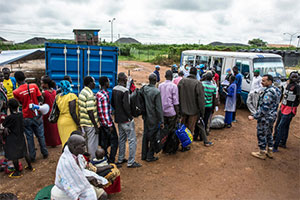 One Thousand Internally Displaced Persons (IDPs) Relocated from Tomping Camp in South Sudan. Credit: UN Photo/Isaac Billy
It took hundreds of thousands of years for the world’s human population to cross one billion in 1804. Approximately 200 years later, the population has multiplied sevenfold. In 2023, the global population crossed 8 billion, and is expected to reach 9 billion before 2050. With the planet more crowded than ever, it is essential to keep track of population trends, urbanization, migration, and reproduction across the world.
Life expectancy has seen significant strides in the past century, largely due to economic development and increased standards of living. On the contrary, trends in global fertility are shifting, with certain regions in Africa and Asia reporting higher rates, while parts of Europe and North America report stagnant or lower rates. This is in part due to differences in sexual and reproductive healthcare, as well as societal and economic conditions around the world. For example, child marriage is prevalent in certain societies, where childbearing is also considered a familial duty. Meanwhile, stagnating economies frequently experience lower marriage and childbearing rates.
The increase in migration and urban development around the world is also linked to global population trends. By 2050, it is expected that approximately 66 percent of all people will live in cities. Furthermore, global crises such as warfare and natural disasters also prompt transnational migration. Transnational migration is linked to a variety of socioeconomic issues in both host and receiving countries: migrants often leave developing countries with less access to educational and economic opportunities and arrive in developed countries where they are frequently the targets of ethnic, racial, and cultural discrimination, and economic exploitation. Recent crises in Europe and the United States demonstrate the importance of advocating for migrants worldwide. As migrants from the Global South are increasingly stripped of their legal and civic rights in unlawful deportations, or targeted in acts of identity-based violence, it is essential to keep track of population trends and protect the human rights of migrant populations. Climate-related disasters are now a major driver of displacement, with nearly half of all new internal displacements in 2025 being disaster-related.
IPS is devoted to covering issues surrounding population trends, migration, and reproduction through its compelling articles, which use both statistics and human stories to provide readers with robust and informative viewpoints.

The Week with IPS

NEXT STOP - SDGs
Tracking global progress towards a sustainable world
Tracking global progress towards a sustainable world
