Languages
Saturday, October 17, 2026



News and Views from the Global South
Population

“The Time is Now” to Invest in Youth, Girls
The demographic dividend: though not a new concept, it is one of the major buzzwords at the UN this year. But what does it really mean? There are 1.8 billion young people between the ages of 10 and 24 around the world, the most in the history of humankind.
To Achieve Ambitious Goals – We Need to Start with our Basic Rights
Recent protests in Ethiopia have seen people demonstrate in their thousands, angry at their authoritarian government, its favouritism towards those close to the ruling elite, and its failure to share the country’s wealth more equally.
Parliamentarians Study Nexus of Youth, Refugees and Development
Held for the first time in the Arab world, an annual meeting of Asian and Arab Parliamentarians examined how regional conflicts hinder the development of effective policies to achieve sustainable development, particularly as they generate large numbers of refugees, internally displaced persons and migrants.
Promoting Sustainable Population Growth, Key to Raising Human Rights Standards
The world population has witnessed a remarkable growth during the recent decades. In 1965, it stood at 3.3 billion people. In 2017 –52 years later-- the global population reached a staggering 7.5 billion people corresponding to more than a doubling of the Earth’s residents over the last half-century.
Mideast: Water Use Innovations ‘Crucial’ to Face Climate Change
In the Near East and North Africa region, the per capita renewable water availability is around 600 cubic metres per person per year --only 10 per cent of the world average- and drops to just 100 cubic metres in some countries, the United Nations warned.
Is Religion the New Colonial Frontier in International Development?
A decade ago, it was difficult to get Western policy makers in governments to be interested in the role of religious organizations in human development. The secular mind-set was such that religion was perceived, at best, as a private affair. At worst, religion was deemed the cause of harmful social practices, an obstacle to the “sacred” nature of universal human rights, and/or the root cause of terrorism. In short, religion belonged in the ‘basket of deplorables’.
Top 300 Cooperatives Generate 2.5 Trillion Dollars in Annual Turnover
The top 300 cooperatives alone generate 2.5 trillion dollars in annual turnover, more than the Gross Domestic Product (GDP) of France, according to the UN Department of Economic and Social Affairs (UNDESA).
SLIDESHOW: When Women Have Land Rights, the Tide Begins to Turn
 In Meghalaya, India’s northeastern biodiversity hotspot, all three major tribes are matrilineal. Children take the mother’s family name, while daughters inherit the family lands.
Rural Poverty? Cooperatives!
Humanity has had and has big projects. Mastery of nature is one, still going on. Middle range phenomena have been mastered, but not the micro level of viri–HIV is a current case–nor the macro level of climate–to the contrary, humanity is making it worse.
Global Devaluation of Work Drives Up Unemployment in Brazil
In addition to driving up the number of unemployed people to 14.2 million, the severe recession of the last two years led Brazil to join the global trend of flexibilisation of labour laws in order to further reduce labour costs.
“Black Soils” – Excessive Use of Arsenic, Cadmium, Lead, Mercury…
Soils are polluted due mostly to human activities that leave excess chemicals in soils used to grow food, the United Nations reports.
No Wall for Ethiopia, Rather an Open Door—Even for Its Enemy
It’s one thing to read about the exodus of souls flowing out of Eritrea, it’s quite another to look into the tired eyes, surrounded by dust and grime, of a 14-year-old Eritrean girl who’s just arrived on the Ethiopian side of the shared border.
Asia-Pacific: Farming Rice and Fish Together to Reduce Poverty
Rice is a major food commodity and staple food for many, and adding fish to flooded rice paddies has been a farming tradition practiced in a number of Asian countries for many centuries—even for more than 1000 years in some Chinese areas, the United Nations reports.
BRICS to Lead World’s Efforts to Eradicate Hunger, Poverty by 2030
With the clock ticking toward the 2030 deadline for meeting the international goals to eradicate hunger and poverty, five of the world's most important emerging economies are well positioned to take a leading role in helping to achieve these objectives, according to the United Nations.
Drought Pushes 1 in 3 Somalis to a Hunger Knife-Edge
Another famine in former European colonies in Africa and another time in its Eastern region, with Ethiopia and Somalia among the major victims of drought and made-made climate disasters mainly caused by US and European multinational business.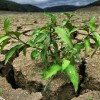
Mideast: Drought to Turn People into Eternal Migrants, Prey to Extremism?
Worldwide, land degradation, severe droughts and advancing desertification are set to force populations to flee their homes and migrate. In the specific case of the Middle East and North of Africa (MENA), such an obliged choice implies the additional risk to turn peoples into easy prey to extremist, terrorist groups.
Heavy Toll of Disrupted Farming, Higher Prices and Displaced Livelihoods
Large agricultural harvests in some regions of the world are buoying global food supply conditions, but protracted fighting and unrest are increasing the ranks of the displaced and hungry elsewhere, according to a United Nations new report.
When Women Have Land Rights, the Tide Begins to Turn
In Meghalaya, India’s northeastern biodiversity hotspot, all three major tribes are matrilineal. Children take the mother’s family name, while daughters inherit the family lands.
Solar Tents Improve Nutrition in Highlands Villages in Bolivia
In this remote highlands valley community in central Bolivia, a group of Quechua indigenous women have learned how to combat the intense frosts and the shortage of water in solar tents, and to use what they grow to prepare nutritious new meals for their families.
Latin America Lacks Clear Policies to Tackle Human Trafficking
Each year, some three million undocumented immigrants enter the United States, half of them with the help of traffickers, as part of a nearly seven-billion- dollar business, according to the United Nations Office on Drugs and Crime (UNODC).
Large Landowners Jeopardise Indigenous Revival in Brazil
The attack with guns and machetes that left at least 10 Gamela indigenous people wounded, in the northeastern state of Maranhão, highlighted the growing threats against the resurgence and survival of native people in Brazil.« Previous Page — Next Page »





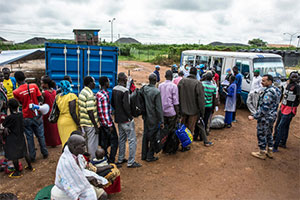 One Thousand Internally Displaced Persons (IDPs) Relocated from Tomping Camp in South Sudan. Credit: UN Photo/Isaac Billy
It took hundreds of thousands of years for the world’s human population to cross one billion in 1804. Approximately 200 years later, the population has multiplied sevenfold. In 2023, the global population crossed 8 billion, and is expected to reach 9 billion before 2050. With the planet more crowded than ever, it is essential to keep track of population trends, urbanization, migration, and reproduction across the world.
Life expectancy has seen significant strides in the past century, largely due to economic development and increased standards of living. On the contrary, trends in global fertility are shifting, with certain regions in Africa and Asia reporting higher rates, while parts of Europe and North America report stagnant or lower rates. This is in part due to differences in sexual and reproductive healthcare, as well as societal and economic conditions around the world. For example, child marriage is prevalent in certain societies, where childbearing is also considered a familial duty. Meanwhile, stagnating economies frequently experience lower marriage and childbearing rates.
The increase in migration and urban development around the world is also linked to global population trends. By 2050, it is expected that approximately 66 percent of all people will live in cities. Furthermore, global crises such as warfare and natural disasters also prompt transnational migration. Transnational migration is linked to a variety of socioeconomic issues in both host and receiving countries: migrants often leave developing countries with less access to educational and economic opportunities and arrive in developed countries where they are frequently the targets of ethnic, racial, and cultural discrimination, and economic exploitation. Recent crises in Europe and the United States demonstrate the importance of advocating for migrants worldwide. As migrants from the Global South are increasingly stripped of their legal and civic rights in unlawful deportations, or targeted in acts of identity-based violence, it is essential to keep track of population trends and protect the human rights of migrant populations. Climate-related disasters are now a major driver of displacement, with nearly half of all new internal displacements in 2025 being disaster-related.
IPS is devoted to covering issues surrounding population trends, migration, and reproduction through its compelling articles, which use both statistics and human stories to provide readers with robust and informative viewpoints.

The Week with IPS

NEXT STOP - SDGs
Tracking global progress towards a sustainable world
Tracking global progress towards a sustainable world
