Languages
Friday, October 2, 2026



News and Views from the Global South
Population

Native Protest Camp in Argentine Capital Fights for Land and Visibility
The indigenous camp installed six months ago in the Argentine capital is virtually invisible to passersby who drive or walk quickly around it. The protesters are demanding the return of their land in the northeastern province of Formosa, which has not been fully demarcated and is caught in a web of conflicting economic interests.
Humanitarian Response in Afghanistan Falters in the Face of Intensifying Conflict
As the number of civilians impacted by the intensifying conflict in Afghanistan rises along with the fighting, humanitarian agencies are struggling to meet the needs of the wounded, hungry and displaced.
U.N. Marks Humanitarian Day Battling Its Worst Refugee Crisis
The United Nations is commemorating World Humanitarian Day with “inspiring” human interest stories of survival – even as the world body describes the current refugee crisis as the worst for almost a quarter of a century.
Kashmir: Where a Pilgrimage Threatens a Delicate Ecosystem
As he struggled to find a section of the stream clean enough to rinse off his muddy shoes, Mohan Kumar, a Hindu pilgrim on his way to the holy Amarnath shrine in Indian-administered Kashmir, gazed with despair over the filth that lay thick on the landscape.
The U.N. at 70: Leading the Global Agenda on Women’s Rights and Gender Equality – Part Two
The efforts of the United Nations and the global women’s movement to promote the women’s rights agenda and make it a top international priority saw its culmination in the creation of U.N. Women, by the General Assembly in 2010.
Designed to Fail: Gaza’s Reconstruction Plan
The rubble of twisted concrete and metal bakes in the hot Mediterranean sun of a regional heat wave.
Clan Wars Increase Displacement, Hinder Development in Papua New Guinea
The charred foundations are all that is left of the homes that made up Kenemote village in the mountainous Eastern Highlands Province of Papua New Guinea in the southwest Pacific Islands.
The U.N. at 70: Leading the Global Agenda on Women’s Rights and Gender Equality – Part One
If there is any idea and cause for which the United Nations has been an indispensable engine of progress globally it is the cause of ending all forms of “discrimination and violence against women and girls, ensuring the realization of their equal rights and advancing their political, economic and social empowerment.
Tiny Island Nation Pleads for Global Moratorium on New Coal Mines
The tiny island of Kiribati in the Central Pacific, with a population of about 103,000, has long been identified as one of the U.N. member states threatened with physical extinction due to sea-level rise triggered largely by climate change.Impressive Relief Effort Alleviating Hardship in Flood-Affected Myanmar
With the rainy season still far from over, flood-affected communities in the Sagaing Region and other parts of northern and western Myanmar are preparing for more hardships, while the government continues what the United Nations has called an “incredible” relief effort.
U.N. to Unleash “Power of Education” to Fight Intolerance, Racism
The United Nations is planning to launch a global campaign against the spread of intolerance, extremism, racism and xenophobia -- largely by harnessing the talents of the younger generation.
Widowhood in Papua New Guinea Brings an Uncertain Future
It has only been six months since Iveti, 37, lost her husband of 18 years, but already she is facing hardship and worry about the future.
Settlement Expansion Largely Responsible for Violence in Occupied West Bank
Just weeks after an 18-month-old baby was killed in an arson attack in the Palestinian village of Duma, located south of Nablus city in the Occupied West Bank, a United Nations special committee has blasted Israel’s policy of settlement expansion, saying it is the root cause of violence towards Palestinians.
Opinion: Time for the World to Protect and Value its Young Human Rights Defenders
There’s a deep irony that as people around the world mark International Youth Day on Aug. 12, hardly any attention will be paid to the shrinking space for young human rights defenders who increasingly find themselves on the receiving end of government repression.
Unique Alliance Between Gauchos and Environmentalists Protects Argentina’s Pampas
The traditions of Argentina’s gauchos or cowboys have joined together with modern agricultural technology in a unique alliance between stockbreeders and environmentalists aimed at preserving biodiversity in the pampas, boosting productivity, and enhancing the flavour of this South America’s country’s famous beef.
U.N. Post-2015 Development Agenda Adopted Amidst Closed-Door Deals
At about a quarter to seven on the evening of Sunday, Aug. 2, the member states of the United Nations adopted the post-2015 development agenda outcome document, titled "Transforming Our World: The 2030 Agenda."
Making the World’s Indigenous Visible in the SDGs
As the International Day of the World's Indigenous Peoples approaches on Sunday, Aug. 9, concerns are growing that they will not fully benefit from the newly drafted Sustainable Development Goals (SDGs).
U.N. Taps Private Sector to Fund Development, Advocate Social Causes
When the United Nations seeks outside financial assistance either for development needs or to advocate social causes, it invariably turns to the private sector these days.
Mexico’s Anti-Poverty Programmes Are Losing the Battle
While most of Latin America has been reducing poverty, Mexico is moving in the other direction: new official figures reflect an increase in the number of poor in the last two years, despite the billions of dollars channeled into a broad range of programmes aimed at combating the problem.
Humanitarian Crisis Looming Over Venezuela, Says ICG
A Brussels-based think-tank has warned Venezuela of an impending humanitarian calamity in tandem with growing political instability.
Pakistan One of the World’s First Safe Havens for Refugees
The United Nations has declared that 2015 is already “the deadliest year” for millions of migrants and asylum seekers fleeing war and persecution in their countries.« Previous Page — Next Page »


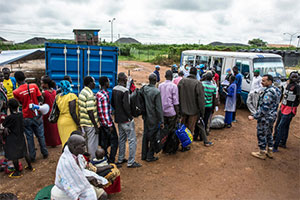 One Thousand Internally Displaced Persons (IDPs) Relocated from Tomping Camp in South Sudan. Credit: UN Photo/Isaac Billy
It took hundreds of thousands of years for the world’s human population to cross one billion in 1804. Approximately 200 years later, the population has multiplied sevenfold. In 2023, the global population crossed 8 billion, and is expected to reach 9 billion before 2050. With the planet more crowded than ever, it is essential to keep track of population trends, urbanization, migration, and reproduction across the world.
Life expectancy has seen significant strides in the past century, largely due to economic development and increased standards of living. On the contrary, trends in global fertility are shifting, with certain regions in Africa and Asia reporting higher rates, while parts of Europe and North America report stagnant or lower rates. This is in part due to differences in sexual and reproductive healthcare, as well as societal and economic conditions around the world. For example, child marriage is prevalent in certain societies, where childbearing is also considered a familial duty. Meanwhile, stagnating economies frequently experience lower marriage and childbearing rates.
The increase in migration and urban development around the world is also linked to global population trends. By 2050, it is expected that approximately 66 percent of all people will live in cities. Furthermore, global crises such as warfare and natural disasters also prompt transnational migration. Transnational migration is linked to a variety of socioeconomic issues in both host and receiving countries: migrants often leave developing countries with less access to educational and economic opportunities and arrive in developed countries where they are frequently the targets of ethnic, racial, and cultural discrimination, and economic exploitation. Recent crises in Europe and the United States demonstrate the importance of advocating for migrants worldwide. As migrants from the Global South are increasingly stripped of their legal and civic rights in unlawful deportations, or targeted in acts of identity-based violence, it is essential to keep track of population trends and protect the human rights of migrant populations. Climate-related disasters are now a major driver of displacement, with nearly half of all new internal displacements in 2025 being disaster-related.
IPS is devoted to covering issues surrounding population trends, migration, and reproduction through its compelling articles, which use both statistics and human stories to provide readers with robust and informative viewpoints.

The Week with IPS

NEXT STOP - SDGs
Tracking global progress towards a sustainable world
Tracking global progress towards a sustainable world
