Languages
Sunday, October 25, 2026



News and Views from the Global South
Poverty & SDGs

Fighting Corruption Essential to Reducing Inequality in Pacific Islands
Corruption continues to have a crippling effect on the lives of many people in southwest Pacific Island countries, exacerbating hardship and inequality and eroding human and national development.
When Will Countries Ever Learn how Well to do Fuel Subsidy Reforms?
Consider the situation. Faced with growing fiscal stress, the government of an energy exporting country decides to cut generous subsidies, doubling the fuel price overnight.
Climate Inaction, Injustice Worsened by Finance Fiasco
Many factors frustrate the international cooperation needed to address the looming global warming catastrophe. As most rich nations have largely abdicated responsibility, developing countries need to think and act innovatively and cooperatively to better advance the South. Climate action The world is woefully offtrack to achieving the current international consensus that it is necessary to keep the global temperature rise by the end of the 21st century to no more than 1.5°C (degrees Celsius) above pre-industrial levels two centuries ago.
Community Organization and Solidarity in Peru Tackle Hunger in Pandemic
It's nine o'clock in the morning and Mauricia Rodríguez is already peeling garlic to season the day's lunch at the Network of Organized Women of Villa Torreblanca, one of more than 2,400 solidarity-based soup kitchens that have emerged in the Peruvian capital in response to the worsening poverty caused by the partial or total halt of economic activities in the country due to COVID-19.
Investing in a Child’s Education is Investing in all of Humanity, Says ECW’s Yasmine Sherif Welcoming Germany’s €200 million Donation
Education lifts millions out of poverty, but because the COVID-19 pandemic wiped out gains made in recent decades, a holistic approach to providing education in crises is crucial, says German Minister for Economic Cooperation and Development, Svenja Schulze.
Up to 70% of Children in Developing Countries to Be Left Unable to Read?
“Unless we take action, the share of children leaving school in developing countries who are unable to read could increase from 53 to 70 percent.”
Mali must not Be a New Site for Clashes Between Global Powers
Last week, I was delighted to speak to the United Nations Security Council. In the ten years that my country has been experiencing conflict, violence, and instability, dozens of conferences and other international summits have been held without ever really making room for those who are mobilized on a daily basis for more social justice, the defense of human rights and achieving Malian peace.
Key Pillars Mostly in Place to Speed up Africa’s Free Trade in 2022
The official start of free trading under the African Continental Free Trade Area (AfCFTA) in January 2021 moved a major continental aspiration closer to reality.
Asia-Pacific: Just 5% of the Region’s Population Owns 70% of Its Total Wealth
The Asia-Pacific region is experiencing growing inequality even while registering impressive economic growth and poverty reduction. Such sharp inequalities continue to be persistent in the region, with nearly 2 in 4 people still unable to afford a healthy diet.
As the Pandemic Devastates the Poor, the World’s 10 Richest Have Multiplied their Wealth into Trillions
The numbers are unbelievably staggering: the world’s 10 richest men more than doubled their fortunes from $700 billion to $1.5 trillion —at a rate of $15,000 per second or $1.3 billion a day, according to a new study from Oxfam International.
Fully Ready to Kill, Shockingly Unprepared to Save Lives
While absolutely ready to kill, with the biggest military powers spending in 2020 nearly two trillion US dollars on weapons, the world is shockingly unprepared to save the lives of millions of unarmed, innocent civilian victims of wars… and other man-made catastrophes.
Democracy Under Assault
There is no doubt that the building the magnificent Women’s Pavilion at the Dubai World Expo 2020 deserves unconditional praise and admiration, a bold landmark that projects the concept of gender empowerment and gender equality.
Can Barter System Work in Today’s India?
When COVID-19 hit in early 2020, it affected every aspect of people’s lives. For many from the most marginalised sections of society, it meant loss of employment and lack of access to education, food, and the market, among other things.
Disparities in the Arab Region: Hunger Doubles, Indebtedness Triggers, Recovery Uneven
The panorama is bleak: hunger in the Arab region continues to rise, with more than 90% increase since 2000, while indebtedness is growing, and the economic recovery is tenuous and uneven.
How Place of Birth Shapes Chances of Going to University
Many newly independent African countries in the 1960s inherited regional and ethnic inequalities in formal educational attainment. These new states bound together sub-national regions of diverse ethnic and religious communities. The regions differed in their exposure to missionary activity – the main vector in the spread of formal western education in the colonial era.
Too Harmful: The March of Salt and Plastics on World Soils
There are more under-reported consequences of human activities unmatching the rhythm of Mother Nature. Such is the case, among many others, of the growing salinisation and ‘plastification’ of the world's soils.
US Democracy Faces Gravest Danger
Unless the Republicans and Democrats put the nation above their party and personal interests, our democracy will face the gravest danger in more than a hundred years. Authoritarianism will creep in, leading to the collapse of American political institutions and the demise of our democracy as we know it.
A Fast-Spreading Pandemic has Reduced an Additional 100 Million People into Poverty
The UN’s highly-ambitious goal of eradicating extreme poverty by 2030 has been severely undermined by a rash of problems worldwide, including an escalating coronavirus pandemic, continued widespread military conflicts and the devastating impact of climate change.
UN’s Overall Development Agenda at Risk as the Coronavirus Pandemic Escalates
The Corona-19 pandemic has had an unparalleled and relentless toll on the world in areas beyond health alone. The World Bank’s latest report on global poverty raises concerns as to the severity of the impact of the pandemic on efforts to fight poverty (SDG 1) and hunger (SDG 2).
Once Tossed and Abused, Human Trafficking Survivor Finds Solace
For over two decades, Nina tossed around like a leaf in a storm. While a teenager, she was lured into the sex trade, and pimps kept a huge chunk of the money that she earned as a sex slave. Nina was often bruised. Once, she refused sex with a man who did not want to use a condom. He beat her so severely that she had found it difficult to breathe.
Severe Water Stress, Absolute Scarcity for 2 to 4 Billion Humans by 2025
Now it comes to the scary water crises, as it is estimated that, globally, over two billion people live in countries that experience high water stress.« Previous Page — Next Page »





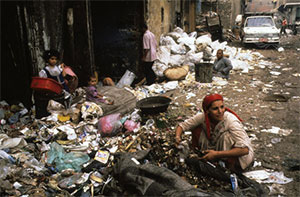 Romani people in Cairo, Egypt, forage through trash. Credit: UN Photo/Armineh Johannes
In 2015, the United Nations adopted the Sustainable Development Goals (SDGs) in an effort to promote “peace and prosperity for people and the planet.” To achieve that goal, it is essential to provide equal opportunities and access to basic services to all people. The 2025 UN SDG Report found that 35% of the 169 SDG targets are on track or making moderate progress, while 18% have reversed compared to the 2025 baseline. One in ten people still live in extreme poverty, one in eleven experience food insecurity, and over 1.1 billion people live in slums without access to clean water and sanitation. It is imperative to acknowledge the societal, technological, economic, and political issues that sustain poverty in countries around the world. Eradicating poverty will require significant frameworks in policy and governance on a national and international scale to ensure that all people will have equal access to basic services and economic opportunities by 2030. Furthermore, a dramatic reduction of United States foreign aid in 2025, including the termination of 83% of USAID programmes, threatens to erode years of fragile development gains.
Throughout the world, violent conflict and natural disasters also contribute to extreme poverty. The complete destruction of infrastructure and blockage of aid has significantly impoverished Palestine since October 7th. The destructive impact of Hurricane Maria in Puerto Rico left $91 billion in damage. An inadequate US government response also revealed significant and enduring questions within the issue of mitigating poverty: how do we rebuild infrastructure after its destruction? How do we restimulate economic development and bring in financial aid after disasters? Similar questions have been raised in the realm of regional cooperation, as devastating floods have wrecked hundreds of thousands of homes across multiple Southeast Asian nations in the past few years. Furthermore, the COVID-19 pandemic has greatly exacerbated the global poverty crisis, particularly in developing countries, setting back the United Nations goal of eradicating poverty by 2030.
IPS is committed to providing comprehensive features that focus on the persisting environmental, sociopolitical, and systemic issues that sustain poverty, and the steps taken worldwide towards poverty eradication.

The Week with IPS

NEXT STOP - SDGs
Tracking global progress towards a sustainable world
Tracking global progress towards a sustainable world

