Languages
Saturday, October 24, 2026



News and Views from the Global South
Poverty & SDGs

6 in 7 People Worldwide Experience ‘High Levels of Insecurity’ – Why?
Safety and security are at the base of the ‘hierarchy of needs’ pyramid, second in importance only to life’s absolute necessities—air, water, food and shelter, warns a new report.
Gender Lens Crucial to Leaving No One Behind (Part 1)
Parliamentarians' leadership in a post-COVID-19 recovery is crucial to achieving the International Conference on Population and Development (ICPD) agenda. The involvement of lawmakers in ensuring a more equal, just, and sustainable society will come under the spotlight during a two-day inter-regional meeting organized by the Asian Population and Development Association (APDA) and the Forum of Arab Parliamentarians on Population and Development (FAPPD,) and supported by UNFPA ASRO in early March 2022.
Migrant Workers’ Remittances Fund Development-Make It Easier for Them: Podcast
 I hope you had a chance to listen to our last episode, Environmental disasters creating more migrants within countries. We talked about the rising number of people who are forced out of their homes because of climate or environmental disasters. Nearly 30 million men, women and children in 149 countries were displaced in 2020, temporarily or for good and the signs are, that those numbers will only grow.
Cyclone Ana Floods Choke Malawi’s Water and Sanitation Goals
On the night of January 24, 2022, as Cyclone Ana-triggered rains incessantly rattled on the rusty roof of her house, amid intervals of gusty winds, a thud woke up Josephine Kumwanje from her sleep.
The New World Wonder: a 100 Million Hectares Wall to Protect Africa
Once completed in 2030, it could well be considered the world’s eighth wonder, this time natural. It is the African-led Great Green Wall or the largest living structure on the planet – an 8.000 kilometres natural hit stretching across the entire width of the continent.
APDA, AFPPD Celebrate Forty Years of Championing Population and Development Agenda
 The Asian Population and Development Association (APDA) has been ahead of the international community in addressing population and development issues, says the former Japanese Prime Minister and Chair of APDA Yasuo Fukuda.
‘Our Common Agenda’: Guterres’ Open Door to Corporate Capture of the UN
On 10 September 2021, UN Secretary-General (SG) Antonio Guterres released the “Our Common Agenda” (OCA) report. This report was in response to a request from UN member states to “report back before the end of the seventy-fifth session of the General Assembly with recommendations to advance our common agenda and to respond to current and future challenges”.
WASH Interventions Key to Reaching Africa’s Child Health Milestones
For two days in a row back in 2018, four-year-old Calvin Otieno suffered from diarrhoea and vomiting, and his mother responded by giving him a salt solution.
Agricultural Power, Waning Industry Dictate Brazil’s Future
With its accelerated growth agriculture has emerged as a key sector of Brazil's economy, but it is failing on its own to spread prosperity and reduce poverty and inequality, with industry in decline.
Dream. Dare. Do.
Conflict, forced displacement, climate change and COVID-19 are disrupting the education of millions of crisis-affected children and adolescents around the world.
ONE OCEAN SUMMIT – An Opportunity For Blue Transformation
The ocean covers more than 70 percent of our planet. There is no question it is critical for our health and well-being. It provides half the earth’s oxygen supply and every organism in existence depends on it to survive.
Call for Increased Global Efforts to Ease Africa’s Climate-Induced Water Crisis
When years ago warnings were sounded that future wars would be fought not over oil but water, the predictions were dismissed as alarmist.
Responding to New Threats to Poverty Eradication in Asia
With consistent, robust economic growth, countries across Asia have made monumental strides in eradicating extreme poverty over the past 30 years. In Bangladesh, for example, the population living in extreme poverty dropped from 43% in 1991 to 10.5% in 2019. Similarly in Cambodia, poverty incidence fell from 53% in 2004 to below 10% by 2016.
Inequality Kills One Person Every Four Seconds
Inequality is deadly… It contributes to the deaths of at least 21,300 people each day—or one person every four seconds. This is a “highly conservative estimate” for deaths resulting from hunger, lack of access to healthcare and climate breakdown in poor countries…
Science Academies and Disciplinary Groups Have Work to do on Gender Equality
Women remain under-represented in science careers and research all over the world. There are several reasons for this, including stereotypes about what kind of work women “can” or “should” do; patriarchal attitudes; and a lack of support for women pursuing science, technology, engineering and maths (STEM) careers.
Education Cannot Wait Interviews The Rt. Hon. Gordon Brown, UN Special Envoy for Global Education and Chair of ECW’s High-Level Steering Group
ECW: You played a critical role in establishing Education Cannot Wait just five years ago. As the Chair of ECW’s High-Level Steering Group, what are some of the key successes achieved by ECW over the last five years; and what needs to be done in the next five years as we approach the 2030 Agenda for Sustainable Development deadline?
From Zero Yield to Bumper Harvest
In the past, the people of Sande Village in Chikwawa district, Malawi, would go to bed with empty stomachs even when the rest of the country harvested bumper yields.
Pro-rich Policies Buoy Billionaires’ Rise in India
If India ranks among the world’s fastest growing economies it is also where inequity is growing the fastest, thanks to endemic features unique to the country such as the caste system.
Three Key Questions for Understanding Shifts in Global Poverty
In 2010 and the following years, there was attention to the fact that much of global poverty had shifted to middle-income countries (for example here, here, and here).
Power of Connection & Collaborations to Fight Modern-day Slavery
The Covid-19 pandemic affected countries and people globally, at the same time exacerbated vulnerabilities such as modern-day slavery. There are over 40.3 million people estimated to be in modern-day slavery, and certain population groups, sectors and geographies such as children, migrant workers, women and girls that were already vulnerable, became more vulnerable to recruitment and exploitation during the pandemic. The United Nations has called the pandemic more than a health crisis, “it is an economic crisis, a humanitarian crisis, and a human rights crisis.”
No Perfect Solution: Africa’s Smallholder Farmers Must Use Both Traditional and New Practices
As an agricultural and environmental scientist, I’ve worked for decades exploring the practical challenges that smallholder farmers encounter in East Africa. These include controlling weeds that can choke their crops and looking for new ways to deal with pests or diseases that threaten their harvests.« Previous Page — Next Page »





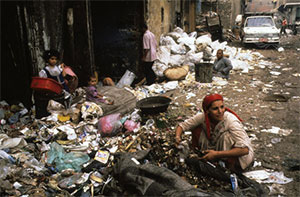 Romani people in Cairo, Egypt, forage through trash. Credit: UN Photo/Armineh Johannes
In 2015, the United Nations adopted the Sustainable Development Goals (SDGs) in an effort to promote “peace and prosperity for people and the planet.” To achieve that goal, it is essential to provide equal opportunities and access to basic services to all people. The 2025 UN SDG Report found that 35% of the 169 SDG targets are on track or making moderate progress, while 18% have reversed compared to the 2025 baseline. One in ten people still live in extreme poverty, one in eleven experience food insecurity, and over 1.1 billion people live in slums without access to clean water and sanitation. It is imperative to acknowledge the societal, technological, economic, and political issues that sustain poverty in countries around the world. Eradicating poverty will require significant frameworks in policy and governance on a national and international scale to ensure that all people will have equal access to basic services and economic opportunities by 2030. Furthermore, a dramatic reduction of United States foreign aid in 2025, including the termination of 83% of USAID programmes, threatens to erode years of fragile development gains.
Throughout the world, violent conflict and natural disasters also contribute to extreme poverty. The complete destruction of infrastructure and blockage of aid has significantly impoverished Palestine since October 7th. The destructive impact of Hurricane Maria in Puerto Rico left $91 billion in damage. An inadequate US government response also revealed significant and enduring questions within the issue of mitigating poverty: how do we rebuild infrastructure after its destruction? How do we restimulate economic development and bring in financial aid after disasters? Similar questions have been raised in the realm of regional cooperation, as devastating floods have wrecked hundreds of thousands of homes across multiple Southeast Asian nations in the past few years. Furthermore, the COVID-19 pandemic has greatly exacerbated the global poverty crisis, particularly in developing countries, setting back the United Nations goal of eradicating poverty by 2030.
IPS is committed to providing comprehensive features that focus on the persisting environmental, sociopolitical, and systemic issues that sustain poverty, and the steps taken worldwide towards poverty eradication.

The Week with IPS

NEXT STOP - SDGs
Tracking global progress towards a sustainable world
Tracking global progress towards a sustainable world

