Languages
Wednesday, October 21, 2026



News and Views from the Global South
Poverty & SDGs

War in Ukraine Poised to Threaten Global Food Security
The war in Ukraine is a catastrophe for that country and for the world. In any crisis it is the most vulnerable that will be most affected, and this time it is no different.
International Women’s Day, 2022
Girls’ Education Must Come First
For decades now, world leaders have talked about ending hunger and poverty and building a new world order based on human rights and gender-equality.

International Women’s Day, 2022
How Bangladesh Became a Test Case for Women’s Empowerment
The increased empowerment of rural women in Bangladesh over the past 10 years has been no accident.
A decade ago, not even one in four rural women could be said to be “empowered” across five key metrics, a figure that surprised even those working on the ground with the country’s poorest. By 2015, this had risen to more than two in five, or 41 per cent, with continued gains in recent years.

International Women’s Day, 2022
To Overcome Africa’s Development Crisis, Invest in Strengthening Girls’ Power
It was on a visit to Lesotho that I first heard the derogatory term Mmutla – nocturnal hare. It is a word used in some southern districts to insult adolescent girls who have been forced into sexual exploitation and transactional sexual relations for survival.
International Women’s Day, 2022
Raising up Women as Light in Dark Times
When I was a young girl, a friend and I spent our summers building a treehouse. We built it because our older brothers were building one and wouldn’t allow us to help them. So, we asked our parents to support us through the procurement of basic tools, collected scrap wood from the local hardware store, chose a tree, and then spent day after day puzzling beams and boards together into structure in which only people of our small size could fit.

Can 70% of the World’s Poor Celebrate International Women’s Day?
The picture is gloomy: not only do women represent 70% of the 1.3 billion people living in conditions of poverty, but also up to 40% of the poorest households in urban areas are headed by women.
The Climate Change Shuffle: Deny, Delay, and Do Nothing
While more than a half century ago the Twist was the craze in dance halls globally, today the Climate Change Shuffle is the craze in government halls and conference sites worldwide as officials dance around the dangers of climate change.
International Women’s Day, 2022
War, Want, Weather and Wellbeing: Where Are We Now?
WAR The world is currently facing a devastating war with dire prospects for our global security. Men are waging this war while women seek peace and security for their families, communities and our global society. Women are give birth and nurture while some men actively seek death and destruction. This is one of the fundamental differences between the sexes which underpins patriarchy and generates inequality on many levels. Women and girls bear the brunt of this unbalanced approach to life.

International Women’s Day, 2022
To be Just, the Energy Transition Must Include & Empower Women
Access to clean energy improves women’s lives in a myriad of ways. It supports access to education and quality healthcare, opens new economic opportunities, and reduces unpaid domestic labour and gender-based violence. Yet too often, the sector as a whole – from industry to policymaking – still fails to include women as energy users, decision-makers and agents of change of the energy transition.

International Women’s Day, 2022
Gender Blind Spots in the Water Sector
UN Women estimates 150 million women and girls are emerging from poverty by 2030, thanks largely to comprehensive education, labor, and social protection strategies and reforms implemented by governments around the world.

Egypt Rushes to Find Alternative Wheat Suppliers Following Ukraine Crisis
Egypt is scrambling to find alternate sources of wheat after the Russian invasion of Ukraine has put supply to the country in jeopardy. This is especially urgent because the price of bread in Egypt has in the past sparked protests in the country.
International Women’s Day, 2022
Sexual Violence Laws are Failing Adolescents
At Equality Now, we have been on a years-long journey to track and analyze sexual violence laws and their implementation around the world. This work was born after working with survivors of sexual violence for over two decades and observing that women and girls reported similar barriers to justice regardless of where they were from.

We Must Carry on Paul Farmer’s Work on Social Determinants of Health
Paul Farmer, the legendary global health equity warrior, recently died in his sleep from heart-related complications at the University of Global Health Equity (UGHE) in Butaro, Rwanda, the university he co-founded.
Education Cannot Wait Interviews German Minister for Economic Cooperation and Development Svenja Schulze
ECW: Germany recently announced €200 million (US$228.3 million), in new, additional funding for Education Cannot Wait (ECW). What inspired Germany to make such a game-changing investment in ECW by prioritizing multi-year funding for education in emergencies?

With One Million Species Endangered, the Web of Life Is at Risk of Extinction
These are not by any means just mere figures. It is about the risk of extinction of the whole life cycle. See what is at stake.
It’s Time to Step up for Street Vendors’ Rights
In the second week of January 2022, Purushottam—locally known as Prashant—a street vendor in central Delhi’s Connaught Place area, died by suicide. It was later discovered that the reason for his death was his inability to pay certain debts.
Young Argentine Women Forge a Future in Cooperative Factory
"We started making shampoos and soaps in the kitchen of a friend’s house in 2017. We were five or six girls without jobs, looking for a collective solution, and today we are here," says Letsy Villca, standing between the white walls of the spacious laboratory of Maleza Cosmética Natural, a cooperative that brings together 44 women in their early twenties in the Argentine capital.
International Women’s Day, 2022
Women Demanding Justice & Peace in the Streets of Myanmar
This will be the second International Women’s Day since the brutal coup erupted in Myanmar – and women remain fiercely in the lead in demanding justice and peace in the streets and behind closed doors.

International Women’s Day, 2022
Collective Solutions to Improve Sexual and Reproductive Health Rights in Climate Action
The devastating effects of climate change continue to disproportionately affect women and girls in the poorest regions, who have contributed the least to global warming.

Gender Lens Crucial to Leaving No One Behind (Part 2)
A crucial two-day meeting of Parliamentarians from the Asian, Arab and African regions will put human-rights-based legislative frameworks under the spotlight as the regions work to implement the ICPD Programme of Action.
6 in 7 People Worldwide Experience ‘High Levels of Insecurity’ – Why?
Safety and security are at the base of the ‘hierarchy of needs’ pyramid, second in importance only to life’s absolute necessities—air, water, food and shelter, warns a new report.« Previous Page — Next Page »





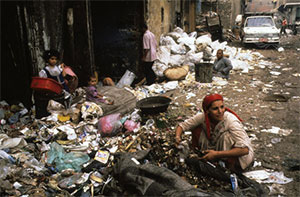 Romani people in Cairo, Egypt, forage through trash. Credit: UN Photo/Armineh Johannes
In 2015, the United Nations adopted the Sustainable Development Goals (SDGs) in an effort to promote “peace and prosperity for people and the planet.” To achieve that goal, it is essential to provide equal opportunities and access to basic services to all people. The 2025 UN SDG Report found that 35% of the 169 SDG targets are on track or making moderate progress, while 18% have reversed compared to the 2025 baseline. One in ten people still live in extreme poverty, one in eleven experience food insecurity, and over 1.1 billion people live in slums without access to clean water and sanitation. It is imperative to acknowledge the societal, technological, economic, and political issues that sustain poverty in countries around the world. Eradicating poverty will require significant frameworks in policy and governance on a national and international scale to ensure that all people will have equal access to basic services and economic opportunities by 2030. Furthermore, a dramatic reduction of United States foreign aid in 2025, including the termination of 83% of USAID programmes, threatens to erode years of fragile development gains.
Throughout the world, violent conflict and natural disasters also contribute to extreme poverty. The complete destruction of infrastructure and blockage of aid has significantly impoverished Palestine since October 7th. The destructive impact of Hurricane Maria in Puerto Rico left $91 billion in damage. An inadequate US government response also revealed significant and enduring questions within the issue of mitigating poverty: how do we rebuild infrastructure after its destruction? How do we restimulate economic development and bring in financial aid after disasters? Similar questions have been raised in the realm of regional cooperation, as devastating floods have wrecked hundreds of thousands of homes across multiple Southeast Asian nations in the past few years. Furthermore, the COVID-19 pandemic has greatly exacerbated the global poverty crisis, particularly in developing countries, setting back the United Nations goal of eradicating poverty by 2030.
IPS is committed to providing comprehensive features that focus on the persisting environmental, sociopolitical, and systemic issues that sustain poverty, and the steps taken worldwide towards poverty eradication.

The Week with IPS

NEXT STOP - SDGs
Tracking global progress towards a sustainable world
Tracking global progress towards a sustainable world

