Languages
Tuesday, October 20, 2026



News and Views from the Global South
Poverty & SDGs

Water Scarcity in Africa to Reach Dangerously High Levels by 2025 – Experts
Joan Waweru was among villagers on their regular trek to the river to fetch water when they discovered a neighbour's dead body, believed to have committed suicide by drowning in river Kamiti.
NGOs Seeking a Monterrey+20 Summit on Financing for Development
This week, exactly 20 years ago, world leaders adopted the United Nation’s Monterrey Consensus. They committed to “Confronting the challenges of financing for development” with a global response and to creating a fully inclusive and equitable global economic system.
War on Syria: Eleven Years of Carnage
“Hundreds of thousands have been killed, more than half of the pre-war population – somewhere in the order of 22 million - have been displaced. More than 100,000 are missing or forcibly disappeared….
Water & Sanitation Crisis Escalates as Yemenis Mark World Water Day
As Yemen enters its 8th year of an escalating conflict, 21.7 million of my fellow Yemenis are forced to rely on humanitarian assistance to survive. The conflict has left a trail of devastation in its wake – the country is in economic freefall, and families face intensified violence, hunger, and disease. As we also mark another World Water Day on March 22, within Women’s History Month, it is a time to reflect on the immense water and sanitation crisis that continues to take countless lives – and how it impacts women and girls so acutely. The destruction of the country’s health and water infrastructure has left Yemen acutely vulnerable to multiple epidemics including malaria, diphtheria, dengue, cholera, and COVID-19.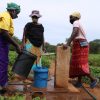
Groundwater at the Heart of the Water Security Equation
Groundwater is invisible and yet its impact is visible everywhere – this infinite resource provides almost half of all drinking water worldwide. About 40% of water for irrigated agriculture and about 1/3 of water required for industry is from groundwater resources. Despite these impressive facts, groundwater remains invisible and less prominent compared to surface water.
Eradicating Polio Would Eradicate So Much Tragedy
In the outskirts of Malawi’s capital, Lilongwe, just beyond where paved roads transition to dirt, an undiagnosed polio infection paralysed a three-year-old girl. From one day to the next, the child’s life was changed forever.
Planet Earth into Planet Plastics
Planet Earth is increasingly being transformed into planet Plastics. Approximately 400,000,000 metric tons of plastics are produced worldwide annually. Those plastics amount to about 50 kilograms, or 110 pounds, every year for each of the 8 billion human inhabitants living on the unfolding planet Plastics.
Addressing Global Food Security with Optimism and Resilience
In an exclusive interview with IPS, Ambassador Cindy Hensley McCain, Permanent Representative of the US Mission to the food and agriculture organizations of the United Nations in Rome, Italy, shares her thoughts on food security, sustainable food systems, the impact of climate change on food production, conflicts and the ongoing crisis in Ukraine, and her plans while working with the Food Agricultural Organization of the United Nations (FAO), International Fund for Agricultural Development (IFAD) and World Food Programme (WFP) with Farhana Haque Rahman and Sania Farooqui.
Women Must be at the Centre of Africa’s Transformative Free Trade Area
Ambassador Mathu Joyini began her role as the Permanent Representative of South Africa to the United Nations in January 2021, becoming the first South African woman to hold the position. Representing the African States Group, she is the Chair of the Bureau for the 2022 Commission on the Status of Women (CSW). She has championed causes related to Africa's peace and security, human rights, women’s empowerment, among others.
The Rise in Food Insecurity Amid the COVID-19 Pandemic and Conflicts
The effects of COVID-19 over the past two years, in addition to the increase in wars and conflicts, climate change and economic crises, have aggravated global food insecurity, generating serious concerns for 2022.
Pandemic Pushes SDGs Further out of Reach of Asia and the Pacific
2022 marks the second anniversary of the COVID-19 pandemic, and while an end to the pandemic is in sight, it is far from over and the consequences will be felt for decades to come. At the same time, the 2030 Agenda for Sustainable Development is becoming increasingly distant. The region must use the 17 Sustainable Development Goals as a roadmap to a fairer recovery.
Education Cannot Wait Secures Future of Children in CAR Conflict Zones
Nine-year-old Marguerite Doumkel sits among other children in a classroom in Paoua, a sub-prefecture of Ouham Pende, in the Central African Republic (CAR).
Uganda Recognizes Pregnant Teens’ Right to Education, but Religion, Stigma Lock Out Most
When schools reopened in Uganda in January, Atim’s baby was 3 months old. The 17-year-old wished to go back to classes but she faced a dilemma—whether to disclose to her teachers that she was a lactating mother.
Youths Trailblazing Paths in Sexual and Reproductive Health Ahead of ICFP Family Planning Conference
Travelling in northern Nigeria, Peace Umanah noticed teenage girls with multiple children – they would be walking with one strapped to their back, holding another by hand and with a protruding belly.
Commission on the Status of Women: The Streets Have Already Spoken
The 66th session of the Commission on the Status of Women (CSW) was just launched. Due to the ongoing impacts of the COVID-19 pandemic, the main annual global forum on gender equality is once again taking place in a hybrid format – both at the UN’s New York headquarters, where government delegations will be meeting, and online, where most civil society activity will take place.
Over 60% of World Workers Not Recognised, Not Registered, Not Protected
More than 60 percent of the world’s adult labour force –or about 2 billion workers– work in the informal economy. “They are not recognised, registered, regulated or protected under labour legislation and social protection. The consequences can be severe, for individuals, families as well as economies.”
‘A Growing Number of Billionaires Is a Sign of Failure’
It is no secret that economic inequality has risen exponentially in the last few decades, both in India and globally. According to the World Inequality Report 2022, India is one of the most unequal countries in the world in terms of both income and wealth inequality. It is estimated that in 2021, the top 10 percent of Indians held 57 percent of the total national income while the bottom 50 percent’s share was just 13 percent.
How COVID Has Affected the Control of Neglected Tropical Diseases
Neglected tropical diseases is an umbrella term used to describe a group of 20 infectious diseases. These diseases affect over 1.7 billion people. They can disable, debilitate and even kill. The world’s most vulnerable and poorest are most affected.
The Future of Food: Jellyfish, Farmed Insects, 3D Printed Meat?
Between the devastating effects of climate change and the fast advancing new technologies, it seems now evident that the future of food will change. Whether it's new foods like jellyfish, edible insects and cell-based meat, or new technologies like blockchain, artificial intelligence and nanotechnology, the future promises exciting opportunities for feeding the world, says a new report.
Exploring the Future of Climate Justice Through My Daughter’s Eyes
People often feel that climate change is difficult to grasp and relate to. I have heard that it’s “too technical, too intangible, or too complicated” for us to care about. As a Latin American mother of two, I confess that for me, relating to climate change is becoming ever more simple. All I do is try to imagine the world my kids will live in in 2050 if we don’t do anything now, and I immediately understand the urgent need for bold, transformative global climate action.
Shall the Arctic Burn?
Climate change and land-use change are projected to make wildfires more frequent and intense, with a global increase of extreme fires of up to 14 percent by 2030, 30 percent by the end of 2050 and 50 percent by the end of the century, according to a new report by the UN Environment Programme (UNEP) and GRID-Arendal, a non-profit environmental communications centre based in Norway.« Previous Page — Next Page »





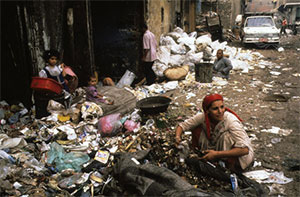 Romani people in Cairo, Egypt, forage through trash. Credit: UN Photo/Armineh Johannes
In 2015, the United Nations adopted the Sustainable Development Goals (SDGs) in an effort to promote “peace and prosperity for people and the planet.” To achieve that goal, it is essential to provide equal opportunities and access to basic services to all people. The 2025 UN SDG Report found that 35% of the 169 SDG targets are on track or making moderate progress, while 18% have reversed compared to the 2025 baseline. One in ten people still live in extreme poverty, one in eleven experience food insecurity, and over 1.1 billion people live in slums without access to clean water and sanitation. It is imperative to acknowledge the societal, technological, economic, and political issues that sustain poverty in countries around the world. Eradicating poverty will require significant frameworks in policy and governance on a national and international scale to ensure that all people will have equal access to basic services and economic opportunities by 2030. Furthermore, a dramatic reduction of United States foreign aid in 2025, including the termination of 83% of USAID programmes, threatens to erode years of fragile development gains.
Throughout the world, violent conflict and natural disasters also contribute to extreme poverty. The complete destruction of infrastructure and blockage of aid has significantly impoverished Palestine since October 7th. The destructive impact of Hurricane Maria in Puerto Rico left $91 billion in damage. An inadequate US government response also revealed significant and enduring questions within the issue of mitigating poverty: how do we rebuild infrastructure after its destruction? How do we restimulate economic development and bring in financial aid after disasters? Similar questions have been raised in the realm of regional cooperation, as devastating floods have wrecked hundreds of thousands of homes across multiple Southeast Asian nations in the past few years. Furthermore, the COVID-19 pandemic has greatly exacerbated the global poverty crisis, particularly in developing countries, setting back the United Nations goal of eradicating poverty by 2030.
IPS is committed to providing comprehensive features that focus on the persisting environmental, sociopolitical, and systemic issues that sustain poverty, and the steps taken worldwide towards poverty eradication.

The Week with IPS

NEXT STOP - SDGs
Tracking global progress towards a sustainable world
Tracking global progress towards a sustainable world

