Languages
Tuesday, October 20, 2026



News and Views from the Global South
Poverty & SDGs

Unintended Pregnancy Rates Highest in Africa: a Look at the Complex Reasons
The United Nations Population Fund recently released the 2022 State of World Population report. It highlights that almost half of all pregnancies between 2015 and 2019 were unintended. That amounts to roughly 121 million unintended pregnancies each year.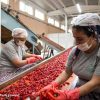
Food Systems Should Deliver Benefits in terms of Climate, Health and Society
Which country do you think best recognises the potential for changes to food systems to reduce emissions? Presumably a developed country, where agriculture is predominantly intensive, heavily subsidised and fuelled by fertilisers and irrigation, and where high consumption of animal proteins is the norm?
Connecting the Dots for the Transforming Education Summit
Look around the world at this very moment. Whether we look at it in stark numbers and statistics, whether we look at it as a generational loss of basic human rights, including the right to an education, or whether we look inwardly and feel the unspeakable human suffering and devastation taking place, we all agree: we are at a historically low point in our collective humanity.
School Meal Programs Getting Back on Track in Central America, Despite Hurdles
A group of preschool students enthusiastically planted cucumbers and other vegetables in their small school garden in southern El Salvador, a sign that school feeding programs are being revived as the world emerges from the COVID-19 pandemic.
Twilight for the 1951 Refugee Convention
Twilight for the 1951 Refugee Convention is becoming a 21st century reality for an increasing number of countries worldwide.
Worrying Insights from UN’s First-Ever Assessment of Water Security in Africa
When it comes to water security – a reliable, good supply of safe water – just 29 African countries have made some progress over the past three to five years. Twenty-five have made none.
Wake-Up Call as Millions of Africa’s Children at Risk of Missing Out on Education – Report
Marisol Ntalami is one of 747,161 candidates who sat for the national Kenya Certificate of Secondary Education in 2020. “I come from a pastoral community. My father has five wives and many children. I am the only girl in the family to have completed primary school and now secondary school. My mother fought very hard for me to stay in school. I am a first-year university student studying actuarial science,” she tells IPS.
ECW Interviews Norway’s Minister of International Development Anne Beathe Tvinnereim
ECW: The International Disability Alliance (IDA), Government of Norway and Government of Ghana hosted the second Global Disability Summit in February. At the summit you called on partners to commit to ensuring children with disabilities can access their inherent human rights, including the right to education. How can we transform the delivery of education in emergencies to ensure no child is left behind?

US Migration Policy Is Enriching Cartels at the Busiest, and Most Dangerous, Part of the US-Mexico Border
“The migrants try to organize themselves to stay safe,” a humanitarian worker told me as we stood near a town square in Reynosa, Mexico, steps away from the U.S. border. More than 2,000 people from many countries, blocked from asking for asylum in the United States, were packed into this square block, living under tents and tarps, amid port-a-potties and cooking fires. Children were everywhere.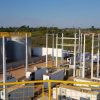
Palm Oil for Biodiesel in the Amazon: Sustainable Fuel or Deforestation Risk?
Oil palm, known as dendezeiro in Brazil, can produce up to ten times more vegetable oil per hectare than other crops, but it is regularly condemned as harmful to the biodiversity of tropical forests in Asia, Africa and Latin America. Now, its cultivation looks set to advance in the Brazilian Amazon.
School Feeding Is Now the World’s Largest Social Safety Net
When Canada and Nepal are used in the same sentence it’s usually because the former is supporting development efforts in the latter. Not when it comes to feeding children at school.
Can Legal Action Alone Put an End to Child Marriage?
On December 22, 2021, the Prohibition of Child Marriage (Amendment) Bill, 2021, which seeks to raise the legal age of marriage for women from 18 to 21, was sent to a parliamentary standing committee for further discussion.
The Middle East’s Food Crisis Spells Disaster
In a short period, the war in Ukraine has already had a major effect on the world economy. The United States and the European Union have levied sanctions on an unprecedented scale against Russia, energy prices have skyrocketed, and with the Black Sea closed, the world’s most fertile region is no longer linked to its markets. This will cause an appreciation of food prices that could wreak havoc in the European periphery.
Learning from the Tuberculosis Pandemic
As countries around the world—from Kenya to Canada, South Africa to Sweden—relish the prospect of an unofficial transition of COVID-19 from pandemic to endemic and start to ease pandemic-related restrictions, many of us in the tuberculosis (TB) community find it hard to relate. In TB, we know what can happen when a pandemic becomes an accepted fact.
Do we Really Need a World Ranking to Measure Happiness?
The 10th edition of the World Happiness Report was recently published and once again the findings raised an array of mixed emotions with many questioning the real foundations underpinning the most discussed aspect of the Report, the World Happiness Ranking,
Why Russia’s War on Ukraine Poses a Risk to Global Food Security
The situation in Ukraine is first and foremost a humanitarian crisis, and the food security and wellbeing of the people of Ukraine should be our immediate concern. However, because of the dominant roles of Russia and Ukraine in global food, fuel and fertiliser markets, there are also massive knock-on effects for people around the world. This is particularly true for the supply and cost of food. Here are three ways that the invasion of Ukraine leads to potential risks to food security in other countries.
As Yemen Continues to be Devastated in an eight-year-old Conflict, a UN Pledging Conference Attracts only one Arab Donor
When North and South Yemen merged into a single country ushering in the Republic of Yemen back in May 1990, a British newspaper remarked with a tinge of sarcasm: “Two poor countries have now become one poor country.” Described as the poorest in an oil-blessed Middle East, Yemen continues to be categorized by the United Nations as one of the 46 least developed countries (LDCs), “poorest of the world’s poor” depending heavily on humanitarian aid while battling for economic survival.
The Cost of War: 23 Million Afghans Suffer Acute Hunger, 95% Don’t Eat Enough Food
Following 20 long years (2011-2021) of brutal war on Afghanistan by the US-led military coalition, which ended up in delivering the country to the Taliban in August 2021, 23 million Afghans now face severe and acute hunger, economic bankruptcy, healthcare system collapse, unbearable family indebtedness, and devastating humanitarian crisis.
Al-Shamiya: When Adversity Becomes Inspiration
When Suhier Abed’s husband broke both legs after falling two floors while working in construction, the 32-year-old mother of five needed to support her family.
Water & Sanitation, a Better Future for Girls & our Planet
At the World Water Forum this week (March 21-26), the international community will raise awareness of the 2 billion people worldwide who lack access to clean water and sanitation. Among them are millions of women and girls, who walk hundreds of miles each year to find water for their families and are blocked from education and economic empowerment also due to poor sanitation services.
South African Court Rules that Clean Air Is a Constitutional Right: What Needs to Change
A court in South Africa has confirmed the constitutional right of the country’s citizens to an environment that isn’t harmful to their health. This includes the right to clean air, as exposure to air pollution affects human health. Air pollution also affects land and water systems, and decreases agricultural yields.« Previous Page — Next Page »





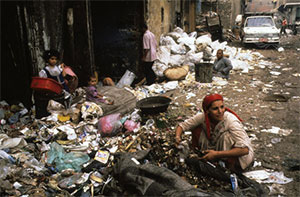 Romani people in Cairo, Egypt, forage through trash. Credit: UN Photo/Armineh Johannes
In 2015, the United Nations adopted the Sustainable Development Goals (SDGs) in an effort to promote “peace and prosperity for people and the planet.” To achieve that goal, it is essential to provide equal opportunities and access to basic services to all people. The 2025 UN SDG Report found that 35% of the 169 SDG targets are on track or making moderate progress, while 18% have reversed compared to the 2025 baseline. One in ten people still live in extreme poverty, one in eleven experience food insecurity, and over 1.1 billion people live in slums without access to clean water and sanitation. It is imperative to acknowledge the societal, technological, economic, and political issues that sustain poverty in countries around the world. Eradicating poverty will require significant frameworks in policy and governance on a national and international scale to ensure that all people will have equal access to basic services and economic opportunities by 2030. Furthermore, a dramatic reduction of United States foreign aid in 2025, including the termination of 83% of USAID programmes, threatens to erode years of fragile development gains.
Throughout the world, violent conflict and natural disasters also contribute to extreme poverty. The complete destruction of infrastructure and blockage of aid has significantly impoverished Palestine since October 7th. The destructive impact of Hurricane Maria in Puerto Rico left $91 billion in damage. An inadequate US government response also revealed significant and enduring questions within the issue of mitigating poverty: how do we rebuild infrastructure after its destruction? How do we restimulate economic development and bring in financial aid after disasters? Similar questions have been raised in the realm of regional cooperation, as devastating floods have wrecked hundreds of thousands of homes across multiple Southeast Asian nations in the past few years. Furthermore, the COVID-19 pandemic has greatly exacerbated the global poverty crisis, particularly in developing countries, setting back the United Nations goal of eradicating poverty by 2030.
IPS is committed to providing comprehensive features that focus on the persisting environmental, sociopolitical, and systemic issues that sustain poverty, and the steps taken worldwide towards poverty eradication.

The Week with IPS

NEXT STOP - SDGs
Tracking global progress towards a sustainable world
Tracking global progress towards a sustainable world

