Languages
Monday, October 26, 2026



News and Views from the Global South
Poverty & SDGs

The Impact of Air Pollution on Child Health
Air pollution is a global public health crisis, and air pollution levels in India are among the highest in the world, posing a heavy threat to the country’s health and economy. According to the 2019 World Air Quality Report, India is home to 21 of the 30 most polluted cities in the world. In these cities, air quality can be as much as 10 times over the safe limits of air pollution recommended by the WHO.
Interview with Siddharth Chatterjee, UN Resident Coordinator in China, on the Beijing Winter Olympics and Paralympics
The interview was originally conducted by Beijing Daily. Beijing Daily: The world is paying attention to whether the Beijing Winter Olympic Games can be successfully held 6 months after the Tokyo Olympics in the face of COVID-19. How do you evaluate the preparations for the Beijing Winter Olympics? What is the key to the success of the Beijing Winter Olym-pics? What kind of signal will the successful hosting of the Beijing Winter Olympics send to the world?
America Faces a Fateful Crossroad in 2022
When my assistant handed me copy expressing my greetings and good wishes for 2022 for approval, I paused, thinking, “is that all I can say, just hope for a better, brighter new year?”
Rural Women in Peru Seed Water Today to Harvest It Tomorrow
"When I was a little girl we didn't suffer from water shortages like we do now. Today we are experiencing more droughts, our water sources are drying up and we cannot sit idly by," Kely Quispe, a small farmer from the community of Huasao, located half an hour from Cuzco, the capital of Peru's ancient Inca empire, told IPS.
Biden Should Add Development to the Next Summit for Democracy – and Convene a Development Summit
U.S. President Biden just hosted The Summit for Democracy to demonstrate the advantages of democracy in the global competition with authoritarian regimes. The U.S. can succeed in this competition by demonstrating to the people of developing countries (i.e., the vast majority of the world’s population) how coupling democracy and development is the best course to improve their lives.
What Would Europe, the US, Do with One Billion Climate Refugees?
A bit of fiction. Or maybe not. If things keep going the way they are, the result will be that such a massive flux would create instability and tensions, impact the global markets, cause record prices of fossil fuels, food and everything else, and the bankruptcy of big private financial corporations…
COP26 Agreed Rules on Trading Carbon Emissions – But They’re Fatally Flawed
One surprise from COP26 – the latest UN climate change conference in Glasgow – was an agreement between world leaders on a new set of rules for regulating carbon markets. This would allow countries to trade the right to emit greenhouse gases.
We Must Rise to the Occasion, Now.
In 2021, COVID-19 continued to plague the world – a world already burdened by armed conflicts, climate-induced disasters and forced displacement. Communities, nations and people struggled to maintain normalcy in the midst of the abnormal. This was especially notable in the education sector – a sector that is the very foundation for achieving all human rights and all Sustainable Development Goals.
Quest for Asian Innovation & Solutions in a Networked World
The UN’s 76th anniversary in 2021 arrived at a time of great upheaval and change. If the world is to transition from COVID-19 and we are to deliver on our promises to future generations - to secure a world where everyone can thrive in peace, dignity, and equality on a healthy planet – then 2022 must be the year we change both gear and discourse.
Doubling Adaptation Finance can be an Opportunity for the World’s Poorest
Amid several disappointments of the 2021 UN climate conference in Glasgow, one sign of hope was the agreement on financing for adaptation to climate change. Developed countries agreed to double adaptation finance for poorer nations by 2025, from 2019 levels.
Energy Inequality in Latin America Exacerbated by Pandemic, High Prices
The effects of the covid-19 pandemic and high energy prices have had an impact on the consumption of polluting fuels in Latin America and the Caribbean, exacerbating energy poverty in the region.
Beyond Expo: Embedding the SDGs in the DNA of Future Technology and Innovation
A landscape of shared global challenges The COVID-19 pandemic has moved us farther away from the Sustainable Development Goals (SDGs). Data shows that the pandemic has pushed a further 124 million people into extreme poverty. Global poverty is now expected to be at 7% by 2030 – only marginally below the level in 2015. And with the global temperature increase already at 1.2 degrees, we are on the verge of the abyss. UN Secretary-General António Guterres is deeply concerned about the impact of the pandemic on the SDGs. But there is hope. He believes in the knowledge, science, technology, and resources to turn it around. He also urges further financing for development and climate action.

A New Transport Agenda to Carry Asia and the Pacific Towards Sustainable Development
Transport ministers from across Asia and the Pacific are meeting this week to consider a potentially transformational agenda for how people and goods are moved around the region and across the globe.
Homeless Camps, a Reflection of Growing Inequality in Chile
Camps made up of thousands of tents and shacks have mushroomed in Chile due to the failure of housing policies and official subsidies for the sector, aggravated by the rise in poverty, the covid-19 pandemic and the massive influx of immigrants.
Fighting Female Genital Mutilation and Cutting in Asia – Podcast
 I suspect that most of you have at least heard of female genital mutilation, or FGM. It’s a practice that happens in numerous African countries, in which girls’ genitalia are removed or cut, for cultural or religious reasons. FGM has been condemned globally for years and campaigners continue working to end it.
How Vitamin-Enriched Foods can be the Gateway to Better Long-Term Nutrition
When one in five pre-school children is stunted due to chronic undernutrition, it is clear that global diets urgently need to improve and diversify to include more nutrient-rich fruits, vegetables and animal-source foods.
ECW Interviews UK Special Envoy for Girls’ Education, Helen Grant
Helen Grant became actively involved in politics in 2006 and was elected as Member of Parliament for the Kent constituency of Maidstone & The Weald at the 2010 General Election.
Climate Crisis Exacerbates Urban Inequality in Latin America
The Brazilian megalopolis of São Paulo recorded 932 flooded premises on Feb. 10, 2020. The Mexican city of Tula de Allende was under water for 48 hours in September 2021. In Lima it almost never rains, but the rivers in the Peruvian capital overflowed in 2017 and left several outlying municipalities covered with mud.
Climate Change: Adapt for the Future, Not the Past
Funding for developing countries to address global warming is grossly inadequate. Very little finance is for adaptation to climate change, the urgent need of countries most adversely affected. Also, adaptation needs to be forward-looking rather than only addressing accumulated problems.
All Humans Are Born Equal in Rights? That’s Still Far from Being True
”All human beings are born free and equal in dignity and rights.” These words are a sound introduction to the transcendental issue of human rights and equalities, as stated by the 1948 Universal Declaration of Human Rights (UDHR).
Poor Communities on the Salvadoran Coast Face Constant Threat of Eviction
Small farmer Francisco Martínez pushed his son’s wheelchair to another part of the courtyard of their house, located in a small coastal community in El Salvador, before saying sadly: "It would be a great injustice if they kicked us out of here."« Previous Page — Next Page »





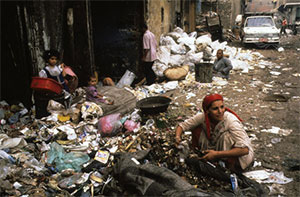 Romani people in Cairo, Egypt, forage through trash. Credit: UN Photo/Armineh Johannes
In 2015, the United Nations adopted the Sustainable Development Goals (SDGs) in an effort to promote “peace and prosperity for people and the planet.” To achieve that goal, it is essential to provide equal opportunities and access to basic services to all people. The 2025 UN SDG Report found that 35% of the 169 SDG targets are on track or making moderate progress, while 18% have reversed compared to the 2025 baseline. One in ten people still live in extreme poverty, one in eleven experience food insecurity, and over 1.1 billion people live in slums without access to clean water and sanitation. It is imperative to acknowledge the societal, technological, economic, and political issues that sustain poverty in countries around the world. Eradicating poverty will require significant frameworks in policy and governance on a national and international scale to ensure that all people will have equal access to basic services and economic opportunities by 2030. Furthermore, a dramatic reduction of United States foreign aid in 2025, including the termination of 83% of USAID programmes, threatens to erode years of fragile development gains.
Throughout the world, violent conflict and natural disasters also contribute to extreme poverty. The complete destruction of infrastructure and blockage of aid has significantly impoverished Palestine since October 7th. The destructive impact of Hurricane Maria in Puerto Rico left $91 billion in damage. An inadequate US government response also revealed significant and enduring questions within the issue of mitigating poverty: how do we rebuild infrastructure after its destruction? How do we restimulate economic development and bring in financial aid after disasters? Similar questions have been raised in the realm of regional cooperation, as devastating floods have wrecked hundreds of thousands of homes across multiple Southeast Asian nations in the past few years. Furthermore, the COVID-19 pandemic has greatly exacerbated the global poverty crisis, particularly in developing countries, setting back the United Nations goal of eradicating poverty by 2030.
IPS is committed to providing comprehensive features that focus on the persisting environmental, sociopolitical, and systemic issues that sustain poverty, and the steps taken worldwide towards poverty eradication.

The Week with IPS

NEXT STOP - SDGs
Tracking global progress towards a sustainable world
Tracking global progress towards a sustainable world

