Languages
Sunday, October 18, 2026



News and Views from the Global South
Green Economy

How to ‘Fix the Business of Food’ and Save the Planet
With up to one billion undernourished people around the world, and agriculture and land use systems increasingly vulnerable to climate change and land degradation, more companies within the global food industry need to start aligning their operations with the United Nations Sustainable Development Goals or SDGs.
Africa’s Industrial Development: Turning Challenges into Opportunities
When world leaders gathered in New York for the 70th session of the General Assembly back in 2016, and proclaimed the period 2016-2025 as the Third Industrial Development Decade for Africa (IDDA III), it reaffirmed the importance of industrialization in supporting Africa’s own efforts towards sustained, inclusive and sustainable economic growth and accelerated development.
In Southern Brazil, Need Becomes an Environmental Virtue
The state of Santa Catarina in southern Brazil is the largest national producer and exporter of pork and this year it also leads in exports of chicken, of which it is the second-biggest producer in the country.
Confronting the New Climate Reality in Asia and the Pacific
In less than ten days world leaders will be gathering at the United Nations in New York for the Climate Action Summit. Their goal is simple; to increase ambition and accelerate action in the face of a mounting climate emergency. For many this means ambition and action that enables countries to decarbonize their economies by the middle of the century. But that is only half the equation. Equally ambitious plans are also needed to build the resilience of vulnerable sectors and communities being battered by climate related disasters of increasing frequency, intensity and unpredictability.
Biogas Makes Pig Farming More Sustainable in Southern Brazil
 Biogas has the potential to provide 36 percent of the electricity consumed in Brazil or replace 70 percent of diesel if purified as biomethane, according to the Brazilian Association of Biogas and Biomethane (Abiogas).
Key Changes in International Agriculture and Rural Development Issues: Three Priority Areas in the Context of the 2030 Development Agenda
Transformations in international agricultural and rural development issues Some major changes in international agricultural and rural development over the last 30-40 years need to be taken into account in efforts to promote sustainable development and an inclusive rural transformation (IFAD 2016) as we approach the third decade of the millennium. This opinion piece, drawing on a longer article published in Agriculture for Development Journal (Summer 2019 Issue), seeks to stimulate reflection and debate on how work to support agricultural and rural development can evolve to address key challenges and opportunities related to migration, sustainable urbanization and youth in a changing global policy context.
Let’s Get Climate Action into Traction with Gender Equality
Climate change is already altering the face of our planet. Research shows that we need to put all our efforts over the coming decade to limit warming to 1.5°C and mitigate the catastrophic risks posed by increased droughts, floods, and extreme weather events.
Dumping Fossil Fuels to Drive Green Development
Disinvestments in fossil fuels amounting to 11 trillion dollars – eight times the global GDP – have been recorded in the last six months of this year, according to a new report.
Civil Society Urges Inclusive, Resilient & Sustainable Urban Areas of the Future
The United Nations held its first major international conference in one of America’s mountain states, bringing scores of civil society organizations (CSOs) to discuss ways on making “cities and human settlements inclusive, safe, resilient and sustainable by 2030.”
Eastern Caribbean Embarks on Strategy Towards a Blue-Green Economy
 Micro, small and medium enterprises as well as niche markets and experiences such as bee tourism may well hold the key for the Organisation of Eastern Caribbean States as countries of that sub-region, known as the OECS, ramp up efforts to build economies that are resilient to the impacts of climate change.
How the African Development Bank Plans to Mobilise Funds for Climate Adaptation
IPS Correspondent Isaiah Esipisu reports from the Climate Change and Development in Africa Conference taking place at the African Union headquarters in Addis Ababa, Ethiopia. 
Pushing For a Green Economy & Clean Energy
Africa is grappling with myriad environmental and climate challenges, from drought to loss of biodiversity, cyclones and plastics pollution.
What Would It Really Take to Plant a Trillion Trees?
Tree planting is capturing the minds of those who look for fast climate action. Earlier this month, the Ethiopian Government announced a new world record: thousands of volunteers planted 353 million trees in one single day. This came shortly after a team of scientists identified suitable places in the world where up to 1 trillion new trees could be planted. Such a massive effort could absorb about 20 years’ worth of global greenhouse gas emissions. And on 8 August 2019, the Intergovernmental Panel on Climate Change launched a Special Report on the importance of land use for the climate. About 23 per cent of all emissions come from the agriculture, land use and forest sector. The Intergovernmental Panel on Climate Change outlines land management opportunities with benefits for food security, biodiversity, and the climate, such as agroforestry.
Producing Energy from Pig and Poultry Waste in Brazil
Romário Schaefer is fattening up 3,300 pigs that he receives when they weigh around 22 kg and returns when they reach 130 to 160 kg - a huge increase in meat and profits for their owner, a local meat-processing plant in this city in Brazil.
Burning Forests for Rain, and Other Climate Catastrophes
The villagers living on the foothills of Mount Kenya have a belief: If they burn the forest, the rains will come.
What a Little Pigeon Could Teach Our World
Over 100 years ago a little brown passenger pigeon named Martha died in the Cincinnati Zoo. She was the last of her breed. Just like that, in an instant, a bird species that had once numbered in the billions was wiped out forever.
Producing Clean Energy from Pigsties in Brazil
Pigs, already the main source of income in this small municipality in southwestern Brazil, now have even more value as a source of electricity.
A Call for Healthy, Blue Oceans in Asia and the Pacific
Leaders at the Group of 20 summit last month agreed on the “Osaka Blue Ocean Vision,” which aims to reduce additional pollution by marine plastic litter to zero by 2050. The UN Economic and Social Commission for Asia and the Pacific (ESCAP) stands ready to support Japan and other countries in the region to ensure healthy and sustainable oceans.
Using Renewable Energy and the Circular Economy to Fight Poverty in Argentina
On the outer edges of Buenos Aires proper, where the paved streets end and the narrow alleyways of one of Argentina’s largest shantytowns begin, visitors can find the En Haccore soup kitchen.
Rwanda Prepares the Foundations for Climate-Resilient Cities
How do you plan a resilient city? A city that can withstand climate change impacts, and the natural disasters that it produces at increased frequencies. And how do you protect the city, its individuals and communities, its business and institutions from either the increased flooding or prolonged droughts that result? It’s a complex question with an even more complex solution, but one that the central African nation of Rwanda is looking to answer.
Indigenous Communities Head Towards Energy Self-Sufficiency in Guatemala
Because the government has never provided them with electricity, indigenous communities in the mountains of northwest Guatemala had no choice but to generate their own energy. « Previous Page — Next Page »





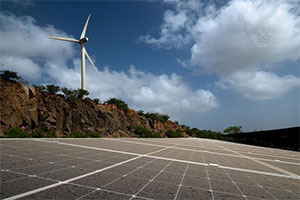 Renewable Energy in Cabo Verde. Credit: UN Photo/Mark Garten
A green economy is an economic model that aims to reduce environmental risks and build a sustainable future. Many of the UN SDGs seek to facilitate a green economy, such as ensuring access to affordable and reliable clean energy, building sustainable cities and communities, and implementing urgent action to combat climate change. Various key negotiations have strived to achieve a green economy, such as the Green New Deal and the Inflation Act of 2022. COP30, held in Belém, Brazil in 2025, agreed to mobilize $1.3 trillion annually for climate action and launched the Belém Mission to 1.5°C. However, the conference was not able to develop a fossil fuel reduction roadmap. Recent years have witnessed a sharp transformation in the geopolitical landscape of international sustainability cooperation. In March 2025, the United States stepped back from formal multilateral support for the SDGs, while China is on the rise as an international leader in renewable energy production. The actions of these global powers may shape shifting alliances on environmental governance. IPS is dedicated to sharing timely news on international developments in building a sustainable future.

The Week with IPS

NEXT STOP - SDGs
Tracking global progress towards a sustainable world
Tracking global progress towards a sustainable world
