Languages
Saturday, October 24, 2026



News and Views from the Global South
Green Economy

Saving for a ‘Rainy Day’ Takes on New Meaning in Caribbean
In the tiny eastern Caribbean nation of St. Vincent and the Grenadines, proverbs relating to the weather are very common. Everyone knows that “Who has cocoa outside must look out for rain”, has nothing to do with the drying of the bean from which chocolate is made or the sudden downpours common in this tropical nation.
Doing Business with Nature
As the environment continues to degrade and natural resources deplete at unprecedented rates, spelling disastrous consequences for societies, a new tool aims to bring financial institutions into the fight to protect nature.Bangladesh Needs Intensive Surveys to Gauge Potential of Its ‘Blue Economy’
(UNB/IPS) - Bangladesh needs intensive surveys in the Bay of Bengal, complemented by proper interpretation of the findings and appropriate research to gauge the potential of its ‘blue economy’ as the country largely depends on the stocks of living and non-living marine resources falling within its Exclusive Economic Zone, experts said.
Taking the Lead in Fight Against Climate Change
As the grandchild of Jamaican citizens who moved to Great Britain, Monique Taffe says she inherited a tradition of recycling and learned not to be part of the “throwaway culture”, as some environmentalists have labelled consumerist societies.
Reverse Engineering for SDGs
When young people from small towns and villages seek higher education they have to usually migrate to big cities leaving their local communities behind. On completion of their degree from the Universities, they generally prefer staying in cities, in search of a good job and a successful career. Though this is a standard practice, it is also a case of lost opportunities, especially for students who pursue higher education in agriculture. Here is why.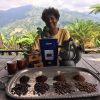
Wake Up and Smell the Organic Coffee
In 1992, the idea of replanting her father’s ruined coffee farm seemed foolhardy at the time. But in retrospect it was the best business decision that Dorienne Rowan-Campbell, an international development consultant and broadcast journalist, could have made.
Agribusiness Is the Problem, Not the Solution
For two centuries, all too many discussions about hunger and resource scarcity has been haunted by the ghost of Parson Thomas Malthus. Malthus warned that rising populations would exhaust resources, especially those needed for food production. Exponential population growth would outstrip food output.
Q&A: Suriname’s President Champions Preserving the World’s Forests
At the Bonn Climate Conference in 2017, Suriname announced its aspirations to maintain its forest coverage at 93 percent of the land area. For Suriname and other High Forest Cover and Low Deforestation (HFLD) nations, maintaining forest coverage is their contribution to saving the planet from the effects of climate change, something they did not cause.
Q&A: We Are Helping the World Mitigate Climate Change, Now it’s Time to Help Us
The Caribbean nation of Suriname may be one of the most forested countries in the world, with some 93 percent of the country’s surface area being covered in forests, but it is also the most threatened as it struggles with the impacts of climate change.
Our Forests Provide the World With Oxygen But We Need More Climate Change Finance – HFLD Countries
Suriname, the most forested country in the world, is this week hosting a major international conference on climate financing for High Forest Cover and Low Deforestation (HFLD) countries.
Farmers Secure Land and Food Thanks to ‘Eyes in the Skies’
Six years ago while wondering how best to use her engineering skills, Tanzanian ICT entrepreneur Rose Funja decided to enter an innovation competition. Years later she has turned a digital idea into a viable business that helps smallholder farmers across the East African nation access credit.
Blue Economy: The New Frontier for Africa’s Growth & How Japan Can Help
1. Why Blue Economy in Africa? What potentials does Africa have? The blue economy in Africa is neglected, ignored or underexploited, but it can offer a range of African solutions to African economic problems. More than one-quarter of Africa’s population lives within 100km of the coast and derive their livelihoods there. According to the International Energy Agency (IEA), by 2020, the annual economic value of energy activities related to maritime affairs will reach EUR 2.5bn.1 Out of the 54 African countries, 34 are coastal countries and over 90% of African exports and imports are transported by sea. The territorial waters under African jurisdiction cover a surface area of 13 million km², with a continental shelf of some 6.5 million km² comprising exclusive economic zones (EEZ). The continent covers 17% of the world’s surface water resources. The strategic dimension of the blue economy is an indisputable reality for African countries. It is for this reason that it has been included in the African Union’s Agenda 2063 and that a practical handbook on the blue economy was prepared by the United Nations Economic Commission for Africa in March 2016.
Q&A: Continuous Struggle for the Caribbean to be Heard in Climate Change Discussions
In recent years Caribbean Community (CARICOM) countries have experienced escalated climate change impacts from hurricanes, tropical storms and other weather-related events thanks to global warming of 1.0 ° Celsius (C) above pre-industrial levels. And it has had adverse effects on particularly vulnerable countries and communities.
Desertification, Land Degradation and Climate Change Go Hand in Hand
The link between desertification, land degradation and climate change is among several issues occupying the attention of the 197 Parties to the United Nations Convention to Combat Desertification (UNCCD) for the next three days.
Moving Beyond South Korea’s Hierarchal Business Structure for Sustainable Green Growth
Despite the international rise of South Korean businesses like Samsung, Hyundai and LG as global powerhouses, the corporate culture in this East Asian nation is often known to have a vertically rigid command line.
Family Farming Wages a Difficult Battle in Argentina
"Our philosophy is based on two principles: zero tolerance of pesticides or bosses," says Leandro Ladrú, while he puts tomatoes and carrots in the ecological bag held by a customer, in a large market in the Argentine capital, located between warehouses and rusty old railroad cars.
Building Mongolia’s Green Future
The landlocked country of Mongolia sparks certain images in the mind—rolling hills with horses against a picturesque backdrop. However, the East Asian country is facing a threat that will change its landscape: climate change.
Q&A: ‘There’s a Lot More Climate Finance Available than People Think’
While growth in the green economy looks promising, government regulation and a business-as-usual approach are among the hurdles inhibiting cleaner energy production.
Local Innovation Facilitates Solidarity-Based Biogas Networks in Cuba
Black plastic pipes, readily available on the mainly empty shelves of Cuba’s shops, distribute biogas to homes in the rural town of La Macuca, buried under the ground or running through the grass and stones in people’s yards.Aborted Fuel Tax Initiative in France: Its Ramifications for Green Growth
Emmanuel Macron was voted to French Presidency in 2017 with the mission of strengthening the integration of the European Union and pursuing economic and ecological reforms. So from the outset, he was set to distinguish himself, not just in Europe but on the world stage, especially after President Trump pulled the United States out of the Paris Agreement. So Macron held the summit meeting on `One Planet’ in Paris last December to push for stronger environment and climate policy. He also spoke of the environment when he addressed the Congress in April 2018, stating that “Let us face it: There is no Planet B.”i
Ghana’s Contribution to Plastic Waste Can Be Reduced with the Right Investment
Twelve-year-old Naa Adjeley lives in Glefe, a waterlogged area that is one of the biggest slums along the west coast of Accra, Ghana. The sixth grade student, his parents and three siblings use 30 single-use plastic bags per day for breakfast.« Previous Page — Next Page »





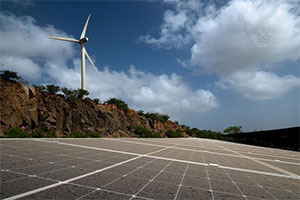 Renewable Energy in Cabo Verde. Credit: UN Photo/Mark Garten
A green economy is an economic model that aims to reduce environmental risks and build a sustainable future. Many of the UN SDGs seek to facilitate a green economy, such as ensuring access to affordable and reliable clean energy, building sustainable cities and communities, and implementing urgent action to combat climate change. Various key negotiations have strived to achieve a green economy, such as the Green New Deal and the Inflation Act of 2022. COP30, held in Belém, Brazil in 2025, agreed to mobilize $1.3 trillion annually for climate action and launched the Belém Mission to 1.5°C. However, the conference was not able to develop a fossil fuel reduction roadmap. Recent years have witnessed a sharp transformation in the geopolitical landscape of international sustainability cooperation. In March 2025, the United States stepped back from formal multilateral support for the SDGs, while China is on the rise as an international leader in renewable energy production. The actions of these global powers may shape shifting alliances on environmental governance. IPS is dedicated to sharing timely news on international developments in building a sustainable future.

The Week with IPS

NEXT STOP - SDGs
Tracking global progress towards a sustainable world
Tracking global progress towards a sustainable world
