Languages
Sunday, October 18, 2026



News and Views from the Global South
Green Economy

Native Communities in Mexico Demand to be Consulted on Wind Farms
“It hurts us that our land is affected, and the environmental impacts are not even measured. Wind farm projects affect streams and hurt the flora,” said Zapotec Indian Isabel Jiménez, who is taking part in the struggle against the installation of a wind park in southern Mexico.
Bahamas Builds Resilience Against a Surging Sea
Small Island Developing States (SIDS) have championed the phrase “1.5 to stay alive” in demanding that global temperature increases be kept as far below 1.5 degrees C as possible to limit the anticipated devastating effects of climate change on the world’s most vulnerable countries.
Caribbean Looks to France as Key Partner in Climate Financing
By the time leaders of the international community sit down in Paris later this year to discuss climate change, at least two Caribbean leaders are hoping that France can demonstrate its commitment to assisting their adaptation efforts by re-joining the Barbados-based Caribbean Development Bank (CDB).
U.N., World Bank Set 2030 Deadline for Sustainable Energy for All
Secretary-General Ban Ki-moon, an unrelenting advocate of sustainable energy for all (SE4All), once dramatised the need for modern conveniences by holding up his cell phone before an audience in the Norwegian capital of Oslo and asking: “What would we do without them?”
Opinion: Edinburgh University Bows to Fossil Fuel Industry
The University of Edinburgh has taken the decision to not divest from fossil fuels, bowing to the short-term economic interests of departments funded by the fossil fuel industry, with little to no acknowledgement of the long-term repercussions of these investments.
Opinion: Clean Energy Access, a Major Sustainable Development Goal
The Sustainable Energy for All (SE4ALL) Forum will take place May 18-21 in New York. Success in achieving sustainable development and tackling climate change challenges requires investment in clean energy solutions.
NGOs Urge Post-2015 Declaration Include Water, Sanitation as Basic Human Rights
Virtually every major international conference concludes with a “programme of action” (PoA) – described in U.N. jargon as “an outcome document” – preceded by a political declaration where 193 member states religiously pledge to honour their commitments.
Opinion: A Development Fairytale or a Global Land Rush?
In our work at Greenpeace and the Oakland Institute around access and control over natural resources, we face constant accusations of being anti-development or “Northern NGOs who care more for the trees”, despite working with communities around the world, from Cameroon, to China, to the Czech Republic.
Caribbean Looks to Paris Climate Summit for Its Very Survival
Caribbean leaders on Saturday further advanced their policy position on climate change ahead of the 21st Conference of Parties, also known as COP 21, scheduled for Paris during November and December of this year.
Opinion: The Bursting of Europe’s Biofuels Bubble
Last week, the European Union reached a momentous decision to finally agree a reform to its disastrous biofuels legislation, signalling Europe’s U-turn on the burning of crops for biofuels.
Opinion: South-South Cooperation Vital for Sustainable Development
Sustainable development is central to a range of key discussions at the United Nations and elsewhere at the moment.
Unifying Transmission from North to South Means Cheaper Energy in Chile
Chile expects to have a more efficient and stable electricity market, with a more steady - and above all, less expensive – supply, when the country’s two major power grids are interconnected over a distance of more than 3,000 km.
Costa Rica’s Energy Nearly 100 Percent Clean
Costa Rica has almost reached its goal of an energy mix based solely on renewable sources, harnessing solar, wind and geothermal power, as well as the energy of the country’s rivers.
Watch What Happens When Tribal Women Manage India’s Forests
Kama Pradhan, a 35-year-old tribal woman, her eyes intent on the glowing screen of a hand-held GPS device, moves quickly between the trees. Ahead of her, a group of men hastens to clear away the brambles from stone pillars that stand at scattered intervals throughout this dense forest in the Nayagarh district of India’s eastern Odisha state.
Caribbean Stakes Out “Red Lines” for Paris Climate Talks
When the international climate change talks ended in Peru last December, the 15-member Caribbean Community (CARICOM), a political and economic union comprising small, developing, climate-vulnerable islands and low-lying nations, left with “the bare minimum necessary to continue the process to address climate change”.
Expo 2015 Host City Promotes Urban Food Policy Pact
How can we provide healthy food for everyone, without threatening the survival of our planet? This is the fundamental issue at the centre of Expo 2015 – which has ‘Feeding the Planet, Energy for Life’ as its central theme – and a huge challenge for cities.
Riches in World’s Oceans Estimated at Staggering 24 Trillion Dollars
The untapped riches in the world’s oceans are estimated at nearly 24 trillion dollars – the size of the world’s leading economies, according to a new report released Thursday by the World Wide Fund for Nature (WWF).
Water Politics Polarised in Mexico
Laura Romero has piped water in her home for only a few hours a day, and at least once a week she is cut off completely. Like the rest of the residents in her neighbourhood in the north of the Mexican capital, she has to store water in containers like drums or jerrycans.
Shift to Renewables Seems Inevitable, But Is It Fast Enough?
Climate change may be one of the most divisive issues in the U.S. Congress today, but despite the staunch denialism of Republicans, experts say the global transition from fossil fuels to renewables is already well underway.
Clean Cookstoves Could Change the Lives of Millions in Nepal
 When 26-year-old Laxmi married into the Archaya household in Chhaimale village, Pharping, south of Nepal’s capital Kathmandu, she didn’t think she would be spending half the day in the kitchen inhaling smoke from the stove.

Women Farmers Rewrite Their History in Chile’s Patagonia Region
More than 100 women small farmers from Chile’s southern Patagonia region have joined together in a new association aimed at achieving economic autonomy and empowerment, in an area where machismo and gender inequality are the norm.« Previous Page — Next Page »





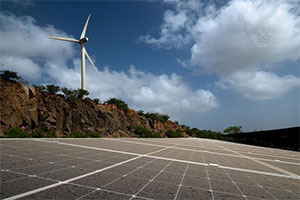 Renewable Energy in Cabo Verde. Credit: UN Photo/Mark Garten
A green economy is an economic model that aims to reduce environmental risks and build a sustainable future. Many of the UN SDGs seek to facilitate a green economy, such as ensuring access to affordable and reliable clean energy, building sustainable cities and communities, and implementing urgent action to combat climate change. Various key negotiations have strived to achieve a green economy, such as the Green New Deal and the Inflation Act of 2022. COP30, held in Belém, Brazil in 2025, agreed to mobilize $1.3 trillion annually for climate action and launched the Belém Mission to 1.5°C. However, the conference was not able to develop a fossil fuel reduction roadmap. Recent years have witnessed a sharp transformation in the geopolitical landscape of international sustainability cooperation. In March 2025, the United States stepped back from formal multilateral support for the SDGs, while China is on the rise as an international leader in renewable energy production. The actions of these global powers may shape shifting alliances on environmental governance. IPS is dedicated to sharing timely news on international developments in building a sustainable future.

The Week with IPS

NEXT STOP - SDGs
Tracking global progress towards a sustainable world
Tracking global progress towards a sustainable world
