Languages
Monday, October 19, 2026



News and Views from the Global South
Green Economy

Antigua Draws a Line in the Vanishing Sand
Jabberwock beach, located on the northeastern coast of Antigua, features a mile-long white sand beach and is a favourite with locals and visitors alike.
Nepal: A Trailblazer in Biodiversity Conservation
At dusk, when the early evening sun casts its rays over the lush landscape, the Chitwan National Park, a UNESCO World Heritage Site about 200 km south of Nepal’s capital, Kathmandu, is a place of the utmost tranquility.
In Belize, Climate Change Drives Coastal Management
A five-year project launched here in Belize City in March seeks to cement a shift in view of climate change and its impact on Belize’s national development.
Recycling Revives Art of Glass-Blowing in Lebanon
In the Khalife workshop, in the southern coastal village of Sarafand, four men stand beside an oven, fixed in concentration despite the oppressive temperature. Blowing through a long tube, one of the group carefully shapes white-hot melted glass into a small ball, while two others coax it into the form of a beer glass. The fourth, the veteran of the group, cuts off the top of the glass, creating an opening from which beer will one day flow.U.N. Water Report Not “Doom And Gloom”, Says Author
The lead author of a United Nations water report has spoken out about media depictions of his findings, denying the report lays out a “doom and gloom” scenario.
Opinion: A Major Push Forward for Gender and Environment
Experts from around the world gathered in New York recently to launch work on the Global Gender Environment Outlook (GGEO), the first comprehensive, integrated and global assessment of gender issues in relation to the environment and sustainability.Turkey Investing in Coal Despite Cheaper Renewable Energy
In response to rising demand for electricity, pressure to keep prices affordable and a need to maintain energy security, the Turkish government plans to increase electricity generation from coal.
Q&A: “Protect Your Biodiversity”
Richard Huber is chief of the Sustainable Communities, Hazard Risk, and Climate Change Section of the Department of Sustainable Development of the Organisation of American States (OAS). Its objective? Foster resilient, more sustainable cities – reducing, for example, consumption of water and energy – while simultaneously improving the quality of life and the participation of the community.
Pacific Islanders Say Climate Finance “Essential” for Paris Agreement
As Pacific Islanders contemplate the scale of devastation wrought by Cyclone Pam this month across four Pacific Island states, including Vanuatu, leaders in the region are calling with renewed urgency for global action on climate finance, which they say is vital for building climate resilience and arresting development losses.
Hold the Rich Accountable in New U.N. Development Goals, Say NGOs
When the World Economic Forum (WEF) met last January in Switzerland, attended mostly by the rich and the super-rich, the London-based charity Oxfam unveiled a report with an alarming statistic: if current trends continue, the world’s richest one percent would own more than 50 percent of the world’s wealth by 2016.
High-Tech to the Rescue of Southern Africa’s Smallholder Farmers
Agriculture is the major employer and a backbone of the economies of Southern Africa.‘Water Man of India’ Wins Stockholm Water Prize
A conservationist known as ‘The Water Man of India’ has been named Stockholm Water Prize Laureate for 2015.

Opinion: Sustainable Development Goals Could Be a Game-Changer for Water
Suppose money was being deposited and withdrawn from your bank account, but you didn’t know how much. And suppose you knew you had bills coming due, but you didn’t know when or what amount would be required to cover them.
Women in the Philippines at the Forefront of the Health Food Movement
When Tinay Alterado’s team from ARUGAAN, an organisation of women healthcare advocates, visited Eastern Visayas, a region of the Philippines devastated by Typhoon Haiyan in November 2013, they noticed that the relief and rescue sites were flooded with donated milk formula, which nursing mothers were feeding to their babies in vast quantities.
In Thrall to the Mall Crawl and Urban Sprawl
There's little argument about the basic facts: It's ugly (think strip malls and big box stores). It's not very convenient (hours spent behind the wheel to get to work). And it wreaks havoc on the natural environment (lost farmland and compromised watersheds).
Women Turn Drought into a Lesson on Sustainability
When a group of women in the remote village of Sadhuraks in Pakistan’s Thar Desert, some 800 km from the port city of Karachi, were asked if they would want to be born a woman in their next life, the answer from each was a resounding ‘no’.
Caribbean Community Climate-Smarting Fisheries, But Slowly
Caribbean nations have begun work on a plan to ‘climate smart’ the region's fisheries as part of overall efforts to secure food supplies.
Indonesia’s Palm Oil Industry in Need of a Makeover
Over the past three decades, 50 percent of the 544,150 square kilometres that comprise Kalimantan, the Indonesian portion of the island of Borneo, has been taken over by the palm oil industry.
Feeding a Warmer, Riskier World
Artificial meat. Indoor aquaculture. Vertical farms. Irrigation drones. Once the realm of science fiction, these things are now fact. Food production is going high tech – at least, in some places.
Coal: Burning Up Australia’s Future
With less than a year to go before the United Nation’s annual climate change meeting scheduled to take place in Paris in November 2015, citizens and civil society groups are pushing their elected leaders to take stock of national commitments to lower carbon emissions in a bid to cap runaway global warming.
Renewable Energies in Latin America Weather Low Oil Prices
Traditionally, falling oil prices have discouraged development of renewable energy sources, but clean energy is making steady progress in Latin America, according to regional experts.« Previous Page — Next Page »





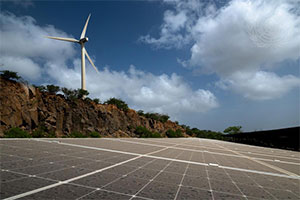 Renewable Energy in Cabo Verde. Credit: UN Photo/Mark Garten
A green economy is an economic model that aims to reduce environmental risks and build a sustainable future. Many of the UN SDGs seek to facilitate a green economy, such as ensuring access to affordable and reliable clean energy, building sustainable cities and communities, and implementing urgent action to combat climate change. Various key negotiations have strived to achieve a green economy, such as the Green New Deal and the Inflation Act of 2022. COP30, held in Belém, Brazil in 2025, agreed to mobilize $1.3 trillion annually for climate action and launched the Belém Mission to 1.5°C. However, the conference was not able to develop a fossil fuel reduction roadmap. Recent years have witnessed a sharp transformation in the geopolitical landscape of international sustainability cooperation. In March 2025, the United States stepped back from formal multilateral support for the SDGs, while China is on the rise as an international leader in renewable energy production. The actions of these global powers may shape shifting alliances on environmental governance. IPS is dedicated to sharing timely news on international developments in building a sustainable future.

The Week with IPS

NEXT STOP - SDGs
Tracking global progress towards a sustainable world
Tracking global progress towards a sustainable world
