Languages
Saturday, November 14, 2026



News and Views from the Global South
Labour
ARGENTINA: Football Referee School Offers Way Out of Poverty
A new school to train football referees to work amateur-level tournaments in Argentina aims at providing skills and a legitimate source of income for young people from poor homes.
RWANDA: Women Win by Formalising Businesses
The vast majority of businesses in Rwanda - like elsewhere in Africa - are informal. Government expects that a drive to register an estimated 900,000 informal enterprises will both strengthen these businesses and improve tax revenues.
Argentine Hake On the Brink of Collapse
The Argentine hake fisheries of the southern Atlantic Ocean, among the world's leaders in the white fish market, are on the verge of collapse due in part to the indifference of the Argentine people, who are apparently more interested in beef, a staple of their diet.INDIA: 25 Years On, Bhopal Tragedy Victims Still Crying for Justice
Twenty-five years after an industrial gas leak from the factory of a U.S. multinational firm in this ancient Indian city killed thousands and impaired nearly half a million, victims are still crying for justice.BAHRAIN: Passport Confiscation Still Hounds Migrant Workers
When Abdulkhaliq Mohammed arrived in Bahrain as a contract labourer 20 years ago, the first thing he did on setting foot in the oil-rich Gulf state was to hand his passport over to his employer.
Q&A: “Bluewashing Has Become a Very Risky Business”
The Global Compact (GC), which celebrates its 10th anniversary with a summit meeting later this month, has been described as a key initiative of the United Nations to prod private companies and blue-chip corporations to pro-actively address environmental, social and governance (ESG) issues relating to the workplace.
Windfall for Botswana Farmers
Two of Botswana's biggest breweries are putting smiles on the faces of farmers. No, they are not giving beer away: the breweries are planning to buy sorghum from small-scale farmers at prices far higher than the Botswana Agricultural Marketing Board (BAMB) is offering.INDONESIA: Natural Fertiliser from Microbes Boosts Crop Yields
Ten years after an Indonesian agriculturist discovered microbes capable of producing natural fertilisers, farmers attest that they have boosted agricultural production.
Difficult Times Call for Dangerous Jobs
Life can be hard working in these tunnels, and it is always at risk. But many have no choice but to work in them, particularly since mid-2007, when Israel and Egypt, with the help of the international community, imposed a siege of staggering severity on the 1.5 million humans in the Gaza Strip.Millennium Goals Need Development, Not Charity
The Millennium Development Goals (MDGs) came into existence in the right place, the United Nations, but at a most unpropitious time, in September 2000, when ideas about the invincibility of market forces still held sway in the world.
MEXICO: Women Electrical Workers at Centre of Struggle for Jobs
"Our male coworkers have had to acknowledge it: we have worked side by side in this struggle," says Emilia Peña, describing the role of women in driving forward the battle waged by thousands of workers to reopen a state power company in Mexico.SRI LANKA: Garment Sector, Gov’t Optimistic about Trade Pact with EU
Relations between Sri Lanka and European Union (EU), which turned frosty around six months back, appear to be thawing as the government makes a last ditch stand to regain a crucial trade concession that has been suspended over human rights issues hounding the south Asian island state.SRI LANKA: War-Affected Women Bewail Their Plight
Rajini Padamaraj, 32, is burdened with the responsibility of looking after the needs of her entire household, composed of her mother and two younger siblings.Thai, Argentine Textile Workers Unite Against Slave Labour
Textile cooperatives founded by former slave labourers from Argentina and Thailand will jointly launch a new brand of clothing in June to raise awareness about exploitation and promote decent jobs in the garment industry.URUGUAY: Job Training Moves “Trans” Off Streets to Better Future
Ruler in hand, Fabiana draws lines with a pencil on orange cardboard, occasionally pushing her curly hair away from her eyes. Next to her, Fernanda fashions a colourful cardboard box, a prototype for what their cooperative will ultimately produce in large quantities.MALAYSIA: Encroaching Forest, Oil Palm Plantations Alarm Villagers
A increasing number of natives in Sarawak state in north Borneo are alarmed at encroaching forest and oil palm plantations, which are taking over their native customary land and destroying their traditional lifestyles and biodiversity.
RIGHTS-PAKISTAN: Green Initiative Gives Hope to the Disabled
Talib Hussain, 29, became the sole breadwinner of his family of seven after his father suffered a stroke that left him half paralysed. Hussain brings home 4,000 Pakistani rupees (about 47 U.S. dollars) monthly, which he dutifully turns over to his mother.AFRICA: Better Data Key to Supporting Women Farmers
An accomplished farmer who won the coveted Woman Farmer of the Year Award in 2008, Thabile Dlamini-Gooday wants to uplift the standard of other women in agriculture. She believes that if women farmers were to work together they could fight hunger and significantly reduce poverty among themselves.
ENERGY: The Sun Lights Up the Night in Haiti
There are shortages of lots of things in Haiti: clean water, arable land, trees, living-wage jobs, housing, schools, fuel, reliable sources of electricity and Internet access. But one thing Haiti has in abundance is sunny days.INDIA: One Woman’s Entrepreneurial Venture Now Employs Thousands
Shameema Wani, 40, never imagined a simple venture, begun from scratch, would grow into the 2,000-strong business enterprise, employing mainly women, that it is today in this capital city of India’s disputed Jammu and Kashmir state.
Decent Work Still a Dream for South Africa’s Domestic Workers
The abuse of domestic workers, the majority of whom are women, is still widespread in South Africa despite calls for the government to intensify the implementation of the domestic workers law.« Previous Page — Next Page »


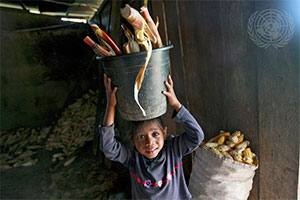 Timorese Girl with Fresh-Picked Corn. Credit: UN Photo/Martine Perret
A global common denominator is the need for a decent job. The economic realities of each country determine just how difficult it is to find one. Despite the labour movement's achievements, serious challenges persist: gender discrimination, child labour, worker migration, the digital divide and AI automation, evaporating pensions, unsafe workplaces, corporate pressure against union organising, negative impacts of trade agreements, and the precariousness of informal employment. The 2025 UN SDG Report identifies jobs and social protections as one of the six priority areas requiring urgent action, with progress either stalled or reversing in many developing nations.
In recent years, the fight to protect labour equality has taken on new dimensions with the rise of Environmental, Social and Governance standards. With the Social aspect aiming to promote equality and human rights, ESG principles have strengthened labour advocacy within corporate and governmental regulatory landscapes. In particular, ESG has become much more institutionalized in emerging economies such as Brazil and China. IPS follows the world’s workers as they confront these challenges - their setbacks and their successes.

The Week with IPS

NEXT STOP - SDGs
Tracking global progress towards a sustainable world
Tracking global progress towards a sustainable world
