Languages
Tuesday, October 13, 2026



News and Views from the Global South
Labour

The Idiocy of Things Requires an “Information Habeas Corpus”!
Today we are saturated with media hype about the joys of information and communication technology (ICT). We will all be connected, all the time, by the Idiocy of Things (IoT )devices and our social media, all converging in the cloud. Our lives will be monitored by smart sensors in homes with smart refrigerators, toasters, TVs, doorbells, alarm systems, garages, cars and electricity meters. We are bombarded with ads showing us how all these smart devices will improve our lives and health, bringing ever greater convenience. Driverless cars will be safer, allowing us to read, monitor our kids or enjoy the scenery. All this ICT and automation is already a multi-billion dollar industry and its producers are salivating over its growth and profits. Individual privacy rights and security concerns seem to be an afterthought.
A Jarring Anomaly of Society
It is easy to miss stories about child domestic workers being tortured and killed. Easy because stories of children being killed have become eerily regular. It is May 28 and there is the report of 14-year-old Konika Rani being hacked to death by a drug addict with three of her classmates also grievously injured by him. There is also the horror of having to read about a six-year-old being left critically wounded after being raped by her neighbour. Next to this is the news of 11-year-old Hasina Akhter dying in hospital from the fatal wounds inflicted on her, presumably by her employers.The Price of Non-Governmental Growth
It is well known that since the 1980s, Bangladesh has made astonishing progress on a wide variety of development indicators such as reducing the prevalence of extreme hunger and poverty, increasing primary education enrolment rates, and reducing child and maternal mortality. This progress has been mirrored by an impressive record of sustained GDP growth, spanning decades. In contrast to these successes, the quality of our democratic institutions has languished to the point where they now threaten to undermine all these hard-won gains. This article argues that the provision of public goods and services by non-governmental organisations (NGOs) has not only contributed to these successes, but also to this failure.
Latest Population Projection of 25 Million Poses Serious Challenges
The most recent population projections expect the Island’s population to reach 25 million by 2042 and 25.8 million by 2062. It is expected to stabilise around the mid 2060s at 25-26 million. This is a significant departure from earlier projections that expected population stability much earlier at around 23-24 million in the 2030s and to decline thereafter.
New International Accord to Tackle Illegal Fishing
A new international accord to tackle illegal and under-reported fishing will come into force on June 5.
Traditional Mexican Recipes Fight the Good Fight
In a clay pot, Araceli Márquez mixes tiny Mexican freshwater fish known as charales with herbs and a sauce made of chili peppers, green tomatoes and prickly pear cactus fruit, preparing a dish called mixmole.
Prickly Pears Drive Local Development in Northern Argentina
Family farmers in the northern Argentine province of Chaco are gaining a new appreciation of the common prickly pear cactus, which is now driving a new kind of local development.
Bangladesh’s Urban Slums Swell with Climate Migrants
Abdul Aziz, 35, arrived in the capital Dhaka in 2006 after losing all his belongings to the mighty Meghna River. Once, he and his family had lived happily in the village of Dokkhin Rajapur in Bhola, a coastal district of Bangladesh. Aziz had a beautiful house and large amount of arable land.
Refugees Bring Economic Benefits to Cities
Refugees are now more likely to live in cities than in refugee camps, bringing with them planning challenges but also opportunities for economic growth.
Bees and Silkworms Spin Gold for Ethiopia’s Rural Youth
Beekeeping and silkworm farming have long been critical cogs of Ethiopian life, providing food, jobs and much needed income.
Deadly Algal Bloom Triggers Social Uprising in Southern Chile
A ban on harvesting shellfish in Chiloé due to a severe red tide outbreak sparked a social uprising that has partially isolated thousands of local residents of the southern Chilean archipelago and revived criticism of an export model that condemns small-scale fishing communities to poverty and marginalisation.
Climate Change Leaves Kashmir’s Economy High and Dry
Trudging barefoot on his two-acre piece of land, 57-year-old Mukhtar Ahmad has little hope of growing any crops this year due to the sudden dry spell that has struck Kashmir’s winter.
WFO Calls for Farmer-Centred Sustainable Development
Over 600 delegates representing at least 570 million farms scattered around the world gathered in Zambia from May 4-7 under the umbrella of the World Farmers' Organisation (WFO) to discuss climate change, land tenure, innovations and capacity building as four pillars on which to build agricultural development.May Day Hijacked by Politicians
Workers of the world – or at least in Sri Lanka – ‘Divide’. The rallying call of the International Workers, from the barricades as they romantically say, for workers of the world to ‘Unite’ is now a thing of the past. The interests of the working class have been submerged by the interests of the political class.
Farmers Can Weather Climate Change – With Financing
Merian Kalala, a farmer in Solwezi, capital of the North-Western Province of Zambia, knows firsthand that climate change is posing massive problems for agricultural productivity.
Farmers Hold Keys to Ending Poverty, Hunger, FAO Says
With recent data showing that 793 million people still go to bed hungry, ending hunger and poverty in 15 years is the next development challenge that world leaders have set for themselves.
Seeking a New Farming Revolution
As the World Farmers' Organization meets for its annual conference in Zambia to promote policies that strengthen this critical sector, IPS looks at how farmers across the globe are tackling the interconnected challenges of climate change, market fluctuations, water and land management, and energy access.
In sight but out of mind
This year Bangladesh exceeded all expectations, achieving a GDP rate of over 7 percent. With higher growth, the issue of labour rights is also gaining prominence in our national discourse, with more and more emphasis being given on workplace safety and wellbeing. Those amongst us who are educated are becoming more and more aware of our rights in our workplace, as we unhesitatingly demand for better pay, better facilities, a better life, really. And why shouldn't we? This is our right as promised by our Constitution and by our state. But there still remains a large portion of our workforce, over 80 percent to be precise, who are not warranted recognition by any of our state apparatuses. When we talk proudly of progress and development, we tend to take for granted that only those who fall under a formalised structure deserve acknowledgement and thereby can demand their rights under the law. We choose to ignore more than half of Bangladesh's population who, despite their indispensible contribution, are regarded as expendable, replaceable, and thus, undeserving of formal rights or protection.
When Only Men Make the News
On the onset, it seems women are everywhere in the media. You switch on the TV, there is inevitably an attractive woman luring you into buying a product. On the radio, there is the 'young new thing' vivaciously flirting with her male co-host while shuffling through songs; and in print, the entertainment pages would simply not sell without a titillating image of a female celebrity and a scoop on her latest rendezvous. But take a closer look, beyond the objectified and stereotypical images of women, being manufactured and mass consumed ad nauseam, and where are the women, really? Take a look at the news media, for instance. Where are the women in the newsrooms, in the bylines on the front and back pages, in the column spaces of our opinion pages, in the talk shows, not simply as hosts, but as commentators on so-called hard issues such as politics and foreign affairs? Where are the women in our news (discounting the PM and her alter-ego), except as wailing victims of violence, natural disasters and such and as muses of our male photographers during cultural festivals?
Maquilas Help Drive Industrialisation in Paraguay
“There were cases of people who stopped coming to work after receiving their first wages and then came back a few days later to ask if there was more work,” because they were used to casual work in the informal economy, said Ivonne Ginard.
Not So Smart Idea
As Bhubaneswar experiences scorching heat of 43.2 degrees Celsius in early April, 5 degrees above normal, 44-year-old Prasanti Behera barely sleeps at night. Two summers ago, a fire charred 50 homes in her slum and burnt in seconds US$600 she had painstakingly saved over two years for her daughter’s marriage.« Previous Page — Next Page »





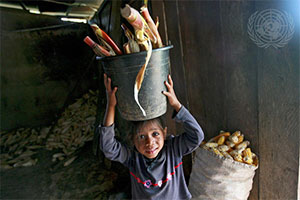 Timorese Girl with Fresh-Picked Corn. Credit: UN Photo/Martine Perret
A global common denominator is the need for a decent job. The economic realities of each country determine just how difficult it is to find one. Despite the labour movement's achievements, serious challenges persist: gender discrimination, child labour, worker migration, the digital divide and AI automation, evaporating pensions, unsafe workplaces, corporate pressure against union organising, negative impacts of trade agreements, and the precariousness of informal employment. The 2025 UN SDG Report identifies jobs and social protections as one of the six priority areas requiring urgent action, with progress either stalled or reversing in many developing nations.
In recent years, the fight to protect labour equality has taken on new dimensions with the rise of Environmental, Social and Governance standards. With the Social aspect aiming to promote equality and human rights, ESG principles have strengthened labour advocacy within corporate and governmental regulatory landscapes. In particular, ESG has become much more institutionalized in emerging economies such as Brazil and China. IPS follows the world’s workers as they confront these challenges - their setbacks and their successes.

The Week with IPS

NEXT STOP - SDGs
Tracking global progress towards a sustainable world
Tracking global progress towards a sustainable world
