Languages
Tuesday, October 27, 2026



News and Views from the Global South
Natural Resources

Conservation Efforts by Ethnic Communities in Bangladesh Bolster Water Security
Just a few years ago, Sudarshana Chakma (35), a resident of the remote Digholchari Debarmatha village under Bilaichari upazila in the Rangamati Hill District, had to traverse a long hilly path to fetch water for her household because there were no local water sources. "Unchecked deforestation and degradation of village common forests (VCFs) led to the drying up of all-natural water sources in our village. We struggled to collect drinking and household water," Chakma explained to IPS.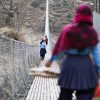
New Report Examines Progress on Global Sustainable Development Goals
At the half-way point of the 2030 Agenda, the Sustainable Development Goals (SDGs) “are in deep trouble.” The need to accelerate progress towards the Sustainable Development Goals has never been more urgent as only approximately 12% of targets are currently on track. “Planet” is equally at risk as “people”.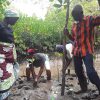
Coastal Indigenous and Minority Women Driving Kenya’s Blue Forest Conservation Efforts
Tsunza Peninsula is a natural wonder that sits just inside the many inlets of Mombasa Island on the border between Mombasa and Kwale Counties—a little-known spectacle of lagoons, islands, and thick mangroves in Kinango Sub-County, Kwale County, on Kenya’s coastal region.
Snowless Winter and a Climate Crisis: Kashmir’s ‘Unprecedented’ Weather
Abdul Gani Malik, a 75-year-old goldsmith living in Kashmir’s capital, Srinagar, has witnessed eras of tranquility and turbulence in the Himalayan region. What he has not seen, however, is a snowless Kashmir during the winter.
Inequality Also Afflicts Clean Energy in Latin America
The specter of blackouts hovers over the Mexican city of La Paz, the capital of the state of Baja California Sur in Mexico's far northwestern corner, as summer approaches, due to increased electricity demand from air conditioning and insufficient capacity in the local grid.
State of the World’s Migratory Species Report ‘Alarming’ Threats, Global Action Urged
A groundbreaking State of the World’s Migratory Species report is calling for accelerated global conservation measures to counter the threat of extinction faced by 1 in 5 of all migratory species.
Blinken’s Visit to Africa: Is US Counterterrorism Counterproductive?
US Secretary of State Antony Blinken’s week-long tour across four African countries was aimed at strengthening the US-Africa relationship—a relationship, according to some commentators, already waning as China and Russia are increasing their influence.
Illegal Artisanal Mining Threatens Amazon Jungle and Indigenous Peoples in Brazil
Artisanal mining, or "garimpo" as it is known in Brazil, has returned to the headlines as a factor in the deaths of Yanomami indigenous people, whose territory in the extreme north of Brazil suffers constant encroachment by miners, which has intensified in recent years.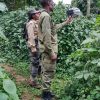
Rwanda’s Biodiversity Conservation Gains Momentum With Bird Sounds Recording
Claver Ntoyinkima wakes up early in the morning, at least three times a week, and goes into the Nyungwe rainforest to record bird vocalizations. Ntoyinkima is one of several community members in a remote village in rural southwestern Rwanda who volunteer with a group of scientists to help boost wildlife conservation.
The Ghost of Oil Haunts Mexico’s Lacandona Jungle
The Lacandona jungle in the southern Mexican state of Chiapas is home to 769 species of butterflies, 573 species of trees, 464 species of birds, 114 species of mammals, 119 species of amphibians and reptiles, and several abandoned oil wells.
Charting Out a Sustainable Path for Island, Coastal Communities Facing Climate Crisis
There is an irreparable connection between culture and the seas: loss of land due to rising sea levels and loss of livelihood due to changing fish migration patterns are having a massive impact on coastal communities.
Fashion Forward: Protect Africa from ‘Fagia’ Amid Alarming Global Stocktake
Thousands of bales of cheap, poor-quality secondhand clothing arrive on boats and ships docking on Africa’s extensive 26,000-kilometer-long coastline, dotted with at least 100 ports and harbors. From Nigeria, Zimbabwe, Madagascar, Uganda, and Kenya, Africa’s ecosystems are chocking with cheap, air-polluting, and emissions-producing low-quality clothing as they often contain plastic-based fibers.
COP28: Sowing Seeds of Change in Fertile Hearts and Minds
In the heart of Earth Child Institute's mission to nurture the future stewards of our planet, the story of Eric Hansel unfolds as a testament to the transformative power of educating children on environmental responsibility. Hailing from Pennsylvania, USA, Hansel's journey took a poignant turn when his career as a respiratory therapist plunged him into the harsh realities of a trauma unit, witnessing families losing their children to various diseases. It was during these challenging moments that Hansel resolved to be part of a movement that aimed to instill eco-consciousness in the hearts of the young.
Kashmir’s Apple Industry Faces Dire Threats as Climate Change Takes its Toll
Of Kashmir’s seven million inhabitants, a staggering one million rely directly on apple farming. The region is pivotal in India’s apple and horticulture production, contributing to over 70 percent of the country’s apple supply. This not only provides income to farmers but also sustains a vast network of laborers, traders, and transporters within the fruit economy.
Uganda: When Climate Justice Becomes Climate Justice Denied
On December 4, 2019, landslides in the Bududa region of Uganda killed 20. The landslides occurred after heavy rains, and a Red Cross report estimated that 96 households were affected, with 49 houses destroyed. It displaced many, while others continued to live in high-risk areas that could "slide at any moment."
Climate Change Turns African Rivers into Epicentres of Conflict
Almost all major river basins in Africa have become the epicentres for conflicts over the last 20 years, and agricultural yields on the continent could drop by up to 50 percent in the coming years owing to the drying up of 'traditional' water sources, thanks in part to effects climate change and degradation of the environment, the inaugural edition of the State of Africa's Environment Report 2023 released in Nairobi finds.
WORLD FOOD DAY 2023

Water is essential for life on Earth. It makes up 50% of our human bodies. It covers about 70% of the planet’s surface.

Ecuadorians Vote to Preserve Yasuní National Park, but Implementation Is the Problem
The decision reached by Ecuadorians to put an end to oil production in Yasuní National Park, in a popular referendum in August, was a triumph for civil society and a global milestone in environmental democracy. But when it comes to implementation, the result is less promising.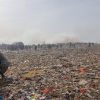
Informal Workers Key to Successful Waste Management in Africa
With the African continent recycling less than 11 percent of its waste, COP28 provided leaders on the African continent to consider integrated waste systems that include informal waste workers.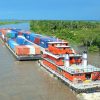
Traffic on the Paraná Waterway Triggers Friction between Argentina and Paraguay
In addition to being a majestic river - the second longest in South America after the Amazon - the Paraná River is the waterway through which a large part of the area's primary goods are exported. Today, its economic importance has sparked an unexpected diplomatic conflict between Argentina and the countries with which it shares the basin.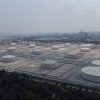
Pemex Exploits Fossil Fuels with Money from International Banks
At the entrance to the municipality of Paraíso, in the southeastern Mexican state of Tabasco, there is a traffic circle that displays three things that are emblematic of the area: crabs, pelicans and mangroves.« Previous Page — Next Page »





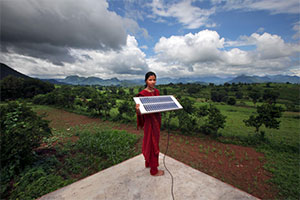 Bringing clean energy to rural India. Credit: Abbie Trayler-Smith / Panos Pictures / Department for International Development
Large reserves of oil, gas and minerals in developing countries generate opulent revenues. They could be used to stimulate economic growth and reduce poverty, but often result in environmental destruction and conflict, benefiting large companies and corrupt governments. Furthermore, competition over natural resources often manifests through geopolitical conflict. For example, before the US-Iraq war, Iraq’s domestic oil industry was nationalized. With US aggression came weakened Iraqi institutions and foreign intervention, thus eventually leading to the privatization of Iraqi oil, leaving the industry now largely dominated by Western companies. As another example, China’s rising investments within the lithium sector in South America are increasing the US-China rivalry across the Western Hemisphere. Notably, Bolivia has the largest reserves of lithium in the world, and the nation’s state-owned lithium extraction firm recently signed a contract with China’s CBC Consortium, while rejecting the entry of Western firms into the nation. In Bolivia’s case, rising Chinese investment in the nation’s lithium sector also raises concerns about environmental sustainability and the sociopolitical rights of Indigenous communities. More broadly, Sub-Saharan Africa holds nearly 30% of global reserves of critical minerals required for low-carbon technologies. Despite this, the region attracts less than 10% of global exploration investment, depicting a critical barrier to both the clean energy transitions and Sub-Saharan Africa’s economic development. Furthermore, resource wealth continues to fuel conflict like Sudan’s civil war, which has led to 9.1 million internally displaced people and is intensely connected to competition over gold, water, and agricultural land. IPS covers news about major oil, gas, and mining projects, their effects on the environment and local communities, and the ideas and actions of the interest groups involved.

The Week with IPS

NEXT STOP - SDGs
Tracking global progress towards a sustainable world
Tracking global progress towards a sustainable world
