Languages
Tuesday, October 27, 2026



News and Views from the Global South
Natural Resources
African Coups and Resource Rights
When the heads of state of all United Nations members spoke in front of the UN General Assembly last week, a number of African leaders were not able to attend, having been removed from office in military-led coups.
Dangerous Scramble for Renewable Energy Resources
The growing and changing material requirements for new technologies have triggered natural resource scrambles for strategic minerals, generating dangerous rivalries fought out in the global South.
Enhancing Mining Revenue
The commodity boom early this century was mainly driven by mineral prices. Yet, mining’s contribution to developing countries’ revenue has been modest, largely due to massive tax evasion and avoidance.
Africa Finds Common Ground on Climate as Nairobi Declaration Unveiled
To cool down a burning planet, Africa’s Head of State and Government at the inaugural Africa Climate Summit unveiled the ‘Nairobi Declaration’ as curtains fell on the inaugural Africa Climate Summit held in Nairobi, September 4-6, 2023, under the theme “Driving Green Growth and Climate Finance Solutions for Africa and the World.”
Invasive Species, Fast-Riding Horsemen Galloping the Biodiversity Apocalypse
Mango farmer Eufria Nyadome used to earn USD 60 from selling a 20-litre bucket of fresh mangoes and now can barely make USD 20 even though her mango trees are giving a good yield. She is throwing away buckets of rotten mangoes.
Biodiversity Credits: Solution or Empty Promise for Latin America?
Located in northwestern Colombia, the Bosque de Niebla is home to 154 species of plants, 120 bird species, 21 species of mammals, 16 water springs and five hectares of wetlands.
Flooding, Water Insecurity Looms as Indian Kashmir’s Titanic Water Bodies Shrink
Sadiq Dar, 68, is surprised how the heavy siltation of Wular Lake has turned many of its areas into land masses. “When we were growing up, we would only see water in this lake. Now, we see cattle grazing in it while a large portion is also being used by children for playing cricket,” he tells IPS.
Mining Revenues Undermined
The primary commodity price boom early this century has often been attributed to a commodity ‘super-cycle’, i.e., a price upsurge greater than what might be expected in ‘normal’ booms. This was largely due to some minerals as most agricultural commodity price increases were more modest.
If Governments Have the Tools to Stop Fishing-Related Deaths, Why Aren’t They Being Used?
Long before Hollywood highlighted the dangers of commercial fishing in The Perfect Storm, Deadliest Catch and other programming, governments around the world knew that this was one of the most hazardous jobs, killing thousands of fishers every year.
Mexico Needs to Step Up Treatment and Reuse of Water to Address Crisis
At the entrance to the coastal city of Ensenada in the northwestern Mexican state of Baja California a sign reads: “Every drop matters to us. Take care of the water." The message is important, as the city faces shortages due to hoarding by agricultural producers and builders, as well as the drought that has become more severe because of the effects of the climate emergency.
Bolivia’s Natural Gas Dreams Are Fading
One of the largest natural gas reservoirs in South America is showing signs of decline and the hopeful expectations that emerged in 2006, to turn Bolivia into a regional energy leader, are waning.
We Need to Talk About Deep Blue Carbon
Almost half of the world’s population lives in coastal zones. For islands in the Pacific and Caribbean islands such as Dominica, where up to 90 percent of the population lives on the coast, the ocean is fundamental to lives and livelihoods. From fisheries to tourism and shipping, this essential body which covers over 70 percent of the planet, is a lifeline.
Governments Are Changing Fisheries Management for the Better, but More Action Is Still Needed
Global fisheries are worth more than US$140 billion each year, according to the Food and Agriculture Organization (FAO) of the United Nations. But this hefty sum does not capture the true value of fish to ocean health, and to the food security and cultures of communities around the world.
Rwanda: Better Mapping of Erosion Risk Areas Needed More Than Ever
Following severe flooding and landslides that hit major parts of Rwanda earlier this month, experts are convinced that investing in the mapping of erosion risk areas could go a long way to keeping the number of casualties down.
Nothing Beats Bushmeat, Not Even the Risk of Disease
Meat from wild animals is relished across Africa and widely traded, but scientists are warning that eating bush meat is a potential health risk, especially in the wake of pandemics like COVID-19.
Biodiversity Rich-Palau Launches Ambitious Marine Spatial Planning Initiative
Growing up in Palau in the western Pacific Ocean, Surangel Whipps Jr. played on the reefs and spearfished on an island teeming with birds, giant clams, fish, and turtles.
UNDP Good Growth Partnership: Getting All on Board to Meet Deforestation Targets (Part 1)
Indonesia finds itself in a delicate balancing act of uplifting people from poverty, managing climate change and biodiversity, and satisfying an increasingly demanding international market for sustainable farming practices—and at the pivot of this complexity is the management of its palm oil sector.
A Plan for the Gulf States to Power a Low-Emissions Revolution
This year’s United Nations Climate Change Conference, COP 28, will be hosted by the United Arab Emirates, which, together with its Gulf neighbors, enjoys abundant solar, natural gas and financial resources. At the same time, many poorer countries are struggling to generate the additional affordable electricity they need to power their development — especially as wealthier nations halted their overseas financing for high-emitting coal power plants.
Kenyan Entrepreneur Using Organic Microbes to Unlock Hidden Nutrients in Dairy Feeds
Using naturally occurring microbes, a Kenyan entrepreneur has developed a molasses-based supplement that pre-ferments animal feeds to unlock all the necessary nutrients that would otherwise find a way out of the animal through cow dung, and dairy farmers have fallen in love with the product.
BP’s Shift ‘Back to Petroleum’ Prods Consideration of a Climate Oil Price Cap
BP, the oil company that previously brought us “Beyond Petroleum” and more recently robust corporate climate goals, has announced a return in emphasis to its traditional business of producing oil. Drawn by the inescapable appeal of oil’s latest high profits, has BP rebranded itself as “Back to Petroleum?”
The Sami People’s Fight Against Norwegian Windmills
There are 151 wind turbines and more than 130 kilometres of connection routes and power lines on the Fosen peninsula, 530 kilometres north of Oslo. Norwegian judges say that they should not be there, and the owners of those lands since time immemorial do too.« Previous Page — Next Page »





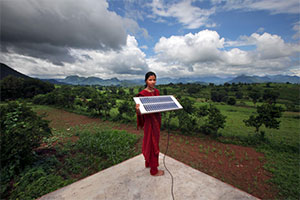 Bringing clean energy to rural India. Credit: Abbie Trayler-Smith / Panos Pictures / Department for International Development
Large reserves of oil, gas and minerals in developing countries generate opulent revenues. They could be used to stimulate economic growth and reduce poverty, but often result in environmental destruction and conflict, benefiting large companies and corrupt governments. Furthermore, competition over natural resources often manifests through geopolitical conflict. For example, before the US-Iraq war, Iraq’s domestic oil industry was nationalized. With US aggression came weakened Iraqi institutions and foreign intervention, thus eventually leading to the privatization of Iraqi oil, leaving the industry now largely dominated by Western companies. As another example, China’s rising investments within the lithium sector in South America are increasing the US-China rivalry across the Western Hemisphere. Notably, Bolivia has the largest reserves of lithium in the world, and the nation’s state-owned lithium extraction firm recently signed a contract with China’s CBC Consortium, while rejecting the entry of Western firms into the nation. In Bolivia’s case, rising Chinese investment in the nation’s lithium sector also raises concerns about environmental sustainability and the sociopolitical rights of Indigenous communities. More broadly, Sub-Saharan Africa holds nearly 30% of global reserves of critical minerals required for low-carbon technologies. Despite this, the region attracts less than 10% of global exploration investment, depicting a critical barrier to both the clean energy transitions and Sub-Saharan Africa’s economic development. Furthermore, resource wealth continues to fuel conflict like Sudan’s civil war, which has led to 9.1 million internally displaced people and is intensely connected to competition over gold, water, and agricultural land. IPS covers news about major oil, gas, and mining projects, their effects on the environment and local communities, and the ideas and actions of the interest groups involved.

The Week with IPS

NEXT STOP - SDGs
Tracking global progress towards a sustainable world
Tracking global progress towards a sustainable world
