Languages
Tuesday, September 29, 2026



News and Views from the Global South
Natural Resources

Open Veins of Africa Bleeding Heavily
The ongoing plunder of Africa’s natural resources drained by capital flight is holding it back yet again. More African nations face protracted recessions amid mounting debt distress, rubbing salt into deep wounds from the past. With much less foreign exchange, tax revenue, and policy space to face external shocks, many African governments believe they have little choice but to spend less, or borrow more in foreign currencies.
The United Kingdom’s, USA’s and Russia’s Great Game: A History Lesson about War and Greed
Like most armed conflicts the Ukrainian war intends to establish hegemony over a certain area, in rivalry with other usurpers. Russian propaganda pinpoints the US and EU as Russia’s main adversaries, while Ukraine is portrayed as a pawn in these nations’ international yearnings. Such a scenario is not new.
COP27 Fiddling as World Warms
The latest annual climate conference has begun in the face of a worsening climate crisis and further retreats by rich nations following the energy crisis induced by NATO sanctions after the Russian invasion of Ukraine. Copping out again The 27th Conference of the Parties (COP 27) to the United Nations Framework Convention on Climate Change (UNFCCC) is now meeting in Sharm-el-Sheikh, Egypt, from 6 to 18 November 2022.
Limits to Growth: Inconvenient Truth of Our Times
Ahead of the first United Nations environmental summit in Stockholm in 1972, a group of scientists prepared The Limits to Growth report for the Club of Rome. It showed planet Earth’s finite natural resources cannot support ever-growing human consumption.
Counting the Massive Financial Costs of Illegal Fishing
As a new report lays bare the massive financial costs to developing states of illegal fishing, campaigners are hoping that drawing attention to the practice’s devastating economic effects will help push governments to greater action against the illicit trade.
Artisanal Miners Ruining Already Diminishing Forests in Zimbabwe
With homemade tents scattered about, hordes of artisanal gold miners throng parts of Mazowe village in Zimbabwe’s Mashonaland Central Province, where they have cut down thousands of trees to process gold ore.
How China Can Retire Coal Early in Pakistan and Elsewhere Through the BRI
With COP 27 approaching, pressure is mounting on wealthy countries to increase their support to poorer ones in the face of climate change. The recent floods in Pakistan have amplified this issue. China, as the world’s second largest economy, will similarly face increasing pressure to help other developing countries on climate.
War, Greed and Mass Manipulation
In his treatise On War, the Prussian general Carl von Clausewitz (1780–1831) stated that war is “merely a continuation of policy with other means”. With his experience from the Napoleonic Wars von Clausewitz knew that totalitarian regimes could end up conducting huge and ruthless military campaigns. Furthermore, he assumed that to win a war it is necessary to mobilize and indoctrinate the inhabitants of an entire nation. Such an endeavour is called total war, a term that actually can be applied to Putin’s war in Ukraine.
Europe in Its Labyrinth
European politicians continue to run in all directions to find a way out of their energy crisis. One of them – Simonetta Sommaruga, the Swiss Environment Minister, asked people to ‘shower together’. Others are competing to grant the business of transporting energy from the North of Africa to the continent. All this is not new.
Accelerating Post-Pandemic SDG 6 Achievements on Water & Sanitation
Global progress has been staggeringly inadequate against Sustainable Development Goal 6, “clean water and sanitation for all.” According to the latest SDGs progress assessment, 2 billion people still lack safely managed drinking water, 3.6 billion lack sanitation services, and 3 billion lack basic hygiene services.
Solar Energy, the Solution for Remote Communities in Argentina
When asked about the impact of incorporating solar energy at the school he runs in Atraico, a remote rural area in the Patagonian steppe in southern Argentina, Claudio Amaya Gatica is unequivocal: "Life has changed, not only for the school but for the whole community.”
Gabon’s Environment Minister Reflects on Conservation Successes, Future Challenges
Over the past few years, Gabon has been successful in its forest conservation efforts. The country has also been able to work hard to achieve the goal of limiting the rise in global temperatures to the 1.5-degree target. Minister of Water, Forests, the Sea, and Environment, Lee White, talks to IPS Correspondent Francis Kokutse:
Africa, The Looted Continent
Africa. The birthplace of “Homo Sapiens.” The land of plenty. The origin of farming. The richest region in terms of natural resources. And human capital. Home to over 1.3 billion humans, continues to be looted.
Energy Transition: Is it Time for Africa to Talk Tough?
Thirty-year-old Difasi Amooti Kisembo is one of the demonstrators near the EU delegation offices in Kampala. He and a handful of others have traveled from Uganda’s oil and gas-rich Albertine region’s district to Uganda’s capital Kampala to express their displeasure with an EU Parliament’s resolution against the planned construction of the East African Crude Oil Pipeline.
Climate Action Plans Could Help Address Injustice, Inequity in African Cities
Equity and justice feature prominently in the Intergovernmental Panel on Climate Change 6th (IPCC) Assessment Report Working Group II, published in 2022. The report focuses on the impacts of climate change, as well as vulnerability and adaptation.
Hard Hit By Climate Change, Villagers Raise a Forest on Their Own
Some ten years ago, Sheemanto Chatri, a 39-year-old farmer hailing from India's northeastern state of Meghalaya, was reeling with distress. The unseasonal rainfall had washed away all the crops he had cultivated after year-long labor in his far-off hamlet.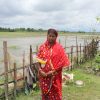
Women Advocates for Harvesting Rainwater in Salinity-Affected Coastal Bangladesh
Like many other women in Bangladesh's salinity-prone coastal region, Lalita Roy had to travel a long distance every day to collect drinking water as there was no fresh water source nearby her locality.
Guatemalans Fight Extractive Industries
The majority of the Guatemalan population continues to oppose mining and other extractive projects, in the midst of a scenario of socio-environmental conflict that pits communities defending their natural resources against the interests of multinational corporations.
Great Wind and Solar Potential Boosts Green Hydrogen in Northern Brazil
Brazil could become a world leader in the production of green hydrogen, and the northeastern state of Ceará has anticipated this future role by making the port of Pecém, with its export processing zone, a hub for this energy source.
Africa Struggles with Neo-Colonialism
After a quarter century of economic stagnation, African economic recovery early in the 21st century was under great pressure even before the pandemic, due to new trade arrangements, falling commodity prices and severe environmental stress.
Africa Needs More Action, Fewer Words to Secure Food and Nutrition
For more than five years, Ritta Achevih was harvesting one bag of maize or less from her small plot each season. She could hardly provide enough healthy food for her big family.« Previous Page — Next Page »


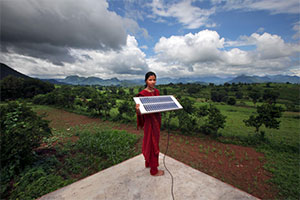 Bringing clean energy to rural India. Credit: Abbie Trayler-Smith / Panos Pictures / Department for International Development
Large reserves of oil, gas and minerals in developing countries generate opulent revenues. They could be used to stimulate economic growth and reduce poverty, but often result in environmental destruction and conflict, benefiting large companies and corrupt governments. Furthermore, competition over natural resources often manifests through geopolitical conflict. For example, before the US-Iraq war, Iraq’s domestic oil industry was nationalized. With US aggression came weakened Iraqi institutions and foreign intervention, thus eventually leading to the privatization of Iraqi oil, leaving the industry now largely dominated by Western companies. As another example, China’s rising investments within the lithium sector in South America are increasing the US-China rivalry across the Western Hemisphere. Notably, Bolivia has the largest reserves of lithium in the world, and the nation’s state-owned lithium extraction firm recently signed a contract with China’s CBC Consortium, while rejecting the entry of Western firms into the nation. In Bolivia’s case, rising Chinese investment in the nation’s lithium sector also raises concerns about environmental sustainability and the sociopolitical rights of Indigenous communities. More broadly, Sub-Saharan Africa holds nearly 30% of global reserves of critical minerals required for low-carbon technologies. Despite this, the region attracts less than 10% of global exploration investment, depicting a critical barrier to both the clean energy transitions and Sub-Saharan Africa’s economic development. Furthermore, resource wealth continues to fuel conflict like Sudan’s civil war, which has led to 9.1 million internally displaced people and is intensely connected to competition over gold, water, and agricultural land. IPS covers news about major oil, gas, and mining projects, their effects on the environment and local communities, and the ideas and actions of the interest groups involved.

The Week with IPS

NEXT STOP - SDGs
Tracking global progress towards a sustainable world
Tracking global progress towards a sustainable world
