Languages
Wednesday, September 30, 2026



News and Views from the Global South
Natural Resources

Africa Struggles with Neo-Colonialism
After a quarter century of economic stagnation, African economic recovery early in the 21st century was under great pressure even before the pandemic, due to new trade arrangements, falling commodity prices and severe environmental stress.
Africa Needs More Action, Fewer Words to Secure Food and Nutrition
For more than five years, Ritta Achevih was harvesting one bag of maize or less from her small plot each season. She could hardly provide enough healthy food for her big family.
Afghanistan: A Treasure Worth More than a Trillion Dollars
Both mainstream media, international bodies and human rights defenders continue to rightly denounce the Taliban's inhuman abuses against the Afghan people’s basic rights, in particular those of women and girls.
Biomethane, the Energy that Cleans Garbage in Brazil
The increasing productivity with which humankind generates waste has gained at least one sustainable counterpart: the extraction of biogas from landfills, a growing activity in Brazil.
Africa Should Trade its Carbon Credits to Fund Renewable Energy – UNECA
Africa needs to trade in carbon credits to reduce greenhouse gas emissions, finance the transition to renewable energy, and boost economic development, the United Nations Economic Commission for Africa (UNECA) says.
Argentina Seeks Elusive Investment to Fully Exploit Shale Gas
Argentina, which has one of the largest unconventional hydrocarbon deposits in the world, has been forced to import gas for 6.6 billion dollars so far this year.
Chinese Fleet Threatens Latin America’s Fish Stocks
Illegal and excessive fishing, mainly attributed to Chinese fleets, remains a threat to marine resources in the eastern Pacific and southwest Atlantic, as well as to that sector of the economy in Latin American countries bathed by either ocean.
Slow food, Accelerating Biodiversity in the Field and On Our Plates
Edward Mukiibi was forced to do agriculture at school as punishment for misbehaviour. Instead of hating the punishment, he loved it, especially when he realised farming was the future of good food, health and wealth.
Both UK & Congo Think They’re Climate Leaders – COP26’s Fallout Shows How Far Adrift They Are
From the fall-out of the pandemic to the interlocking cost of living and energy security crises currently gripping the world, it has been fascinating to see the world’s richest governments bending over backwards to help fossil fuel companies.
Africa Taken for ‘Neo-Colonial’ Ride
Like so many others, Africans have long been misled. Alleged progress under imperialism has long been used to legitimize exploitation. Meanwhile, Western colonial powers have been replaced by neo-colonial governments and international institutions serving their interests.
Unleashing Mangrove Superpower Through Soft Coastal Engineering
The swish of calm waters followed by unexpectedly high tides and violent waves is now too familiar for the fisher community along Kenya’s 1,420-kilometer Indian Ocean coastline.
Zimbabwe Turns to Boreholes Amid Groundwater Level Concerns
Faced with cyclical droughts and low water levels in supply dams, Zimbabwe is turning to boreholes for relief, raising concerns about already precarious groundwater levels across the country.
The Africa We Want is Still Within Reach – & a Priority for the United Nations
The “Africa We Want” - as outlined in Agenda 2063 - embodies the African Union’s bold vision of an integrated, prosperous, and peaceful continent.
East African Countries Seek Cross-border Cooperation to Combat Wildlife Trafficking
For many years, East African countries were considered wildlife trafficking hotspots. Now conservation organisations have started to mobilise all stakeholders to combat the illegal trade that targets animals – some to the edge of extinction.
Narrow Valuation of Nature is Widening Biodiversity Loss
Nature has diverse values for different people, but it is poorly evaluated, and this is driving the global biodiversity crisis, top scientists say in a new report.
Wild Species Central to Human Survival, New IPBES Report Offers Options for their Sustainable Use
Fifty thousand wild species meet the needs of billions of people worldwide, providing food, cosmetics, shelter, clothing, medicine and inspiration. But now, a million species of plants and animals face extinction with far-reaching consequences, including endangering economies, food security and livelihoods.
Tap Into Indigenous Knowledge To Preserve Our Forests
A few years ago, I found myself in the Baka indigenous sacred forest in Assok, in Cameroon in the course of my work in supporting them to preserve their forest against land grabbers. We were building a forest hut using only leaves and the knowledge of our indigenous partners.
Nature-Positive Ventures Crucial for Africa’s future, say experts at Africa Green Economy Conference
Africa’s unique natural capital assets were the center of conversation at the 2022 Africa Green Economy Conference. Held in a hybrid format from June 27 to 30, participants gathered to discuss the value of nature in Africa’s economy and call for more nature-positive ventures in development.
Mexico Makes Risky Bet on Liquefied Gas in New Global Scenario
Liquefied gas does not occupy a prominent position in Mexico's energy mix, but the government wants to change that scenario, to take advantage of the crisis unleashed by Russia's invasion of Ukraine and the need for new sources of the fuel due to the sanctions against Russia.
A Voice for African Wildlife: A Conversation with Kaddu Sebunya
The CEO of the Nairobi-based African Wildlife Foundation, Kaddu Sebunya – in London to mark AWF’s 60th anniversary while fundraising and lobbying – shares his thoughts with IPS on the climate and food crises, how Africans have their voice, why western countries need a ‘reset’ with Africa, what Prince Charles should say to the Commonwealth, how China is eating western ‘cake’, and what worries him more than anything else.
Indigenous Communities Want Stake in New Deal to Protect Nature
In early June 2022, more than 30 people from the Maasai community in the Loliondo division in Tanzania’s northern Ngorongoro District were reportedly injured, and one person died following clashes with security forces over the demarcation of their ancestral lands for a new game reserve.« Previous Page — Next Page »


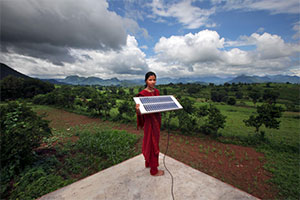 Bringing clean energy to rural India. Credit: Abbie Trayler-Smith / Panos Pictures / Department for International Development
Large reserves of oil, gas and minerals in developing countries generate opulent revenues. They could be used to stimulate economic growth and reduce poverty, but often result in environmental destruction and conflict, benefiting large companies and corrupt governments. Furthermore, competition over natural resources often manifests through geopolitical conflict. For example, before the US-Iraq war, Iraq’s domestic oil industry was nationalized. With US aggression came weakened Iraqi institutions and foreign intervention, thus eventually leading to the privatization of Iraqi oil, leaving the industry now largely dominated by Western companies. As another example, China’s rising investments within the lithium sector in South America are increasing the US-China rivalry across the Western Hemisphere. Notably, Bolivia has the largest reserves of lithium in the world, and the nation’s state-owned lithium extraction firm recently signed a contract with China’s CBC Consortium, while rejecting the entry of Western firms into the nation. In Bolivia’s case, rising Chinese investment in the nation’s lithium sector also raises concerns about environmental sustainability and the sociopolitical rights of Indigenous communities. More broadly, Sub-Saharan Africa holds nearly 30% of global reserves of critical minerals required for low-carbon technologies. Despite this, the region attracts less than 10% of global exploration investment, depicting a critical barrier to both the clean energy transitions and Sub-Saharan Africa’s economic development. Furthermore, resource wealth continues to fuel conflict like Sudan’s civil war, which has led to 9.1 million internally displaced people and is intensely connected to competition over gold, water, and agricultural land. IPS covers news about major oil, gas, and mining projects, their effects on the environment and local communities, and the ideas and actions of the interest groups involved.

The Week with IPS

NEXT STOP - SDGs
Tracking global progress towards a sustainable world
Tracking global progress towards a sustainable world
