Languages
Wednesday, October 14, 2026



News and Views from the Global South
Natural Resources

Haunting Forest Spirits – is Mother Nature Striking Back?
Epidemic diseases are not random events that afflict societies capriciously and without warning, on the contrary, every society produces its own specific vulnerabilities. To study them is to understand the importance of a society's structure, its standard of living, and its political priorities. […] Epidemics are a mirror, they show who we really are: Our ethics, beliefs, and socio-economic relationships. Frank Snowden 1
COVID-19 and Hope for a Compassionate Future
The Coronavirus, COVID-19, makes its deadly round across the world. People fall sick and die, communities and entire nations end up in its deadly grip and try to cope with it. Everything is changing, and changing fast and we all have to deal with it together, even if many of us are being physically apart. Humans are social beings. Our mental and physical capacities are created around that fact and crave for support and compassion.
Green Counter-Revolution in Africa?
In 2006, the Bill and Melinda Gates Foundation and the Rockefeller Foundation jointly launched the Alliance for a Green Revolution in Africa (AGRA). The African Green Revolution Forum claims AGRA is the “world’s most important and impactful forum for African agriculture”.
Reimagining Farming Post-Covid Pandemic
Together with medical services and transportation, farming and food production have been correctly identified as ‘essential services’ by all countries under lockdown. The Covid-19 pandemic has not yet made a dent in the food supply and so far, there are no reports of shortage of essential food and agricultural goods. All cities and towns are actively coordinating with government agencies, farms, businesses and transport companies to maintain the supply chain and ensure full availability of food for the population,
Harness Youth to Change World’s Future
Vanessa Nakate of Uganda may have been cropped out of a photograph taken at the World Economic Forum, but she along with Swedish activist Greta Thunberg have made the climate crisis centre stage.
Women & Climate: Planting a Global Forest in a Connected World
In January of this year, Britain’s Prince Harry and his wife Meghan, the Duke and Duchess of Sussex, shocked much of the world when they announced they would be stepping down from their roles as senior royals.
An Ambitious Year for Climate Action Is a Big Year for Women’s Empowerment
This year, the Paris Agreement’s effectiveness as a global response to the climate crisis is being tested as governments are preparing to submit more ambitious national targets for mitigation and adaptation.
Preserving World’s Biodiversity: Negotiations Convene at FAO Headquarters
“The world out there is watching and waiting for results,” Elizabeth Maruma Mrema warns while talking to IPS regarding the preservation of biodiversity of our planet.
Pulses for a Sustainable Future
Reducing poverty and inequalities, eliminating hunger and all forms of malnutrition and achieve food security for all – these are some of the most important objectives of the Sustainable Development Goals. Still, the rate of poverty and inequalities is increasing and over 820 million people are going hungry. In addition, 2 billion people in the world are food insecure with great risk of malnutrition and poor health. This alarming situation is further aggravated by current trends such as the rate of population growth, impacts of climate change, loss of biodiversity, soil degradation and many others. Transition to more sustainable food systems can provide adequate solutions to all these challenges. Pulses could play an important role in this transition, having nutritional and health benefits, low environmental footprint, and positive socio-economic impacts as well. What is required to promote and support the production and consumption of more pulses? This question is particularly relevant now, since 10 February is the World Pulses Day.
World Drains Away Valuable Energy, Nutrients & Water in Fast-Growing Wastewater Streams
Vast amounts of valuable energy, agricultural nutrients, and water could be recovered from the world’s fast-growing volume of municipal wastewater.
Venezuela: Violent Abuses in Illegal Gold Mines
Residents of Venezuela’s southern Bolívar state are suffering amputations and other horrific abuses at the hands of armed groups, including Venezuelan groups called “syndicates” in the area and Colombian armed groups operating in the region, both of which exercise control over gold mines, Human Rights Watch said Tuesday, February 4.
Oil-rich Gulf Turns to Renewable Energy
The increased frequency of climate-induced weather extremes and public opinion pressure are forcing even major fossil fuel exporting countries in West Asia to make a big push towards renewable energy.
Blue Innovation in the Commonwealth
With 95 per cent of the ocean still unexplored by humans, we are only just beginning to understand its profound influence on life on earth, including its effect on global climate and ecosystems.
BIOGAS: Cow Dung Holds the Key to Nepal’s Green Economy
Nepal’s future may not be in hydropower, as most assume, but actually in the dung heap. A new industrial-scale biogas plant near Pokhara has proved that livestock and farm waste producing flammable methane gas can replace imported LPG and chemical fertiliser.
Let’s Give Trade a Chance
Imagine going through the day without consuming or using some product, service, data, technology, personal contact, or payment which has not – at least in some part – crossed one or more national borders before reaching you.
Not all Trade is Good – the Case of Plastics Waste
Currently, approximately 300 million tons of oil-based plastic waste are produced every year. A significant amount of plastic waste ends up in the oceans, having a detrimental effect on marine ecosystems and coastal communities. Most of this waste originates from the Asia-Pacific region.
Plastic: The Largest Predator in Our Oceans
Plastic pollution is currently the largest global threat to marine life. Each year, 10-20 million tonnes of plastic ends up in our oceans, killing approximately 100,000 marine mammals and over a million seabirds.
Lithium and Clean Energy in Argentina: Development or Mirage?
The intense white brightness of the salt flats interrupts the arid monotony of the Puna in northwest Argentina, resembling postcards from the moon. Beneath its surface are concealed the world's largest reserves of lithium, the key mineral in the transition to clean energy, the mining of which has triggered controversy.
Fostering Sustainable Urbanization and Rural-Urban Linkages
As urbanization continues apace, coupled with rapid population growth and rural to urban migration, the challenges for inclusive rural transformation continue, and the importance of fostering improved rural-urban linkages for better food systems becomes increasingly important.. According to the UN, by 2050 some 66% of the world’s population of 9 billion is expected to live in urban areas. Such rapid urbanization is increasingly shaping the rural space and rural livelihoods (through markets, demand for agricultural goods and labour, migration, and through the provision of services to rural areas). It is therefore critical for the increasing emphasis on urban development to take into account the importance of rural development.
The Adaptive Age: No Institution or Individual can Stand on the Sidelines in the Fight Against Climate Change
When I think of the incredible challenges we must confront in the face of a changing climate, my mind focuses on young people. Eventually, they will be the ones either to enjoy the fruits or bear the burdens resulting from actions taken today.
What Do We Want from Our Oceans?
This is a question we need to ask ourselves but before answering we need to acknowledge the diversity of expectations and aspirations that we all have for oceans, which cover more than two-thirds of the planet’s surface.« Previous Page — Next Page »





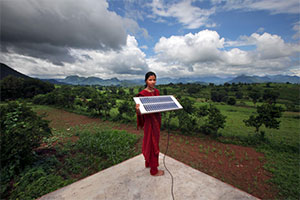 Bringing clean energy to rural India. Credit: Abbie Trayler-Smith / Panos Pictures / Department for International Development
Large reserves of oil, gas and minerals in developing countries generate opulent revenues. They could be used to stimulate economic growth and reduce poverty, but often result in environmental destruction and conflict, benefiting large companies and corrupt governments. Furthermore, competition over natural resources often manifests through geopolitical conflict. For example, before the US-Iraq war, Iraq’s domestic oil industry was nationalized. With US aggression came weakened Iraqi institutions and foreign intervention, thus eventually leading to the privatization of Iraqi oil, leaving the industry now largely dominated by Western companies. As another example, China’s rising investments within the lithium sector in South America are increasing the US-China rivalry across the Western Hemisphere. Notably, Bolivia has the largest reserves of lithium in the world, and the nation’s state-owned lithium extraction firm recently signed a contract with China’s CBC Consortium, while rejecting the entry of Western firms into the nation. In Bolivia’s case, rising Chinese investment in the nation’s lithium sector also raises concerns about environmental sustainability and the sociopolitical rights of Indigenous communities. More broadly, Sub-Saharan Africa holds nearly 30% of global reserves of critical minerals required for low-carbon technologies. Despite this, the region attracts less than 10% of global exploration investment, depicting a critical barrier to both the clean energy transitions and Sub-Saharan Africa’s economic development. Furthermore, resource wealth continues to fuel conflict like Sudan’s civil war, which has led to 9.1 million internally displaced people and is intensely connected to competition over gold, water, and agricultural land. IPS covers news about major oil, gas, and mining projects, their effects on the environment and local communities, and the ideas and actions of the interest groups involved.

The Week with IPS

NEXT STOP - SDGs
Tracking global progress towards a sustainable world
Tracking global progress towards a sustainable world
