Languages
Wednesday, October 21, 2026



News and Views from the Global South
Natural Resources

Our Food Systems Need Transformation
The right to food is a universal human right. Yet, over 820 million people are going hungry, according the latest edition of the State of Food Security and Nutrition in the World (SOFI 2019). In addition, 2 billion people in the world are food insecure with great risk of malnutrition and poor health” 1.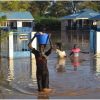
Let’s Walk the Talk to Defeat Climate Change – African Leaders Told
African leaders have been asked to walk the talk, and lead from the front, in order to build resilience and adaptation to the adverse impacts of climate change on the continent.
Pushing For a Green Economy & Clean Energy
Africa is grappling with myriad environmental and climate challenges, from drought to loss of biodiversity, cyclones and plastics pollution.
What Would It Really Take to Plant a Trillion Trees?
Tree planting is capturing the minds of those who look for fast climate action. Earlier this month, the Ethiopian Government announced a new world record: thousands of volunteers planted 353 million trees in one single day. This came shortly after a team of scientists identified suitable places in the world where up to 1 trillion new trees could be planted. Such a massive effort could absorb about 20 years’ worth of global greenhouse gas emissions. And on 8 August 2019, the Intergovernmental Panel on Climate Change launched a Special Report on the importance of land use for the climate. About 23 per cent of all emissions come from the agriculture, land use and forest sector. The Intergovernmental Panel on Climate Change outlines land management opportunities with benefits for food security, biodiversity, and the climate, such as agroforestry.
How to Bring the Indus Delta Back to Life – Give it Water
Gulab Shah, 45, is having sleepless nights. He and his family are worried about their imminent migration from their village in Jhaloo to a major city in Pakistan, thanks to the continued ingress of sea water inland.
Are Jair Messias Bolsonaro and Donald John Trump a Menace to the Planet?
We live in different worlds. The ones of friends, family and work colleagues. Worlds which are overshadowed by other, much bigger ones. Global spheres of international finance, politics, climate change, etc., contexts that might threaten our smaller circle of relationships; our family, our income, our general wellbeing, in short – our entire existence. However, even at those levels there exist small circles of acquaintances and associates able to make decisions that affect the entire humankind. Let me take one example – the regimes of U.S. President Donald J. Trump and Brazilian President Jair Messias Bolsonaro, which are menacing our global natural habitat.
Towards a Sustainable Future: Case of China’s Economic Transformation
The Asia-Pacific region is at a crossroads. The traditional export-oriented, manufacturing-driven growth is facing headwinds from sluggish external demand and rising protectionist trade measures.
How India’s Indigenous Female Forest Dwellers Feel about Owning Their Own Land
 Kumaribai Jamkatan, 51, has been fighting for women’s land rights since 1987.
Though the constitution of India grants equal rights to men and women, women first started to stake their claim for formal ownership of land only after 2005–the year the government accorded legal rights to daughters to be co-owners of family-owned land.
Kumaribai Jamkatan, 51, has been fighting for women’s land rights since 1987.
Though the constitution of India grants equal rights to men and women, women first started to stake their claim for formal ownership of land only after 2005–the year the government accorded legal rights to daughters to be co-owners of family-owned land. 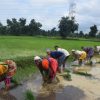
In the Midst of Conflict, India’s Indigenous Female Forest Dwellers Own their Land
Jam Bai, an Indigenous farmer from Korchi village in western India, is a woman in hurry. After two months of waiting, the rains have finally come and the rice saplings for her paddy fields must be sown this week while the land is still soft.
Burning Forests for Rain, and Other Climate Catastrophes
The villagers living on the foothills of Mount Kenya have a belief: If they burn the forest, the rains will come.
Extreme Floods, the Key to Climate Change Adaptation in Africa’s Drylands
Extreme rainfall and heavy flooding, often amplified by climate change, causes devastation among communities. But new research published on Aug. 7 in the scientific journal Nature reveals that these dangerous events are extremely significant in recharging groundwater aquifers in drylands across sub-Saharan Africa, making them important for climate change adaptation.
What a Little Pigeon Could Teach Our World
Over 100 years ago a little brown passenger pigeon named Martha died in the Cincinnati Zoo. She was the last of her breed. Just like that, in an instant, a bird species that had once numbered in the billions was wiped out forever.
Money Grows on Trees–Don’t Uproot Them
Jennifer Handondo, a small scale farmer of Choma district in southern Zambia, plants food crops such as maize mostly for her family’s needs. Because of uncharacteristically high temperatures and low rainfall during the rainy season in March, the divorced mother who single-handedly supports her three children, has not been able to harvest as much as she usually does. So she has diversified into selling seedlings of neem, Moringa and other medicinal trees.
Human Rights Watch Disappoints on Human Rights
On 22 July 2019, Kenneth Roth published an article in Publico, Lisbon, entitled: “UN Chief Guterres has disappointed on Human Rights”.
The Libyan Disaster: Little Bits of History Repeating
The Libyan catastrophe and the suffering of ”illegal” migrants are generally depicted as fairly recent events, though they are actually the results of a long history of greed, contempt for others and fatal shortsightedness. Like former Yugoslavia, Libya was created from a mosaic of tribal entities, subdued by colonial powers and then ruled by an iron-fisted dictator. Now, Libya is a quagmire where local and international stakeholders battle to control its natural resources. The country holds the largest oil reserves in Africa, oil and gas account for 60 percent of GDP and more than 90 percent of exports.1 This is one reason why Egypt, France, Russia, Saudi Arabia, the U.S., and many other nations are enmeshed in Libya. Furthermore, European nations try to stop mainly sub-Saharan refugees and migrants from reaching their coasts from Libya. An attempt to understand Italy´s essential role in the struggle over Libya´s oil and attempts to control unwanted immigration may help to clarify some issues related to the current situation.
Why Environmental and Humanitarian Action Must Be Linked
Environmental and humanitarian action is often understood as two different sectors. However, the lack of awareness regarding its intersections could lead to further long-term devastation.
Indigenous Communities Head Towards Energy Self-Sufficiency in Guatemala
Because the government has never provided them with electricity, indigenous communities in the mountains of northwest Guatemala had no choice but to generate their own energy. 
Could the Election of Qu Dongyu as FAO´s General-Director be a Turning-point for Sustainable Agricultural Development?
Agriculture is the bedrock of sedentary human civilization, without it we would have no governments or nations. It was food surplus generated by agriculture that enabled people to live in cities and form regimes able to organize food production in such a manner that some community members could engage in other activities than direct food production and thus give rise to the ideologies, techniques and goods which now constitute and govern our existence.
Air Pollution Ranked as Biggest Environmental Threat to Human Health
In a world that is becoming more and more industrial by the day, air pollution appears to be on the rise. While there have been efforts in major cities to combat the grave effects that pollution can have on the overall health of its citizens, there is still more progress to be made.
South Africa’s First Carbon Farm
Land restoration could attract large private investments in the fight against climate change over the coming decades, if Governments and the United Nations put the right incentives and conditions in place.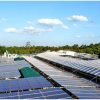
Developing Technologies for Zero-Carbon Economies
Never before has half a degree (0.5C) meant so much for humanity. We are behaving as if we have time to deal with climate change. We don’t. The main problem is that we believe we must sacrifice growth and prosperity for the sake of decarbonisation. We don’t.« Previous Page — Next Page »





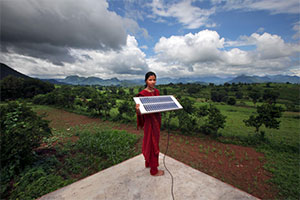 Bringing clean energy to rural India. Credit: Abbie Trayler-Smith / Panos Pictures / Department for International Development
Large reserves of oil, gas and minerals in developing countries generate opulent revenues. They could be used to stimulate economic growth and reduce poverty, but often result in environmental destruction and conflict, benefiting large companies and corrupt governments. Furthermore, competition over natural resources often manifests through geopolitical conflict. For example, before the US-Iraq war, Iraq’s domestic oil industry was nationalized. With US aggression came weakened Iraqi institutions and foreign intervention, thus eventually leading to the privatization of Iraqi oil, leaving the industry now largely dominated by Western companies. As another example, China’s rising investments within the lithium sector in South America are increasing the US-China rivalry across the Western Hemisphere. Notably, Bolivia has the largest reserves of lithium in the world, and the nation’s state-owned lithium extraction firm recently signed a contract with China’s CBC Consortium, while rejecting the entry of Western firms into the nation. In Bolivia’s case, rising Chinese investment in the nation’s lithium sector also raises concerns about environmental sustainability and the sociopolitical rights of Indigenous communities. More broadly, Sub-Saharan Africa holds nearly 30% of global reserves of critical minerals required for low-carbon technologies. Despite this, the region attracts less than 10% of global exploration investment, depicting a critical barrier to both the clean energy transitions and Sub-Saharan Africa’s economic development. Furthermore, resource wealth continues to fuel conflict like Sudan’s civil war, which has led to 9.1 million internally displaced people and is intensely connected to competition over gold, water, and agricultural land. IPS covers news about major oil, gas, and mining projects, their effects on the environment and local communities, and the ideas and actions of the interest groups involved.

The Week with IPS

NEXT STOP - SDGs
Tracking global progress towards a sustainable world
Tracking global progress towards a sustainable world
