Languages
Thursday, October 22, 2026



News and Views from the Global South
Natural Resources
Developing Technologies for Zero-Carbon Economies
Never before has half a degree (0.5C) meant so much for humanity. We are behaving as if we have time to deal with climate change. We don’t. The main problem is that we believe we must sacrifice growth and prosperity for the sake of decarbonisation. We don’t.
Restoring Our Degraded Planet
On the 1st of March 2019, we saw one of the rare moments in history when the entire world comes together and agrees on a joint way forward. The United Nations General Assembly recognized the urgent need to tackle the compounded crisis of climate change and biodiversity loss, and passed a resolution to proclaim 2021-2030 as the UN Decade on Ecosystem Restoration. With the aim to restore at least 350 million hectares of degraded landscapes by 2030 – an area the size of India – the UN Decade is a loud and clear call to action for all of us. And it is a great opportunity for the UN-REDD Programme and its partner countries to build on 10 years worth of relevant experience with safeguards, impactful policies and measures, and attracting private and public investments.
Watch Out: Your Money Is Being Used to Destroy the World!
Perhaps the most direct way to introduce this tough issue is what the United Nations Secretary-General, António Guterres, stated just one week ahead of the 5 June World Environment Day, which focuses this year on air pollution, caused chiefly by the use of fossil fuels both in transport, industry and even household cooking, heating, etc.
These Aliens Are Here to Stay (And They Are Dangerous)
No, no, no. Nothing to do with what US and Europe’s far-right fanatics now use to vociferate, saying once and again that “migrants come here to destroy our democracy, our civilisation, and our life-style”.
4 Revolutionary Tips to Stop Aquaculture and Fisheries Ignoring, Resisting or Eroding Gender Equality
In my years in fisheries research in Australia, few researchers were women, all fishers were assumed to be men, "girly" calendars were occasionally pinned on the office, lab or tea room wall at work and the workplace rules of engagement for women were still being worked out by trial and error. I vividly remember when my colleague, “Jessie”, the only woman technician in our research agency, was assigned to go into the field for a week to support a fish tagging project run by men scientists. The men took umbrage and went to the Union to protest this affront to their work conditions. The Union warned them that they could be sacked for discriminating against a woman. So change was at hand - or so it seemed.
Global Energy Consumption is Up — So Are Emissions
Our acceptance of climate change doesn’t keep pace with our energy consumption reduction. However, the latest International Energy Agency’s (IEA’S) Global Energy and CO2 Status Report for 2018 has some good news.
“A Question of Life or Death”
The mining industry is one of the world's most dangerous industries. Globally, the death toll is at least 14,000 workers per year. But how many lives are actually lost is something that neither trade unions, national governments or the United Nations know.
Lessons From China: Fostering Agricultural Growth and Poverty Reduction
As China has moved from a poor isolated country to a major player in the world economic and political sphere, developing countries need to learn how to engage.
Pakistan’s Battle Against Climate Change
Pakistan, which has been listed as the 7th most vulnerable country affected by climate change, is now seriously tackling the vagaries of weather, both at the official as well as non-official level. Pursuant to an initiative launched by the Pakistan Parliament’s Upper House, the Senate, which specially entrusted a sub-Committee of the Standing Committee on Climate Change to focus on “Green and Clean” Islamabad, media, civil society and students have taken up the cudgels on combating climate change.
Global Governance and Information
The past seventy years since the end of the second world war have been marked by profound changes in our international system. Relations between states have become more horizontally structured interactions with a rising significance of the common good articulated and pursued by newly-created international programmes and organisations.
All What Your Jeans Can (and Do) Hide!
Paris, Milan, New York, Tokyo… These are just some of the world’s most prestigious fashion catwalks. There, and elsewhere, perfectly – and often unrealistically – silhouetted young women and men graciously parade to impress elite guests and TV watchers with surprising, fabulous creativity of the most renowned fashion designers and dressmakers.
What’s in a Name? Everything.
On March 19, 78 years old Nursultan Äbisjuly Nazarbayev unexpectedly announced his resignation as President of Kazakhstan, referring to the need for “a new generation of leaders”. The same day the speaker of the nation´s parliament was appointed as interim president, awaiting presidential elections scheduled for 2020.
Anguilla’s Fishers Share their First-Hand Knowledge About Climate Change and its Impact
Fishers in Anguilla saw posted on Youtube this week a video they helped produce that depicts the impacts of climate change on their industry. Titled “Anguilla’s Fishing Dilemma”, the four-and-a-half minute video highlights some of the main challenges Anguilla’s 92 licensed fishers face in earning a living.
Helping St. Vincent’s Fishers Maintain an Essential Industry in a Changing Climate
 From an influx of sargassum in near-shore waters, to fish venturing further out to sea to find cooler, more oxygenated water, fishers in St. Vincent and the Grenadines are battling the vagaries of climate change. The country is doing what it can to respond.
Innovative Sustainable Business: A Three Trillion-Dollar Opportunity that UN Environment Wants People to Develop
In the East African region, communities around the continent’s largest water body, Lake Victoria, regard the water hyacinth as a great menace that clogs the lake and hampers their fishing activities. But in Lagos, Nigeria, some groups of women have learned how to convert the invasive weed into a resource, providing them with the raw material needed to make handicrafts.
Island Women Take the Lead in Peatland Restoration
Eluminada Roca has lived all her life next to the Leyte Sab-a Basin peatlands. The grandmother from of San Isidro village in Philippines’ Leyte island grew up looking at the green hills that feed water to the peatland, she harvested tikog—a peatland grass to weave mats—and ate the delicious fish that was once in abundant in the waters. But today, the land is losing its water, the grass is disappearing and the fish stock has drastically decreased.
Saving for a ‘Rainy Day’ Takes on New Meaning in Caribbean
In the tiny eastern Caribbean nation of St. Vincent and the Grenadines, proverbs relating to the weather are very common. Everyone knows that “Who has cocoa outside must look out for rain”, has nothing to do with the drying of the bean from which chocolate is made or the sudden downpours common in this tropical nation.
Doing Business with Nature
As the environment continues to degrade and natural resources deplete at unprecedented rates, spelling disastrous consequences for societies, a new tool aims to bring financial institutions into the fight to protect nature.
‘No Way to Defend Ourselves Against the Onslaught of Climate Change’
Two of the most prominent women in the Caribbean nation of Suriname are speaking out about developed countries that release large volumes of greenhouse gases into the atmosphere.
Reverse Engineering for SDGs
When young people from small towns and villages seek higher education they have to usually migrate to big cities leaving their local communities behind. On completion of their degree from the Universities, they generally prefer staying in cities, in search of a good job and a successful career. Though this is a standard practice, it is also a case of lost opportunities, especially for students who pursue higher education in agriculture. Here is why.
Agribusiness Is the Problem, Not the Solution
For two centuries, all too many discussions about hunger and resource scarcity has been haunted by the ghost of Parson Thomas Malthus. Malthus warned that rising populations would exhaust resources, especially those needed for food production. Exponential population growth would outstrip food output.« Previous Page — Next Page »





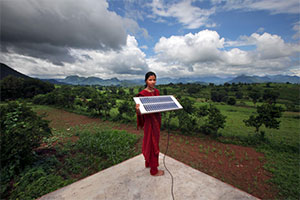 Bringing clean energy to rural India. Credit: Abbie Trayler-Smith / Panos Pictures / Department for International Development
Large reserves of oil, gas and minerals in developing countries generate opulent revenues. They could be used to stimulate economic growth and reduce poverty, but often result in environmental destruction and conflict, benefiting large companies and corrupt governments. Furthermore, competition over natural resources often manifests through geopolitical conflict. For example, before the US-Iraq war, Iraq’s domestic oil industry was nationalized. With US aggression came weakened Iraqi institutions and foreign intervention, thus eventually leading to the privatization of Iraqi oil, leaving the industry now largely dominated by Western companies. As another example, China’s rising investments within the lithium sector in South America are increasing the US-China rivalry across the Western Hemisphere. Notably, Bolivia has the largest reserves of lithium in the world, and the nation’s state-owned lithium extraction firm recently signed a contract with China’s CBC Consortium, while rejecting the entry of Western firms into the nation. In Bolivia’s case, rising Chinese investment in the nation’s lithium sector also raises concerns about environmental sustainability and the sociopolitical rights of Indigenous communities. More broadly, Sub-Saharan Africa holds nearly 30% of global reserves of critical minerals required for low-carbon technologies. Despite this, the region attracts less than 10% of global exploration investment, depicting a critical barrier to both the clean energy transitions and Sub-Saharan Africa’s economic development. Furthermore, resource wealth continues to fuel conflict like Sudan’s civil war, which has led to 9.1 million internally displaced people and is intensely connected to competition over gold, water, and agricultural land. IPS covers news about major oil, gas, and mining projects, their effects on the environment and local communities, and the ideas and actions of the interest groups involved.

The Week with IPS

NEXT STOP - SDGs
Tracking global progress towards a sustainable world
Tracking global progress towards a sustainable world
