Languages
Thursday, August 27, 2026



News and Views from the Global South
Natural Resources

NGOs Call for Disinvestments in Biodiversity Destruction
A discussion held earlier this week at the ongoing Convention of Biodiversity’s (CBD) Conference of Parties in Egypt highlighted that grants to curb deforestation in the Amazon are not enough if they are accompanied with investments that increase the loss of biodiversity.
The Blue Economy – A New Frontier for Small Island Developing States
The blue economy—a concept and economic model that balances economic development with equity and environmental protection, and one that uses marine resources to meet current needs without compromising the ability of future generations to meet their own—is not a new idea.
Improved Husbandry Practices Boosts Aquaculture in Kenya
Despite the humid late October midday weather in Kisumu County near the shores of Lake Victoria, Jane Kisia is busy walking around her fish ponds feeding her fish. As she rhythmically throws handfuls of pellets into the ponds, located within her homestead, the fish ravenously gobble them up.
Venture Capital Can Turbo Charge Growth in Emerging Markets
Global poverty is undoubtedly the most critical economic and moral challenge of the 21st century. While economists debate how to raise up the world’s poorest – the more than 800 million people living on less than US$1.25 a day.-- entrepreneurs are spurring innovation and growth in emerging markets.
Africa Set for a Massive Free Trade Area
Following the unveiling of the African Continental Free Trade Agreement in Kigali, Rwanda, in March 2018, Africa is about to become the world’s largest free trade area: 55 countries merging into a single market of 1.2 billion people with a combined GDP of $2.5 trillion.
Kenya Looks to Lead the Way in Developing the Blue Economy’s Potential
For many years now, the economic potential of the African continent has been discussed, promoted and hailed by everyone from economists to policymakers to world leaders – and with very good reason. After all, Africa is a vast, populous, developing continent with enormous natural and human resource riches and a raft of rapidly developing economies which are helping create prosperity and raise living standards and social opportunities through economic growth.
Earth’s Biodiversity: A Pivotal Meeting at a Pivotal Time
The quality of the air we breathe, the food we eat and the water we drink depend directly on the state of our biodiversity, which is now in severe jeopardy. We need a transformational change in our relationship with nature to ensure the sustainable future we want for ourselves and our children.
Q&A: All Sustainable Development Goals Relate in Some Way to the Oceans
When Peter Thomson, the United Nation’s Secretary General’s Special Envoy for the Ocean, heard in 2010 there was going to be a 2030 Sustainable Development Agenda, he knew he had to include the ocean question.
Using Data to Restore Land
A new landmark initiative aims to make quality data and tools available to the international community in order to combat an “existential crisis”: land degradation.
Creating Beauty and Worth from Bamboo Enhances the Livelihoods of Ghana’s Artisans
Yaw Owiredu Mintah from Ghana has been working as an all-round processor of bamboo and rattan since the 1980s. And while he says that he can do most things with bamboo like weaving, framing and finishing, he admits, “I need to improve my skills and designs because all of us are, most of the time, doing the same things.”
Lack of Funds Prevent Ugandan Communities from Investing in Cage Aquaculture
Colvince Mubiru had heard about cage fish farming on Uganda’s lakes. The small business owner decided to try his hand at it and spent USD8,000 to set up farming cages for Nile Tilapia on Lake Victoria, expecting to reap a huge profit. But just six months into his enterprise, he made huge losses.
Genesis of a mess
How do major messes get created? The genesis of some messes reflects the decisions of elites over a small period of time, eg, the Rwanda genocide. But other messes emerge gradually, with various elite groups adding different, mutually reinforcing, layers of the mess over time to produce an intractable situation.
Africa’s Giant Blue Economy Potential
With good reason, Africa is excited over the prospects of sharing in the multi-trillion maritime industry, with the continent’s Agenda 2063 envisioning the blue economy as a foremost contributor to transformation and growth.
Caribbean Looks to Protect its Seafood From Mercury
Four Caribbean countries have done an inventory of the major sources of mercury contamination in their islands, but a great deal of work still needs to be done to determine where and what impact this mercury is having on the region's seafood chain.
“Governments are Starting to See that Organic Food Policy Works”
Many countries and farmers around the world are not readily making the switch to organic farming. But the small Himalayan mountain state of Sikkim, which borders Tibet, Nepal and Bhutan, is the first 100 percent organic farming state in the world.
Seychelles Issues World’s First Blue Bond to Fund Fisheries Projects
The Republic of Seychelles announced on Monday that it has issued a 10-year blue bond to finance fisheries projects, making it the world’s first country to utilise capital markets for funding the sustainable use of marine resources.
Africa’s Bumpy Road to Sustainable Energy
For years, Kenyans freely used and disposed of plastic bags. The bags were ubiquitous—in the markets, in the gutters and in the guts out of 3 out of every 10 animals taken to slaughter.
Kashmir’s Fisherwomen Live Between Hope and Despair
Much has changed since Rahti Begum, a fisherwoman in Kashmir, now in her late 60s, first began wandering the streets with a bucketful of fish on her head. She was 17 when her father roped her into the business that became the source of her livelihood for the remainder of her life.
Barbados Looks Beyond its Traditional Sugar and Banana Industries into the Deep Blue
Allan Bradshaw grew up close to the beach and always knew he wanted to become a fisherman. Now 43 years old, he has been living his childhood dream for 25 years. But in recent years Bradshaw says he has noticed a dramatic decline in the number of flying fish around his hometown of Consett Bay, Barbados.
Solar Power Lights up the World’s Fastest-Growing Refugee Camp
Solar energy has long powered homes, businesses and portable electronics. Now, it’s powering a field hospital in the middle of the world’s fastest-growing refugee camp.
For the Survival of the Nile and its People
Running through eleven countries for 6,853 kilometres, the Nile is a lifeline for nearly half a billion people. But the river itself has been a source of tension and even conflict for countries and territories that lie along it and there have been rumours of “possible war for the Nile” for years now. While to date there has been no outbreak of irreversible tension, experts say that because of increasing changes in the climate a shared agreement needs to be reached on the redistribution of water soon.« Previous Page — Next Page »


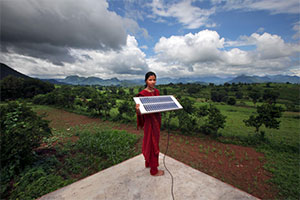 Bringing clean energy to rural India. Credit: Abbie Trayler-Smith / Panos Pictures / Department for International Development
Large reserves of oil, gas and minerals in developing countries generate opulent revenues. They could be used to stimulate economic growth and reduce poverty, but often result in environmental destruction and conflict, benefiting large companies and corrupt governments. Furthermore, competition over natural resources often manifests through geopolitical conflict. For example, before the US-Iraq war, Iraq’s domestic oil industry was nationalized. With US aggression came weakened Iraqi institutions and foreign intervention, thus eventually leading to the privatization of Iraqi oil, leaving the industry now largely dominated by Western companies. As another example, China’s rising investments within the lithium sector in South America are increasing the US-China rivalry across the Western Hemisphere. Notably, Bolivia has the largest reserves of lithium in the world, and the nation’s state-owned lithium extraction firm recently signed a contract with China’s CBC Consortium, while rejecting the entry of Western firms into the nation. In Bolivia’s case, rising Chinese investment in the nation’s lithium sector also raises concerns about environmental sustainability and the sociopolitical rights of Indigenous communities. More broadly, Sub-Saharan Africa holds nearly 30% of global reserves of critical minerals required for low-carbon technologies. Despite this, the region attracts less than 10% of global exploration investment, depicting a critical barrier to both the clean energy transitions and Sub-Saharan Africa’s economic development. Furthermore, resource wealth continues to fuel conflict like Sudan’s civil war, which has led to 9.1 million internally displaced people and is intensely connected to competition over gold, water, and agricultural land. IPS covers news about major oil, gas, and mining projects, their effects on the environment and local communities, and the ideas and actions of the interest groups involved.

The Week with IPS

NEXT STOP - SDGs
Tracking global progress towards a sustainable world
Tracking global progress towards a sustainable world
