Languages
Wednesday, October 7, 2026



News and Views from the Global South
Natural Resources

Shale Oil Fuels Indigenous Conflict in Argentina
The boom in unconventional fossil fuels has revived indigenous conflicts in southwest Argentina. Twenty-two Mapuche communities who live on top of Vaca Muerta, the geological formation where the reserves are located, complain that they were not consulted about the use of their ancestral lands, both “above and below ground.”
G20 Seeks to Streamline Private Investment in Infrastructure
Industrialised countries have agreed to collaborate on a new programme aimed at funnelling significant private-sector investment into global infrastructure projects, particularly in developing countries.
How a Small Tribe Turned Tragedy into Opportunity
When the Asian tsunami washed over several Indian Ocean Rim countries on Boxing Day 2004, it left a trail of destruction in its wake, including a death toll that touched 230,000.
How SADC is Fighting Wildlife Crime
"We are underpaid, have no guns and in most instances are outnumbered by the poachers," says Stain Phiri, a ranger at Vwaza Marsh Wildlife Reserve — a 986 km reserve said to have the most abundant and a variety of wildlife in Malawi — which also happens to be one of the country’s biggest game parks under siege by poachers.
U.N. Chief Eyes Upcoming Summits to Resolve Development Crisis
The continued widespread economic recession - aggravated by the recent Ebola outbreak in West Africa - is threatening to undermine the U.N.'s highly-touted post-2015 development agenda.
Why Are G20 Governments Subsidising Dangerous Climate Change?
Just a week after the Intergovernmental Panel on Climate Change (IPCC) gave its starkest warning yet that the vast majority of existing oil, gas and coal reserves need to be kept in the ground, a new report reveals that governments are flagrantly ignoring these warnings and continuing to subsidise exploration for fossil fuels.
Fishing for Peace in Korea
Environmental problems, by their nature, don’t respect borders. Air and sea pollution often affect countries that had nothing to do with their production. Many extreme weather events, like typhoons, strike more than one country. Climate change affects everyone.
As TPP Trade Talks Miss Third Deadline, Opponents Claim Momentum
For the third year in a row, government negotiators for 12 Pacific Rim countries have missed an internal deadline to reach agreement on a controversial U.S.-led trade deal.
A Fair Climate Treaty or None at All, Jamaica Warns
As the clock counts down to the last major climate change meeting of the year, before countries must agree on a definitive new treaty in 2015, a senior United Nations official says members of the Alliance of Small Island Developing States (AOSIS) “need to be innovative and think outside the box” if they hope to make progress on key issues.
Responding to Climate Change from the Grassroots Up
As concern mounts over food security, two community groups are on a drive to mobilise average people across Antigua and Barbuda to mitigate and adapt in the wake of global climate change, which is affecting local weather patterns and by extension, agricultural production.
Extractives Companies “Not Ready” for Transparency Requirements
The world’s largest corporations continue to publicise scant information about their global operations, according to new analysis that warns that extractives companies in particular are unprepared for pending disclosure requirements.
UNIDO Comes a Long Way
The United Nations Industrial Development Organisation (UNIDO) has come a long way since 1997, when it faced the risk of closure in the aftermath of the end of the Cold War.
Inside Pakistan’s Untapped Fishing Industry
If you want to know what ‘sea traffic’ looks like, just go down to the Karachi Harbour. Built in 1959, the dockyard houses close to 2,000 big and small boats anchored in the grey sludge at the edge of Pakistan’s southern port city, which opens into the Arabian Sea.
U.N. Favours Changeover from Landlocked to ‘Land-linked’
Some 440 million people are living in 32 countries that are among the world’s poorest, most of them least developed, and geographically isolated from world markets not only because they have very few commodities to export, but also because they have no direct territorial access to the sea.
Using Phytotechnology to Remedy Damage Caused by Mining
Combating the negative effects of its own production processes is one of the challenges facing the mining industry, one of the pillars of the Chilean economy.
Inside Pakistan’s Untapped Fishing Industry
 If you want to know what ‘sea traffic’ looks like, just go down to the Karachi Harbour. Built in 1959, the dockyard houses close to 2,000 big and small boats anchored in the grey sludge at the edge of Pakistan’s southern port city, which opens into the Arabian Sea.
Canada Accused of Failing to Prevent Overseas Mining Abuses
The Canadian government is failing either to investigate or to hold the country’s massive extractives sector accountable for rights abuses committed in Latin American countries, according to petitioners who testified here Tuesday before an international tribunal.
Better Water Management Needed to Eradicate Poverty
It demands repetition: water is a precondition for all life. It keeps us alive – literally – while being a prerequisite for or integral part of most of our daily activities. Think hospitals without water, think farms, energy producers, industries, schools and homes without our most needed resource. All sectors, without exception, are dependent on water.
OPINION: From Almaty to Vienna, New Prospects For LLDCs
Kazakhstan being the world’s largest landlocked country, and also the ninth largest country in the world of more than 2.7 million square kilometres, hosted in 2003 in Almaty the First United Nations Conference on Landlocked Countries.
There’s CO2 Under Those Hills
“If they go ahead and dig those wells, all my work will be destroyed, all my life, everything,” says Franca Tognarelli, looking at the hills and vineyards around her house in Certaldo, Val d’Elsa, in the heart of Tuscany.
Fossil Fuels Won’t Benefit Africa in Absence of Sound Environmental Policies
Recent discoveries of sizeable natural gas reserves and barrels of oil in a number of African countries — including Uganda, Tanzania and Kenya — have economists hopeful that the continent can boost and diversify its largely agriculture-based economy.« Previous Page — Next Page »





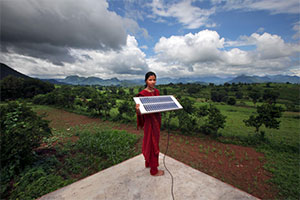 Bringing clean energy to rural India. Credit: Abbie Trayler-Smith / Panos Pictures / Department for International Development
Large reserves of oil, gas and minerals in developing countries generate opulent revenues. They could be used to stimulate economic growth and reduce poverty, but often result in environmental destruction and conflict, benefiting large companies and corrupt governments. Furthermore, competition over natural resources often manifests through geopolitical conflict. For example, before the US-Iraq war, Iraq’s domestic oil industry was nationalized. With US aggression came weakened Iraqi institutions and foreign intervention, thus eventually leading to the privatization of Iraqi oil, leaving the industry now largely dominated by Western companies. As another example, China’s rising investments within the lithium sector in South America are increasing the US-China rivalry across the Western Hemisphere. Notably, Bolivia has the largest reserves of lithium in the world, and the nation’s state-owned lithium extraction firm recently signed a contract with China’s CBC Consortium, while rejecting the entry of Western firms into the nation. In Bolivia’s case, rising Chinese investment in the nation’s lithium sector also raises concerns about environmental sustainability and the sociopolitical rights of Indigenous communities. More broadly, Sub-Saharan Africa holds nearly 30% of global reserves of critical minerals required for low-carbon technologies. Despite this, the region attracts less than 10% of global exploration investment, depicting a critical barrier to both the clean energy transitions and Sub-Saharan Africa’s economic development. Furthermore, resource wealth continues to fuel conflict like Sudan’s civil war, which has led to 9.1 million internally displaced people and is intensely connected to competition over gold, water, and agricultural land. IPS covers news about major oil, gas, and mining projects, their effects on the environment and local communities, and the ideas and actions of the interest groups involved.

The Week with IPS

NEXT STOP - SDGs
Tracking global progress towards a sustainable world
Tracking global progress towards a sustainable world
