Languages
Wednesday, October 7, 2026



News and Views from the Global South
Natural Resources

OPINION: Towards an Inclusive and Sustainable Future for Industrial Development
As representatives of the United Nations Industrial Development Organization (UNIDO), we are sometimes asked whether industrial development is still relevant to a world which many observers have claimed over the past decades to have entered the “post-industrial age”. Our answer is always an emphatic “yes”, shaped both by the evidence of history and current events.
They Say the Land is ‘Uninhabited’ but Indigenous Communities Disagree
Disregarding the rights of indigenous people to their traditional lands is costing companies millions of dollars each year, and costing communities themselves their lives.
St. Vincent Takes to Heart Hard Lessons on Climate Change
Glenda Williams has lived in the Pastures community in eastern St. Vincent all her life. She's seen the area flooded by storms on multiple occasions.
Bougainville Voices Say ‘No’ to Mining
The viability of reopening the controversial Panguna copper mine in the remote mountains of Central Bougainville, an autonomous region in the east of Papua New Guinea, has been the focus of discussions led by local political leaders and foreign mining interests over the past four years.
“Yeil” – The New Energy Buzzword in Argentina
In Argentina they call it “yeil”, the hispanicised version of “shale”. But while these unconventional gas and oil reserves are seen by many as offering a means to development and a route towards energy self-sufficiency, others believe the term should fall into disuse because the global trend is towards clean, renewable sources of energy.
OPINION: Where Governments Fail, It’s Up to the People to Rise
Pomerania in northern Poland is famous for its unpolluted environment, fertile soils and historic heritage. So far, these valuable farmlands have been free from heavy industry but that situation might change as a shadow looms over the lives of Pomeranians.
How Long Before Another Soma Mine Disaster?
Six days a week, Tahir Cetin spends seven and a half hours hundreds of feet underground on a narrow ledge, mining coal near Soma, Turkey. He breathes in dust that is destroying his lungs, and digs into walls that could collapse on top of him. With one false step, he could fall to his death.
OPINION: The Front Line of Climate Change is Here and Now
The fate of my country rests in your hands: that was the message which Ian Fry, representing Tuvalu gave at the United Nations Climate Change Conference in Copenhagen five years ago. This is also the message that the Pacific Climate Warriors have come to Australia to bring.
Kazakhstan’s Nazarbayev Signals U-Turn on Alternative Energy
From small villages to big cities, wherever you go in Kazakhstan these days, billboards offer reminders that Astana is gearing up to host Expo 2017, the next World’s Fair. Kazakhstan helped secure the right to host the event with a pledge to emphasise green energy alternatives. But now it appears that Kazakhstan is red-lighting its own green transition.Global South Brings United Front to Green Climate Fund
The United Nations’ key mechanism for funding climate change-related mitigation and adaptation in developing countries is now ready to receive funds, following a series of agreements between rich and poor economies.
Añelo, from Forgotten Town to Capital of Argentina’s Shale Fuel Boom
This small town in southern Argentina is nearly a century old, but the unconventional fossil fuel boom is forcing it to basically start over, from scratch. The wave of outsiders drawn by the shale fuel fever has pushed the town to its limits, while the plan to turn it into a “sustainable city of the future” is still only on paper.
The Nagoya Protocol: A Treaty Waiting to Happen
For over 20 years, Mote Bahadur Pun of Nepal’s western Myagdi district has been growing ‘Paris polyphylla’ - a Himalayan herb used to cure pain, burns and fevers.
OPINION: The Politics of Biodiversity Loss
To mainstream biodiversity concerns into development planning, we must offer a compelling rationale and demonstrate biodiversity’s relevance to wealth generation, job creation and general human wellbeing. Only a persuasive “why” resonating throughout society will successfully get us to urgently needed negotiations of who, what, where, when and how to halt disastrous biodiversity loss.
We Must Think of “Security” in New Ways
Recent events in the Arab world and elsewhere have underscored the point that traditional notions of security being dependent solely on military and related apparatus are outmoded.
Pacific Islanders Take on Australian Coal
The recent blockade of ships entering the world’s largest coal port in Newcastle, Australia, has brought much-needed attention to the negative impacts of the fossil fuel industry on global climate patterns. But it will take more than a single action to bring the change required to prevent catastrophic levels of climate change.
Belize Fights to Save a Crucial Barrier Reef
Home to the second longest barrier reef in the world and the largest in the Western Hemisphere, which provides jobs in fishing, tourism and other industries which feed the lifeblood of the economy, Belize has long been acutely aware of the need to protect its marine resources from both human and natural activities.
OPINION: Innovation Needed to Help Family Farms Thrive
Family farms have been contributing to food security and nutrition for centuries, if not millennia. But with changing demand for food as well as increasingly scarce natural resources and growing demographic pressures, family farms will need to innovate rapidly to thrive.
Pacific Climate Change Warriors Block World’s Largest Coal Port
Climate Change Warriors from 12 Pacific Island nations paddled canoes into the world’s largest coal port in Newcastle, Australia, Friday to bring attention to their grave fears about the consequences of climate change on their home countries.
Family Farmers – Forward to the Future
"Who is more concerned than the rural family with regards to preservation of natural resources for future generations?"
Bamboo Could Be a Savior for Climate Change, Biodiversity
Bamboo Avenue is a two-and-a-half mile stretch of road in Jamaica’s St. Elizabeth parish. It is lined with giant bamboo plants which tower above the road and cross in the middle to form a shady tunnel. The avenue was established in the 17th century by the owners of the Holland Estate to provide shade for travelers and to protect the road from erosion.
Africa Can Be its Own ‘Switzerland’
Africa has the capacity to access at least 200 billion dollars for sustainable development investment but it will remain a slave to foreign aid unless it improves the climate for investment and trade and plugs illicit financial flows, development experts say.« Previous Page — Next Page »





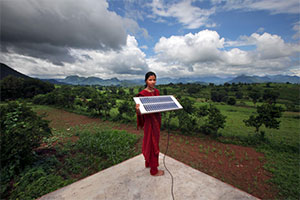 Bringing clean energy to rural India. Credit: Abbie Trayler-Smith / Panos Pictures / Department for International Development
Large reserves of oil, gas and minerals in developing countries generate opulent revenues. They could be used to stimulate economic growth and reduce poverty, but often result in environmental destruction and conflict, benefiting large companies and corrupt governments. Furthermore, competition over natural resources often manifests through geopolitical conflict. For example, before the US-Iraq war, Iraq’s domestic oil industry was nationalized. With US aggression came weakened Iraqi institutions and foreign intervention, thus eventually leading to the privatization of Iraqi oil, leaving the industry now largely dominated by Western companies. As another example, China’s rising investments within the lithium sector in South America are increasing the US-China rivalry across the Western Hemisphere. Notably, Bolivia has the largest reserves of lithium in the world, and the nation’s state-owned lithium extraction firm recently signed a contract with China’s CBC Consortium, while rejecting the entry of Western firms into the nation. In Bolivia’s case, rising Chinese investment in the nation’s lithium sector also raises concerns about environmental sustainability and the sociopolitical rights of Indigenous communities. More broadly, Sub-Saharan Africa holds nearly 30% of global reserves of critical minerals required for low-carbon technologies. Despite this, the region attracts less than 10% of global exploration investment, depicting a critical barrier to both the clean energy transitions and Sub-Saharan Africa’s economic development. Furthermore, resource wealth continues to fuel conflict like Sudan’s civil war, which has led to 9.1 million internally displaced people and is intensely connected to competition over gold, water, and agricultural land. IPS covers news about major oil, gas, and mining projects, their effects on the environment and local communities, and the ideas and actions of the interest groups involved.

The Week with IPS

NEXT STOP - SDGs
Tracking global progress towards a sustainable world
Tracking global progress towards a sustainable world
