Languages
Tuesday, October 13, 2026



News and Views from the Global South
Natural Resources

Bamboo Could Be a Savior for Climate Change, Biodiversity
Bamboo Avenue is a two-and-a-half mile stretch of road in Jamaica’s St. Elizabeth parish. It is lined with giant bamboo plants which tower above the road and cross in the middle to form a shady tunnel. The avenue was established in the 17th century by the owners of the Holland Estate to provide shade for travelers and to protect the road from erosion.
Africa Can Be its Own ‘Switzerland’
Africa has the capacity to access at least 200 billion dollars for sustainable development investment but it will remain a slave to foreign aid unless it improves the climate for investment and trade and plugs illicit financial flows, development experts say.
High-Tech, High Yields: Caribbean Farmers Reap Benefits of ICT
Farmers in the Caribbean are being encouraged to make more use of farm apps and other forms of ICT in an effort to increase the knowledge available for making sound, profitable farming decisions.
Curbing Biodiversity Loss Needs Giant Leap Forward
When political leaders from climate-threatened Small Island Developing States (SIDS) addressed the U.N. General Assembly last month, there was one recurring theme: the urgent need to protect the high seas and preserve the world's marine biodiversity.
Facing Storms Without the Mangrove Wall
As the cyclonic storm Hudhud ripped through India’s eastern state of Andhra Pradesh, home to two million people, at a land speed of over 190 kilometres per hour on Sunday, it destroyed electricity and telephone infrastructure, damaged the airport, and laid waste to thousands of thatched houses, as well as rice fields, banana plantations and sugarcane crops throughout the state.
Family Farming – A Way of Life
It does not make the headlines, but 2014 is the International Year of Family Farming (IYFF) and family farming will be centre-stage at this year’s World Food Day on Oct. 16 at the Food and Agriculture Organisation of the United Nations (FAO).
Ahead of Myanmar Trip, Obama Urged to Demand Extractives Transparency
Lawmakers here are urging President Barack Obama to put transparency in the extractives sector at the centre of an upcoming trip to Myanmar.
Biodiversity, Climate Change Solutions Inextricably Linked
The remarkable biodiversity of the countries of the Caribbean, already under stress from human impacts like land use, pollution, invasive species, and over-harvesting of commercially valuable species, now faces an additional threat from climate change.
Vanuatu Puts Indigenous Rights First in Land Reform
Stemming widespread corruption in the leasing of customary land to investors is the aim of bold land reform, introduced this year in the Southwest Pacific Island state of Vanuatu, which puts the rights of traditional landowners above the discretionary powers of politicians.
Curbing the Illegal Wildlife Trade Crucial to Preserving Biodiversity
For over five years, 33-year-old Maheshwar Basumatary, a member of the indigenous Bodo community, made a living by killing wild animals in the protected forests of the Manas National Park, a tiger reserve, elephant sanctuary and UNESCO World Heritage Site that lies on the India-Bhutan border.
Marine Litter: Plunging Deep, Spreading Wide
Imagine a black-footed albatross feeding its chick plastic pellets, a baby seal in the North Pole helplessly struggling with an open-ended plastic bag wrapped tight around its neck, or a fishing vessel stranded mid-sea, a length of discarded nylon net entangled in its propeller. Multiply these scenarios a thousand-fold, and you get a glimpse of the state of the world’s oceans.
World Bank Pushes Private Sector for Major Investments in Infrastructure
The World Bank has initiated a major call to action for private sector investors around infrastructure projects in developing countries.
Family Farmers Don’t Need Climate-Smart Agriculture
Small farmers can look to options like agroecological intensification and innovation, without necessarily turning to climate-smart agriculture, which is promoted by the United Nations but has awakened doubts among global experts meeting in this Italian city.
A Billion Tons of Food Wasted Yearly While Millions Still Go Hungry
In his parody of the Michael Jackson hit “Beat It”, the American satirist and singer Weird Al Yankovic has a parent urging his son to eat the food on his plate, warning that “other kids are starving in Japan”.
Acid Oceans Could Deal Heavy Blow to Fishing-Dependant Nations
Scientists here are warning Caribbean countries, where the fisheries sector is an important source of livelihoods and sustenance, that they should pay close attention to a new international report released Wednesday on ocean acidification.
Fracking Fractures Argentina’s Energy Development
Unconventional oil and gas reserves in Vaca Muerta in southwest Argentina hold out the promise of energy self-sufficiency and development for the country. But the fracking technique used to extract this treasure from underground rocks could be used at a huge cost.
Thirsty Land, Hungry People
 Gazing out over the parched earth of Sri Lanka’s Northern Province, one might think these farmlands have not seen water in years. In fact, this is not too far from the truth.

Synthetic Biology Could Open a Whole New Can of Worms
Haiti, the poorest country in the Western Hemisphere, is the world’s leading producer of vetiver. In the southwest of the country, vetiver production is hard to ignore.
Financing for Biodiversity: A Simple Matter of Keeping Promises
With governments, activists and scientists tearing their hair out over the world’s impending crisis in biodiversity, the outgoing president of the Convention on Biological Diversity (CBD) delivered a simple message to participants at the 12th Conference of the Parties to the CBD (COP12) currently underway in the Republic of Korea’s northern Pyeongchang county: honour the promises you made last year.
U.S. Investigation into Illegal Timber Imports a “Sea Change”
A year after a U.S. company was accused of engaging in the systematic importing of flooring made from illegally harvested timber, pressure is mounting on federal agencies currently investigating the allegations.
Harper Playing Defence in Canada’s Pipeline Politics
Canada’s tar sands oil boom may be in jeopardy and it appears the ruling Conservative government of Prime Minister Stephen Harper does not have any plan B in its ambition to remake this resource-rich country into “an energy superpower.”« Previous Page — Next Page »





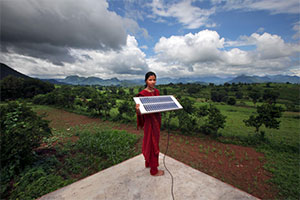 Bringing clean energy to rural India. Credit: Abbie Trayler-Smith / Panos Pictures / Department for International Development
Large reserves of oil, gas and minerals in developing countries generate opulent revenues. They could be used to stimulate economic growth and reduce poverty, but often result in environmental destruction and conflict, benefiting large companies and corrupt governments. Furthermore, competition over natural resources often manifests through geopolitical conflict. For example, before the US-Iraq war, Iraq’s domestic oil industry was nationalized. With US aggression came weakened Iraqi institutions and foreign intervention, thus eventually leading to the privatization of Iraqi oil, leaving the industry now largely dominated by Western companies. As another example, China’s rising investments within the lithium sector in South America are increasing the US-China rivalry across the Western Hemisphere. Notably, Bolivia has the largest reserves of lithium in the world, and the nation’s state-owned lithium extraction firm recently signed a contract with China’s CBC Consortium, while rejecting the entry of Western firms into the nation. In Bolivia’s case, rising Chinese investment in the nation’s lithium sector also raises concerns about environmental sustainability and the sociopolitical rights of Indigenous communities. More broadly, Sub-Saharan Africa holds nearly 30% of global reserves of critical minerals required for low-carbon technologies. Despite this, the region attracts less than 10% of global exploration investment, depicting a critical barrier to both the clean energy transitions and Sub-Saharan Africa’s economic development. Furthermore, resource wealth continues to fuel conflict like Sudan’s civil war, which has led to 9.1 million internally displaced people and is intensely connected to competition over gold, water, and agricultural land. IPS covers news about major oil, gas, and mining projects, their effects on the environment and local communities, and the ideas and actions of the interest groups involved.

The Week with IPS

NEXT STOP - SDGs
Tracking global progress towards a sustainable world
Tracking global progress towards a sustainable world
