Languages
Friday, October 16, 2026



News and Views from the Global South
Natural Resources

Harper Playing Defence in Canada’s Pipeline Politics
Canada’s tar sands oil boom may be in jeopardy and it appears the ruling Conservative government of Prime Minister Stephen Harper does not have any plan B in its ambition to remake this resource-rich country into “an energy superpower.”
Antigua Faces Climate Risks with Ambitious Renewables Target
Ruth Spencer is a pioneer in the field of solar energy. She promotes renewable technologies to communities throughout her homeland of Antigua and Barbuda, playing a small but important part in helping the country achieve its goal of a 20-percent reduction in the use of fossil fuels by 2020.
Humanity Failing the Earth’s Ecosystems
In pure numbers, the past few decades have been marked by destruction: over the last 40 years, Earth has lost 52 percent of its wild animals; nearly 17 percent of the world’s forests have been felled in the last half-century; freshwater ecosystems have witnessed a 75-percent decline in animal populations since 1970; and nearly 95 percent of coral reefs are today threatened by pollution, coastal development and overfishing.
New Global Declaration “Insufficient” to Tackle Deforestation
Heads of state, civil society groups and the leaders of some of the world’s largest companies this week urged their peers to sign on to a landmark new global agreement aimed at halting deforestation by 2030, even as others are warning the accord is too lax.
OPINION: From Elephants to Blue Whales, Sri Lanka Leads the Way on Biodiversity
Sri Lanka will host the World Biodiversity Congress (WBC) Nov. 24-27. Given its long and active history of preserving biodiversity, it would be most appropriate for Sri Lanka to be the next host of this global event, which also marks the U.N.'s Decade on Biodiversity.
Latin America on a Dangerous Precipice
“We could be the last Latin American and Caribbean generation living together with hunger.”
Puerto Rico’s Green Crusaders Still Going Strong
The heart of Puerto Rico’s central mountain range is the site of an extraordinary story of struggle and triumph.
Vaca Muerta, Argentina’s New Development Frontier
Production here has skyrocketed so fast that for now the installations of the YPF oil company at the Loma Campana deposit in southwest Argentina are a jumble of interconnected shipping containers.
OPINION: A Roadmap to Living – and Thriving – in Harmony with Nature
In Nagoya, Japan, in 2010, the international community made a commitment to future generations by adopting the Strategic Plan for Biodiversity 2011–2020 and 20 Aichi Biodiversity Targets.U.S. to Create National Plan on Responsible Business Practices
The United States will begin developing a national action plan on responsible business practices, following on several years of related advocacy from civil society.
Outgunned by Rich Polluters, Africa to Bring United Front to Climate Talks
As climate change interest groups raise their voices across Africa to call for action at the COP20 climate meeting in December and the crucial COP21 in Paris in 2015, many worry that the continent may never have fair representation at the talks.
OPINION: Tackling the Proliferation of Patents to Avoid Limitations to Competition
The steady increase in patent applications and grants that is taking place in developed and some developing countries (notably in China) is sometimes hailed as evidence of the strength of global innovation and of the role of the patent system in encouraging it.
Championing Ocean Conservation Or Paying Lip Service to the Seas?
President Barack Obama this week extended the no-fishing areas around three remote pacific islands, eliciting praise from some, and disappointment from those who fear the move did not go far enough towards helping depleted species of fish recover.
Africa Pays the Price of Low Harvests Thanks to Costly Fertilisers
Eherculano Thomas Rice, is pleased to have harvested 40 bags of white maize from his eight-hectare field in Chimoio, in Mozambique's Manica Province. But he knows that his productivity and yield would be higher if he had been able to afford to buy fertiliser to add to his crop.
The Time Has Come for Agroecology
"It is time for a new agricultural model that ensures that enough quality food is produced where it is most needed, that preserves nature and that delivers ecosystem services of local and global relevance" – in a word, it is time for agroecology.
Obama Mandates Climate Resilience in All U.S. Development Projects
All international development assistance and investments from the United States will now be required to take into account the potential impacts of climate change, according to a new rule signed Tuesday by President Barack Obama.
Climate-Smart Agriculture is Corporate Green-Washing, Warn NGOs
On the sidelines of the U.N.'s heavily hyped Climate Summit, the newly-launched Global Alliance for Climate-Smart Agriculture announced plans to protect some 500 million farmers worldwide from climate change and "help achieve sustainable and equitable increases in agricultural productivity and incomes."
Water: A Defining Issue for Post-2015
A gift of nature, or a valuable commodity? A human right, or a luxury for the privileged few? Will the agricultural sector or industrial sector be the main consumer of this precious resource? Whatever the answers to these and many more questions, one thing is clear: that water will be one of the defining issues of the coming decade.
Experts Warn of Dire Consequences as Lake Victoria’s Water Levels Drop Further
Over the years, Cassius Ntege, a fisherman from Kasenyi landing site on the Ugandan side of Lake Victoria, has observed the waters of the lake receding. And as one of the many who depend on the lake for their livelihoods, he has had to endure the disastrous consequences of the depleting lake.
Climate Change an “Existential Threat” for the Caribbean
When it comes to climate change, Prime Minister Ralph Gonsalves doesn’t mince words: he will tell you that it is a matter of life and death for Small Island Developing States (SIDS).
Green Economy Isn’t Rocket Science – And It’s Not Even Costly
Acting on climate change will not hurt domestic economic growth, and in fact is more likely to boost growth, most analyses now show.« Previous Page — Next Page »





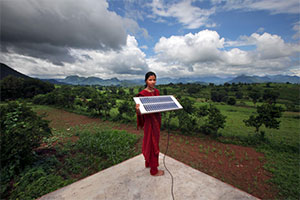 Bringing clean energy to rural India. Credit: Abbie Trayler-Smith / Panos Pictures / Department for International Development
Large reserves of oil, gas and minerals in developing countries generate opulent revenues. They could be used to stimulate economic growth and reduce poverty, but often result in environmental destruction and conflict, benefiting large companies and corrupt governments. Furthermore, competition over natural resources often manifests through geopolitical conflict. For example, before the US-Iraq war, Iraq’s domestic oil industry was nationalized. With US aggression came weakened Iraqi institutions and foreign intervention, thus eventually leading to the privatization of Iraqi oil, leaving the industry now largely dominated by Western companies. As another example, China’s rising investments within the lithium sector in South America are increasing the US-China rivalry across the Western Hemisphere. Notably, Bolivia has the largest reserves of lithium in the world, and the nation’s state-owned lithium extraction firm recently signed a contract with China’s CBC Consortium, while rejecting the entry of Western firms into the nation. In Bolivia’s case, rising Chinese investment in the nation’s lithium sector also raises concerns about environmental sustainability and the sociopolitical rights of Indigenous communities. More broadly, Sub-Saharan Africa holds nearly 30% of global reserves of critical minerals required for low-carbon technologies. Despite this, the region attracts less than 10% of global exploration investment, depicting a critical barrier to both the clean energy transitions and Sub-Saharan Africa’s economic development. Furthermore, resource wealth continues to fuel conflict like Sudan’s civil war, which has led to 9.1 million internally displaced people and is intensely connected to competition over gold, water, and agricultural land. IPS covers news about major oil, gas, and mining projects, their effects on the environment and local communities, and the ideas and actions of the interest groups involved.

The Week with IPS

NEXT STOP - SDGs
Tracking global progress towards a sustainable world
Tracking global progress towards a sustainable world
