Languages
Sunday, October 4, 2026



News and Views from the Global South
Natural Resources

Indonesia’s New President Promises to Put Peat Before Palm Oil
Last week, Indonesia's new president, Joko Widodo, ordered the country’s Ministry of Environment and Forestry to review the licenses of all companies that have converted peatlands to oil palm plantations.
Iraqi Kurds Seek Greater Balance between Ankara and Baghdad
After a period of frostiness, Iraq’s Kurdistan Regional Government (KRG) and Turkey seem intent on mending ties, as each of the parties show signs of needing the other.
Climate Finance Flowing, But for Many, the Well Remains Dry
For more than 10 years, Mildred Crawford has been “a voice in the wilderness” crying out on behalf of rural women in agriculture.
OPINION: Japan’s Misuse of Climate Funds for Dirty Coal Plants Exposed
World governments gathered in Lima, Peru for the latest round of U.N. climate negotiations should have finance on their mind.
Will Rollout of Green Technologies Get a Boost at Lima Climate Summit?
The road towards a green economy is paved with both reward and risk, and policymakers must seek to balance these out if the transition to low-carbon energy sources is to succeed on the required scale, climate experts say.
First Phase of Global Fracking Expansion: Ensuring Friendly Legislation
Multinational oil and gas companies are engaged in a quiet but broad attempt to prepare the groundwork for a significant global expansion of shale gas development, according to a study released Monday.
OPINION: Climate Justice Is the Only Way to Solve Our Climate Crisis
In November, the world's top climate scientists issued their latest warning that the climate crisis is rapidly worsening on a number of fronts, and that we must stop our climate-polluting way of producing energy if we are to stand a chance of avoiding the worst impacts of climate change.
Illegal Logging Wreaking Havoc on Impoverished Rural Communities
Rampant unsustainable logging in the southwest Pacific Island states of Papua New Guinea and Solomon Islands, where the majority of land is covered in tropical rainforest, is worsening hardship, human insecurity and conflict in rural communities.
Led by INTERPOL, U.N. Tracks Environmental Criminals
A coalition of international organisations, led by INTERPOL and backed by the United Nations, is pursuing a growing new brand of criminals - primarily accused of serious environmental crimes - who have mostly escaped the long arm of the law.
Shale Oil Threatens the High Prices Enjoyed by OPEC
Shale fever and the political chess among major oil producers and consumers have put OPEC in one of the most difficult junctures in its 54 years of history.
Women on the Edge of Land and Life
November is the cruelest month for landless families in the Indian Sundarbans, the largest single block of tidal mangrove forest in the world lying primarily in the eastern Indian state of West Bengal.
Filipino Farmers Protest Government Research on Genetically Modified Rice
Jon Sarmiento, a farmer in the Cavite province in southern Manila, plants a variety of fruits and vegetables, but his main crop, rice, is under threat. He claims that approval by the Philippine government of the genetically modified ‘golden rice’ that is fortified with beta-carotene, which the body converts into vitamin A, could ruin his livelihood.
Jewellery Industry Takes Steps to Eliminate “Conflict Gold”
Major U.S. jewellery companies and retailers have started to take substantive steps to eliminate the presence of “conflict gold” from their supply chains, according to the results of a year-long investigation published Monday.
Dry Fields Breed Hunger in Jamaica
 Caribbean countries already grappling with a finite amount of space for food production now face the added challenges of extreme rainfall events or droughts due to climate change.
Lessons from Jamaica’s Billion-Dollar Drought
As Jamaica struggles under the burden of an ongoing drought, experts say ensuring food security for the most vulnerable groups in society is becoming one of the leading challenges posed by climate change.
Will Myanmar’s ‘Triple Transition’ Help Eradicate Crushing Poverty?
 Myanmar is never out of the news for long. This has been the case since a popular uprising challenged military rule in 1988. For over two decades, the country was featured in mainstream media primarily as one unable to cope with its own internal contradictions, a nation crippled by military rule.

The Future of the Planet and the Irresponsibility of Governments
Less than a week after everybody celebrated the historical agreement on Nov. 17 between the United States and China on reduction of CO2 emissions, a very cold shower has come from India.Proposal for International Anti-Corruption Court Seeing “Significant” Momentum
The key U.S. advocate of a proposal to create a multilateral body mandated to investigate allegations of political corruption says the idea is receiving significant interest from civil society, politicians and major business leaders.
Can China’s Silk Road Vision Coexist with a Eurasian Union?
There is a good chance that economic jockeying between China and Russia in Central Asia will intensify in the coming months. For Russia, Chinese economic expansion could put a crimp in President Vladimir Putin’s grand plan for the Eurasian Economic Union.
A Game-Changing Week on Climate Change
- In recent days, two major developments have injected new life into international action on climate change.
Shale Oil Fuels Indigenous Conflict in Argentina
The boom in unconventional fossil fuels has revived indigenous conflicts in southwest Argentina. Twenty-two Mapuche communities who live on top of Vaca Muerta, the geological formation where the reserves are located, complain that they were not consulted about the use of their ancestral lands, both “above and below ground.”« Previous Page — Next Page »


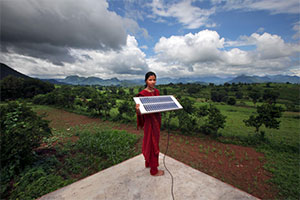 Bringing clean energy to rural India. Credit: Abbie Trayler-Smith / Panos Pictures / Department for International Development
Large reserves of oil, gas and minerals in developing countries generate opulent revenues. They could be used to stimulate economic growth and reduce poverty, but often result in environmental destruction and conflict, benefiting large companies and corrupt governments. Furthermore, competition over natural resources often manifests through geopolitical conflict. For example, before the US-Iraq war, Iraq’s domestic oil industry was nationalized. With US aggression came weakened Iraqi institutions and foreign intervention, thus eventually leading to the privatization of Iraqi oil, leaving the industry now largely dominated by Western companies. As another example, China’s rising investments within the lithium sector in South America are increasing the US-China rivalry across the Western Hemisphere. Notably, Bolivia has the largest reserves of lithium in the world, and the nation’s state-owned lithium extraction firm recently signed a contract with China’s CBC Consortium, while rejecting the entry of Western firms into the nation. In Bolivia’s case, rising Chinese investment in the nation’s lithium sector also raises concerns about environmental sustainability and the sociopolitical rights of Indigenous communities. More broadly, Sub-Saharan Africa holds nearly 30% of global reserves of critical minerals required for low-carbon technologies. Despite this, the region attracts less than 10% of global exploration investment, depicting a critical barrier to both the clean energy transitions and Sub-Saharan Africa’s economic development. Furthermore, resource wealth continues to fuel conflict like Sudan’s civil war, which has led to 9.1 million internally displaced people and is intensely connected to competition over gold, water, and agricultural land. IPS covers news about major oil, gas, and mining projects, their effects on the environment and local communities, and the ideas and actions of the interest groups involved.

The Week with IPS

NEXT STOP - SDGs
Tracking global progress towards a sustainable world
Tracking global progress towards a sustainable world
