Languages
Sunday, October 4, 2026



News and Views from the Global South
Natural Resources

Oil Price Plunge Could Take a Bite from Arms Budgets
In a satirical piece titled 'An Unserious Look at the Year Ahead' in the Wall Street Journal last week, Hugo Rifkind predicts the price of a barrel of oil will fall so low that people across the world would start buying oil for the barrel - and throw the oil out.
OPINION: Understanding Education for Global Citizenship
Education for Sustainable Development (ESD) brings together concerns about the environment, economic development and social aspects. Since 1972, when the first U.N. Conference on the Human Environment was held in Stockholm, Sweden, there has been increasing awareness of the intricate link between conserving the environment and human development.
Falling Oil Prices Threaten Fragile African Economies
The sharp decline in world petroleum prices - hailed as a bonanza to millions of motorists in the United States - is threatening to undermine the fragile economies of several African countries dependent on oil for their sustained growth.
‘Cyclone College’ Raises Hopes, Dreams of India’s Vulnerable Fisherfolk
Ten years have now passed, but Raghu Raja, a 27-year-old fisherman from the coastal village of Nemmeli in southern India’s Kanchipuram district, still clearly remembers the day he escaped the tsunami.
What the U.S. Should Learn from Russia’s Collapse
After months of whispered warnings, Russia’s economic troubles made global headlines when its currency collapsed halfway through December. Amid the tumbling price of oil, the ruble has fallen to record lows, bringing the country to its most serious economic crisis since the late 1990s.
GDP and the Unaccounted for 82 Percent of National Wealth
Virtually all countries use Gross Domestic Product (GDP) as their primary measurement of economic progress and overall societal progress. At the same time, countries express allegiance to the doctrine of sustainable development. This exposes an obvious disconnect.Changes to World Bank Safeguards Risk “Race to the Bottom”, U.N. Experts Warn
An unprecedented number of United Nations special rapporteurs and independent experts are raising pointed concerns over the World Bank’s ongoing review of its pioneering environmental and social safeguards, particularly around the role that human rights will play in these revamped policies.
REDD and the Green Economy Continue to Undermine Rights
Dercy Teles de Carvalho Cunha is a rubber-tapper and union organiser from the state of Acre in the heart of the Brazilian Amazon, with a lifelong love of the forest from which she earns her livelihood – and she is deeply confounded by what her government and policymakers around the world call “the green economy.”
Aboriginal Knowledge Could Unlock Climate Solutions
As a child growing up in Far North Queensland, William Clark Enoch would know the crabs were on the bite when certain trees blossomed, but now, at age 51, he is noticing visible changes in his environment such as frequent storms, soil erosion, salinity in fresh water and ocean acidification.
‘Record’ Illicit Money Lost by Developing Countries Triples in a Decade
Developing countries are losing money through illicit channels at twice the rate at which their economies are growing, according to new estimates released Tuesday. Further, the total volume of these lost funds appears to be rapidly expanding.
OPINION: The Sad Future of Our Planet
It is now official: the current inter-governmental system is not able to act in the interest of humankind.
OPINION: How Shifting to the Cloud Can Unlock Innovation for Food and Farming
The digital revolution that is continuing to develop at lightening speed is an exciting new ally in our fight for global food security in the face of climate change.
Renewable Energy: The Untold Story of an African Revolution
Africa is experiencing a revolution towards cleaner energy through renewable energy but the story has hardly been told to the world, says Achim Steiner, Executive Director of the United Nations Environment Programme (UNEP).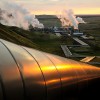
The Rapid Rise of Green Bonds
Most countries joining the growing list of nations pursuing clean geothermal power have been confronted with a huge financial challenge.
Mangrove Conservation Paves the Way to a Sustainable Future
 When the Asian tsunami washed over several Indian Ocean Rim countries on Boxing Day 2004, it left a trail of destruction in its wake, including a death toll that touched 230,000.

Only Half of Global Banks Have Policy to Respect Human Rights
Just half of major global banks have in place a public policy to respect human rights, according to new research, despite this being a foundational mandate of an international convention on multinational business practice.
Divestment Campaign Aims to Bleed Dry the Fossil Fuel Industry
Even as the presence of major oil and gas corporations is nearly ubiquitous at the U.N. climate talks in the Peruvian capital known as COP20, fossil fuel divestment campaigns have gained ground in various countries and are moving to counter the influence of the "dirty energy" lobby here.
OPINION: Addressing Climate Change Requires Real Solutions, Not Blind Faith in the Magic of Markets
Norwegians know something of life in a climate change world. Migratory birds arrive earlier in spring, trees come into leaf before previously expected, and palsa mires (wetlands) are being lost as permafrost thaws.
“Indigenous Peoples Are the Owners of the Land” Say Activists at COP20
The clamor of indigenous peoples for recognition of their ancestral lands resounded among the delegates of 195 countries at the climate summit taking place in the Peruvian capital. “I want my land…that’s where I live and eat, and it’s where my saintly grandparents lie,” Diana Ríos shouted with rage.
“What’s Good for Island States Is Good for the Planet”
The lead negotiator for an inter-governmental organisation of low-lying coastal and small island countries doesn't mince words. She says the new international climate change treaty being drafted here at the ongoing U.N. Climate Change Conference “is to ensure our survival".
Model Contract to Help Protect Developing Countries From ‘Land Grabs’
When the Korean company Daewoo attempted to acquire half the arable land of Madagascar for free, it unleashed a tsunami of investor interest in agricultural land, popularised as the 'land grab'.« Previous Page — Next Page »


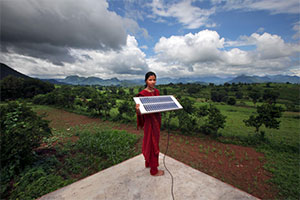 Bringing clean energy to rural India. Credit: Abbie Trayler-Smith / Panos Pictures / Department for International Development
Large reserves of oil, gas and minerals in developing countries generate opulent revenues. They could be used to stimulate economic growth and reduce poverty, but often result in environmental destruction and conflict, benefiting large companies and corrupt governments. Furthermore, competition over natural resources often manifests through geopolitical conflict. For example, before the US-Iraq war, Iraq’s domestic oil industry was nationalized. With US aggression came weakened Iraqi institutions and foreign intervention, thus eventually leading to the privatization of Iraqi oil, leaving the industry now largely dominated by Western companies. As another example, China’s rising investments within the lithium sector in South America are increasing the US-China rivalry across the Western Hemisphere. Notably, Bolivia has the largest reserves of lithium in the world, and the nation’s state-owned lithium extraction firm recently signed a contract with China’s CBC Consortium, while rejecting the entry of Western firms into the nation. In Bolivia’s case, rising Chinese investment in the nation’s lithium sector also raises concerns about environmental sustainability and the sociopolitical rights of Indigenous communities. More broadly, Sub-Saharan Africa holds nearly 30% of global reserves of critical minerals required for low-carbon technologies. Despite this, the region attracts less than 10% of global exploration investment, depicting a critical barrier to both the clean energy transitions and Sub-Saharan Africa’s economic development. Furthermore, resource wealth continues to fuel conflict like Sudan’s civil war, which has led to 9.1 million internally displaced people and is intensely connected to competition over gold, water, and agricultural land. IPS covers news about major oil, gas, and mining projects, their effects on the environment and local communities, and the ideas and actions of the interest groups involved.

The Week with IPS

NEXT STOP - SDGs
Tracking global progress towards a sustainable world
Tracking global progress towards a sustainable world
