Languages
Saturday, October 3, 2026



News and Views from the Global South
Natural Resources

After Nine Years of Foot-Dragging, U.N. Ready for Talks on High Seas Treaty
After four days of intense negotiations - preceded by nine years of dilly-dallying - the United Nations has agreed to convene an intergovernmental conference aimed at drafting a legally binding treaty to conserve marine life and govern the mostly lawless high seas beyond national jurisdiction.
A “Rosetta Stone” for Conducting Biodiversity Assessments
This month saw an important milestone reached by the U.N.’s young Intergovernmental Platform on Biodiversity and Ecosystem Services (IPBES): Publication of its first public product.
Africa Needs to Move Forward on Renewable Energy
Diversification of Africa’s electricity sources by embarking on renewable energy solutions – such as solar, wind, geothermal and hydro power – is being heralded as a solution to the continent’s energy poverty.
The Bahamas’ New Motto: “Sand, Surf and Solar”
When it comes to tourism in the 15-member Caribbean Community (CARICOM), The Bahamas -- 700 islands sprinkled over 100,000 square miles of ocean starting just 50 miles off Florida -- is a heavyweight.
Final Push to Launch U.N. Negotiations on High Seas Treaty
The United Nations will make its third - and perhaps final - attempt at reaching an agreement to launch negotiations for an international biodiversity treaty governing the high seas.
Caribbean Youth Ready to Lead on Climate Issues
At 24 years old, Stefan Knights has never been on the side of those who are sceptical about the reality and severity of climate change.
CORRECTION/Sustainable Energy Starts With the Sun
It began with an experiment to install photovoltaic cells over an irrigation canal that forms part of the Sardar Sarovar canal network – a massive hydel power project across the River Narmada that irrigates some 1.8 million hectares of arable land in the western Indian state of Gujarat.
Pacific Islands Call for New Thinking to Implement Post-2015 Development Goals
As the Millennium Development Goals (MDGs), a set of poverty-alleviation targets set by the United Nations, come to a close this year, countries around the world are taking stock of their successes and failures in tackling key developmental issues.
Aid Freeze Over Energy Controversy a Blow to Tanzanian Economy
As foreign donors drag their feet on injecting badly needed cash into the government’s coffers, local analysts are increasingly worried that this will affect implementation of key development projects that require donor funding.
Africa Must Prioritise Water in Its Development Agenda
Although African countries have been lauded for their efforts towards ensuring that people have access to safe drinking water in keeping with Millennium Development Goals (MDGs), they have nonetheless come under scrutiny for failure to prioritise water in their development agendas.
Island States Throw Off the Heavy Yoke of Fossil Fuels
The Caribbean nation of St. Kitts and Nevis, on a quest to become the world’s first sustainable island state, has taken a giant leap in its programme to cut energy costs.
OPINION: For the Good of Humanity – Towards a Culture of Caring
About a week ago my wife was taken to hospital and diagnosed with pneumonia. She was promptly treated with antibiotics and, wonderfully, is now on the mend.
More Than Half of Africa’s Arable Land ‘Too Damaged’ for Food Production
A report published last month by the Montpellier Panel - an eminent group of agriculture, ecology and trade experts from Africa and Europe - says about 65 percent of Africa's arable land is too damaged to sustain viable food production.
Haitians Worry World Bank-Assisted Mining Law Could Result in “Looting”
With Haiti’s Parliament having dissolved on Tuesday, civil society groups are worried that the Haitian president may move to unilaterally put in place a contentious revision to the country’s decades-old mining law.
Oil, An Invasive Water Species in the Carnival Capital
"We ran down to the beach and found a black tide, whose waves didn’t make the sound of water, but the slurp of a thick paste,” said Alexandre Anderson, describing the oil spill in Guanabara bay in the Brazilian state of Rio de Janeiro which turned him into an activist and leader among the local small-scale fishing community.
St. Vincent Embarks on Renewable Energy Path
For decades, the fertile slopes of La Soufriere volcano, which occupies the northern third of this 344-kilometre-square island, has produced illegally grown marijuana that fuels the local underground economy, and the trade in that illicit drug across the eastern Caribbean.
OPINION: Global Citizenship, A Result of Emerging Global Consciousness
Globalisation is an integral feature of modernity. It already has significantly advanced to transform local experiences into global ones, to unify the disparate villages of the world into a global community, and to integrate national economies into an international economy.
OPINION: No Nation Wants to Be Labeled “Least Developed”
Since 1971, Maldives is one of only three countries that have graduated from the ranks of the world’s “least developed countries” (LDCs) – the other two being Botswana and Cape Verde.
Integrated Farming: The Only Way to Survive a Rising Sea
When the gentle clucking grows louder, 50-year-old Sukomal Mandal calls out to his wife, who is busy grinding ingredients for a fish curry. She gets up to thrust leafy green stalks through the netting of a coop and two-dozen shiny hens rush forward for lunch.
Organic Farming in India Points the Way to Sustainable Agriculture
Standing amidst his lush green paddy fields in Nagapatnam, a coastal district in the southern Indian state of Tamil Nadu, a farmer named Ramajayam remembers how a single wave changed his entire life.
Children Starving to Death in Pakistan’s Drought-Struck Tharparkar District
The main entrance to the Civil Hospital in Mithi, headquarters of the Tharparkar district in Pakistan’s southern Sindh Province, is blocked by a couple of men clad in traditional dress and turbans. They are trying to console a woman who is sobbing so heavily she has to gasp for breath.« Previous Page — Next Page »


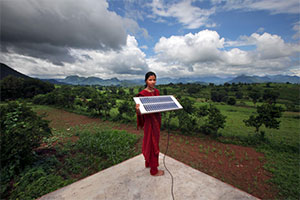 Bringing clean energy to rural India. Credit: Abbie Trayler-Smith / Panos Pictures / Department for International Development
Large reserves of oil, gas and minerals in developing countries generate opulent revenues. They could be used to stimulate economic growth and reduce poverty, but often result in environmental destruction and conflict, benefiting large companies and corrupt governments. Furthermore, competition over natural resources often manifests through geopolitical conflict. For example, before the US-Iraq war, Iraq’s domestic oil industry was nationalized. With US aggression came weakened Iraqi institutions and foreign intervention, thus eventually leading to the privatization of Iraqi oil, leaving the industry now largely dominated by Western companies. As another example, China’s rising investments within the lithium sector in South America are increasing the US-China rivalry across the Western Hemisphere. Notably, Bolivia has the largest reserves of lithium in the world, and the nation’s state-owned lithium extraction firm recently signed a contract with China’s CBC Consortium, while rejecting the entry of Western firms into the nation. In Bolivia’s case, rising Chinese investment in the nation’s lithium sector also raises concerns about environmental sustainability and the sociopolitical rights of Indigenous communities. More broadly, Sub-Saharan Africa holds nearly 30% of global reserves of critical minerals required for low-carbon technologies. Despite this, the region attracts less than 10% of global exploration investment, depicting a critical barrier to both the clean energy transitions and Sub-Saharan Africa’s economic development. Furthermore, resource wealth continues to fuel conflict like Sudan’s civil war, which has led to 9.1 million internally displaced people and is intensely connected to competition over gold, water, and agricultural land. IPS covers news about major oil, gas, and mining projects, their effects on the environment and local communities, and the ideas and actions of the interest groups involved.

The Week with IPS

NEXT STOP - SDGs
Tracking global progress towards a sustainable world
Tracking global progress towards a sustainable world
