Languages
Saturday, October 24, 2026



News and Views from the Global South
Trade & Investment

OPINION: Keep Family Farms in Business with Youth Agripreneurs
Finding a way to allow youth to contribute their natural and ample energies to productive causes is increasingly the touchstone issue that will determine future prosperity.
Uruguay Puts High Priority on Renewable Energies
Uruguay is modifying its energy mix with the aim of achieving carbon neutrality by 2030, by means of a strategy that bolsters non-conventional clean energy sources through public-private partnerships and new investment. A majority of this South American country’s energy already comes from renewable sources.
Africa Gears for Infrastructural Boom
The upcoming week for the Programme for Infrastructure Development in Africa (PIDA), which runs from November 13-17 in Abidjan, the capital city of Ivory Coast, is set to throw this continent into the full gear of infrastructural boom, development experts here say.Refugee Crisis May Threaten Development Aid to World’s Poor
As the spreading refugee crisis threatens to destabilize national budgets of donor nations in Western Europe, Secretary-General Ban Ki-moon Wednesday appealed to the international community not to forsake its longstanding commitment for development assistance to the world’s poorer nations.
Opinion: Economic Slowdown Threatening Progress
Slower economic growth since 2008, and especially with the commodity price collapse since the end of last year, threatens to reverse the exceptional half-decade before the financial crash when growth in the South stayed ahead of the North. From 2002, many developing countries – including some of the poorest– had been growing much faster after a quarter century of stagnation in Africa, for example.UN Targets “Hidden Source” for Development Funding
The United Nations has estimated a hefty funding requirement of over 3.5 trillion to 5.0 trillion dollars per year for the implementation of its ambitious post-2015 development agenda, including 17 Sustainable Development Goals (SDGs), approved by world leaders in September.
World Trade Organization Rules Help to Support Better Public Health
Trade and the multilateral trading system can help in creating a more favourable global environment for public health policies and the implementation of a balanced and effective intellectual property system.
Open Data – Still Closed to Latin American Communities
Open data policies in Latin America have not yet enabled communities to exercise their right to access to information, consultation and participation with regard to mining or infrastructure projects that affect their surroundings and way of life.
Nicaragua’s Interoceanic Canal, a Nightmare for Environmentalists
The international scientific community’s fears about the damage that will be caused by Nicaragua’s future interoceanic canal have been reinforced by the environmental impact assessment, which warns of serious environmental threats posed by the megaproject.
Opinion: The Broken Promises of the Peruvian Development Model
Lima was the host, in October 2015, of the International Monetary Fund (IMF) and the World Bank annual meetings. The two Bretton Woods institutions, criticized for their record of lowering social and environmental conditions, seek to showcase Peru as a success of their neoliberal policies and reforms to the rest of the world.
Brazil’s Megaprojects, a Short-lived Dream
Working as a musician in a military band is the dream of 21-year-old Jackson Coutinho, since hopes that a petrochemical complex would drive the industrialisation of this Brazilian city near Rio de Janeiro have gone up in smoke.
Southeast Asia: How to Make Good Business Out of Doing Good
When his father drove back to pay the 47 Malaysian cents they owed to the food stall they had just left, then nine-year-old Anis Yusal Yusoff, today president and chief executive officer of the Malaysian Institute of Integrity, learned the meaning of standing firm by one’s values.
Cuba’s Extra-Heavy Crude Awaits Technology and Investment
Cuba's oil industry only exploits five percent of the petroleum found in onshore and offshore deposits due to a lack of foreign capital and technology to develop oilfields like Varadero 1000, the country's biggest oil operation until now.
Itaborai, a City of White Elephants and Empty Offices
Itaboraí still recalls its origins as a sprawling city that sprang up along a highway, not far from Rio de Janeiro. But a few years ago big modern buildings began to sprout all over this city in southeast Brazil, whose offices and shops are almost all empty today.
Opinion: TPP is Bad for One’s Health
Reflecting President Barack Obama’s pivot to Asia, the US, Japan and 10 other Pacific Rim nations have inked a Trans-Pacific Partnership (TPP) agreement. This is the largest mega free trade agreement (FTA) in two decades and represents 40 per cent of the global economy.
OPINION: Time to Reform the Global Casino
The year 2015 highlights the global shift from traditional money-based, gross domestic product (GDP)-measured economic growth to the new models of sustainable, inclusive human development embodied in the United Nations Sustainable Development Goals (SDGs) ratified by its 193 member nations.Trans-Pacific partnership raise the barriers for the access to affordable medicines
The pharmaceutical industry from the US and Europe scored a major victory with the adoption, in 1994, of a binding agreement on intellectual property (Agreement on Trade Related Aspects of Intellectual Property Rights - TRIPS) in the context of the nascent World Trade Organization (WTO).
If the World Trade Organisation did not Exist, it Would Have to be Invented
The World Trade Organisation (WTO) is a relative newcomer on the international stage. This year we are marking our 20th anniversary.
Opinion: India’s Compact with Africa
The third India-Africa Forum Summit to be held in New Delhi later this month – in which 54 African countries will participaate – is expected to result in a deeper engagement between India and Africa. This summit takes place at a time when both need each other more than ever before. Both remain bright spots in a bleak and blighted growth landscape. Out of 189 countries, only 63 are expected to grow by 4 per cent and more this year, 36 of which are in Africa. But many countries there are adversely impacted by China's diminishing appetite for commodities and shrinking trade. India is currently one of the fastest growing economies in the world.
Opinion: International Tax Cooperation Crucial for Development
It has become clear that the South, including the least developed countries, has little reason to expect any real progress to the almost half century old commitment to transfer 0.7 percent of developed countries’ income to developing countries. But to add insult to injury, developing countries have, once again, been denied full participation in inter-governmental discussions to enhance overall as well as national tax capacities.
The Spectre of Jobless Growth in India
India faces a serious challenge of dealing with joblessness despite statistically being the world’s fastest growing economy. The spread, depth and intensity of the problem, especially among the educated youth, is not reflected the latest unemployment number of 4.9 per cent in 2013-14. This estimate captures the chronically unemployed – those who sought or were available for work for the major part of the year – but it rarely figures in public discourse as the rate is relatively low and stable over time. Another reason is that the economy continues to generate employment opportunities even if they are largely casual or temporary in the informal sector.« Previous Page — Next Page »





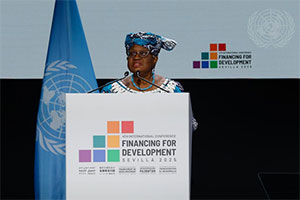 Opening of 4th International Conference on Financing for Development. Credit: UN Photo/Mariscal
International trade and investment are crucial elements of the world economy. While they can be powerful stimulators of development, they can also lead to global imbalances and dynamics of exploitation. In 2025, international trade entered a period of immense disruption, driven in part by a new wave of United States tariffs that reshaped global supply chains and investment flows. The increase in the US tariff rate, the highest since the 1930s, has forced bilateral renegotiations with global trading partners. Furthermore, the debt crisis in developing nations has accelerated while Official Development Assistance (ODA) has substantially dropped 7.3% in 2024.
In the 21st century, advancements in economic diversification in formerly colonized nations have propelled them into more central roles in the global economy. For example, both China and Mexico were able to develop their manufacturing sector and channel this development into booming export flows, thus advancing into the position of emerging economies. Foreign investment also plays an essential role in providing capital for developing countries, although they are oftentimes accompanied by social and environmental exploitation. For example, rising Chinese investments in natural resources in Latin America have often been met with tension as these investment projects fail to properly mitigate environmental risks and protect workers’ rights. In a more multifaceted vein, Sino-African relations have led to infrastructure development in Sub-Saharan Africa while also heightening the region’s economic dependency on China. IPS reports on global news in trade and investment, while shining a light on the nuanced nature of these endeavors.

The Week with IPS

NEXT STOP - SDGs
Tracking global progress towards a sustainable world
Tracking global progress towards a sustainable world
