Languages
Monday, September 28, 2026



News and Views from the Global South
Global Geopolitics

Veto is the Chief Culprit but Expulsion or Suspension is Not the Remedy
The ongoing war in Ukraine has raised the question of expulsion or suspension of the Russian Federation from the United Nations. As is known, following the dissolution of the Soviet Union in 1991, its UN seat was transferred to the Russian Federation.
The War in Ukraine and the Spectre of Genocide
Georg Hegel once stated: ”What experience and history teach is this — that nations and governments have never learned anything from history, or acted upon any lessons they might have drawn from it.” Nevertheless, self-taught historian Vladimir Putin has learned to interpret history in his own manner. During COVID he went down in Kremlin’s archives and after studying old maps and treaties he wrote a lengthy essay On the Historical Unity of Russians and Ukrainians, while declaring that ”the formation of an ethnically pure Ukrainian state is an aggression directed against Russia.”
Ukraine Challenges Legitimacy of Russia’s UN Membership
The overwhelming condemnation of the invasion of Ukraine—which triggered a veto from Russia and an abstention from China last week – has raised a challenging question about the legitimacy of UN memberships of both countries which are permanent members of the Security Council.
Miles’ Law and the War in Ukraine
Where you stand depends on where you sit
This aphorism which dates back to the late 1940s points out that one’s position on issues (where you stand) is shaped by your relationship with the events taking place (where you sit).

The Historic UNGA Resolution on Aggression against Ukraine Deserves Follow-up Action – on the Part of the UN Secretary-General
The majority of the world wants peace. This is clear by now. Just consider the many large-scale anti-war demonstrations taking place around the world; and the outpour of solidarity and support for the people in the Ukraine and the more than one million Ukrainians who fled from their country.
UN’s Political Hypocrisy– as Multi-Million Dollar Purchases Continue from a Blacklisted Russia
The world’s financial institutions, primarily in the US and Europe, have cut off links and economically ostracized Russia for its invasion of Ukraine and violation of the UN charter.
Will Russia Follow USSR Expelled from League of Nations for Invading Finland in a Bygone Era?
The Russian Federation, condemned worldwide for invading a founding member of the United Nations-- and violating the UN charter-- came under heavy fire during a rare Emergency Special Session of the 193-member General Assembly, the highest policy-making body in the Organization.
Not Exactly Sun Tzu: Russian Military Blunderings & the Global Democratic Deficit
Russian President and former intelligence officer Vladimir Vladimirovich Putin has been at the helm of power since 1999, promoting jingoistic nationalism to keep his hold on power and creating a democratic deficit on the home front.
Firm, Unified Response Needed to Russia’s Aggression
It is now clear diplomacy matters little to Vladimir Putin. Despite the efforts of a string of presidents and prime ministers to prevent conflict, on 24 February, Putin started the war he’d been itching for.
World’s Custodian of Peace Remains Glaringly Irrelevant
As a new political twist to an old saying goes: the dogs bark but the military caravan moves on. Despite ominous warnings from an overwhelming majority of member states both in the General Assembly and the Security Council— against a military attack on Ukraine —Russian President Vladimir Putin stood defiant when he ordered a full-scale invasion of a sovereign territory.
Decapitating Terrorist Organisations Won’t End Terror
Killing terrorist organisations’ leaders is no effective way of fighting terrorism — as it’s political and economic crises on which terrorism feeds.
Bob Dylan and the Ukraine Crisis
Fifty-nine years ago, Bob Dylan recorded “With God on Our Side.” You probably haven’t heard it on the radio for a very long time, if ever, but right now you could listen to it as his most evergreen of topical songs:
If Security Council Fails, Violation of UN Charter Should Go Before International Court of Justice
The widening political crisis in Ukraine, which has taken a turn for the worse with the declaration of two new independent states—the Donetsk People’s Republic and the Luhansk People’s Republic -- is likely to prove once again the ineffectiveness of the 15-member UN Security Council (UNSC).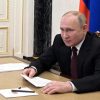
Ukraine: What’s Really Behind Putin’s Deployment of ‘Peacekeeping’ Troops? Experts Explain
Vladimir Putin’s recognition of the independence of the two breakaway republics of Donetsk and Luhansk followed a surreal live broadcast of a security council meeting in the Kremlin. Sitting facing the 13-member council, Putin cajoled and argued as, one by one, his most senior officials – including Dmitry Medvedev, a former president and prime minister, and the country’s foreign minister, Sergei Lavrov – took to the lectern to provide their boss with “reasons” for the formal recognition of the two republics in the country’s east as independent states.
War Clouds in Europe: Alert and Alarm in Asia
What happens in Europe cannot be expected to remain in Europe, particularly in this interconnected world. As war clouds gather in that continent with Russo-Western relations deteriorating by the day over Ukraine, ripples, indeed waves, are expected in consequence on the waters of faraway Asia. There, despite the onslaught of the Covid pandemic, nations appeared till recently to be devoting themselves to economy-boosting efforts, regionally expanding trade (ASEAN), or domestically sharing prosperity (China). Now suddenly, as Russia and the West try to tap the reservoir of till-now vocal support from their respective camp-followers in that region, these countries feel trapped between Scylla and Charybdis. Slowly but surely, given the imperatives of geo-politics, they may be constrained to take sides, albeit in the case of some, most reluctantly.
Ukraine Crisis: The Stakes are High
If the Ukraine crisis erupts into war – even intensified limited war in Eastern Ukraine with overt Russian intervention – the consequences will be severe and far-reaching.
Is Big Power Rivalry Threatening to Sink the Indian Ocean Zone of Peace?
A former Indian ambassador once told an American audience that one of the biggest misconceptions about the Indian Ocean is that it belongs to India. “Not so, but we wish we did”, he said, amidst laughter.
UN’s Investigative Arm Launches Survey to Probe Racism & Discrimination in World Body
The Joint Inspection Unit (JIU)-- the UN’s only independent external oversight body mandated to conduct evaluations, inspections and investigations-- is conducting a survey probing the widespread racism and discrimination in the world body.
It is Time for a More Inclusive & Democratic UN
The global challenges we face are too complex for governance as usual. It is high time to strengthen the United Nations’ (UN) democratic and participatory character.
U.S. to Russia: Do as We Say, Not as We Do
Hidden in plain sight, the extreme hypocrisy of the U.S. position on NATO and Ukraine cries out for journalistic coverage and open debate in the USA’s major media outlets. But those outlets, with rare exceptions, have gone into virtually Orwellian mode, only allowing elaboration on the theme of America good, Russia bad.
A Special Adviser to Probe Racism and Discrimination at UN
“Racism and discrimination have no place in our world -- least of all at the United Nations”, warns UN Secretary-General Antonio Guterres, who will soon appoint a Special Adviser to investigate the growing discrimination based on racial, national or ethnic origins in the world body.« Previous Page — Next Page »


Is the world dominated by three great empires -- the U.S.A, China and the European Union? How much power do the great behemoths of the south -- India, Brazil, and South Africa -- wield? And where does Russia fit in that equation? Are we in the middle of a new Cold War? What are the implications of the armed conflict with Georgia? What about the new axis: Venezuela-Russia? And what role does Turkey play? What about issues like Climate Change and other global forces like the food crisis and the high energy prices? How is all this reshaping the world's forces? IPS looks for some answers.

The Week with IPS

NEXT STOP - SDGs
Tracking global progress towards a sustainable world
Tracking global progress towards a sustainable world
