Languages
Friday, October 2, 2026



News and Views from the Global South
Peace

The UN Has Failed Civilians
Despite the United Nations Security Council’s task of protecting civilians, millions around the world are still being displaced and killed with little to no accountability for perpetrators.
Executive Director of the Geneva Centre: Education constitutes an important building block to counter violent extremist narratives
Equal access to education can open vital spaces for inclusiveness, reconciliation and dialogue as well as address prevailing toxic narratives fuelling violent and extremist ideologies, said the Executive Director of the Geneva Centre for Human Rights Advancement and Global Dialogue Ambassador Idriss Jazairy at a conference organized by the World Council of Churches (WCC).
Stop The War on Children
Too many children are dying as a result of explosive weapons, and the international community must step up to protect and declare children off limits in war.
US Withdrawal From Iran Nuclear Deal: One Year On
On 8 May last year, US President Donald J. Trump announced that the United States would pull out of the Joint Comprehensive Plan of Action (JCPOA), which sets limits on Iran’s nuclear programme to ensure that it cannot produce nuclear weapons.
The Ethiopian City Lost in the Shadow of South Sudan’s War
 Right up against the border with South Sudan, the western Gambella region of Ethiopia has become a watchword for trouble and no-go areas as its neighbour’s troubles have spilled over. But now there may be reason for optimism on either side of the border.
The Burning of Notre Dame and the Spirit of Place
The catastrophic fire in Notre Dame produced a massive emotional reaction. In a Paris famous for its secularism tearful people knelt on the pavement, sang the Ave Maria and prayed to God to save their cathedral. Several stated that it was not only a church burning, but the soul of Paris passing away. What did they mean to say?
Trump’s Arms Control Gambit: Serious or a Poison Pill?
Smart U.S. leadership is an essential part of the nuclear risk reduction equation. Unfortunately, after more than two years into President Donald Trump’s term in office, his administration has failed to present a credible strategy to reduce the risks posed by the still enormous U.S. and Russian nuclear arsenals, which comprise more than 90 percent of the world’s nuclear weapons.
Massacre of the Innocents: Whereto from Here?
We have been here before. This blooded precipice is familiar, this looming abyss. What is unfamiliar, what renders the Easter Sunday massacre most vile and truly nightmarish is the total absence of any knowable rationality.
Kenya and Ethiopia Cross-Border Initiative: A Move Towards Sustainable Peace
Many years of internecine conflict is being replaced by a new narrative of peace along the Kenya-Ethiopia border. Communities that once fought each other are now dreaming of a joint journey towards a better future.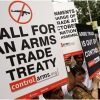
US Takes Back Signature on Arms Trade Treaty
The United States dropped a political bombshell when President Donald Trump announced his administration would withdraw from the historic Arms Trade Treaty (ATT) which the former Obama administration signed in September 2013.
Muslim Terrorists Heading Towards a Jihadist Hell Hole
The history of terrorism in Sri Lanka reveals a clear pattern. The first to take up arms in the post-Independent era were the misguided Sinhala youth. They were educated youth desperately running in search of a quick solution to establish their classless paradise. Their violence did not take them anywhere.
Sri Lanka’s Easter Sunday Carnage: Quo Vadis?
I returned from attending a three-hour Easter Sunday mass at the Fordham University Church around midnight New York time on April 20, 2019, when my phone rang and a colleague asked me what’s going on in Sri Lanka? I said what is going on? He said there were a series of coordinated terrorist bombings with multiple fatalities and scores of injuries in my native country. For the next four and a half hours I was on the phone trying to piece together what happened, including reaching out to Sri Lanka’s Secretary of Defence Hemasiri Fernando.
Global Governance and Information
The past seventy years since the end of the second world war have been marked by profound changes in our international system. Relations between states have become more horizontally structured interactions with a rising significance of the common good articulated and pursued by newly-created international programmes and organisations.
Brunei’s Shariah Code & the New Stone Age
Over a week ago – on April 3 – Brunei, the tiny South East Asian kingdom on the island of Borneo, announced its citizens would face the full force of the Shariah law.
From Empowerment During War, Eritrean Women Must Fight Gender Discrimination in a New Peace
As the first anniversary of the swearing on Ethiopia’s Prime Minster Abiy Ahmed rolled around last week, Ethiopians – and observers worldwide – marvelled at the pace and scale of radical reform he has brought to the formerly repressed country in the past year.
Civil Society Under Attack in Name of Counterterrorism
Counterterrorism measures are not only affecting extremist groups, but are also impacting a crucial sector for peace and security in the world: civil society.
Mobilizing Men as Partners for Women, Peace & Security
In the first month of Bangladesh joining the Security Council in January 2000, President Nelson Mandela was in New York to report to the Council in his capacity as the UN-mandated facilitator of the Burundi Peace Process. In an informal setting, he shared with us that his efforts to include women in the peace table were not working as participating men stonewalled.
Is Republic of China Still a Permanent Member of the Security Council – Despite its Ouster in 1971?
The Republic of China (Taiwan) withdrew from the United Nations in protest when it was ousted from its highly-prized permanent seat in the UN Security Council (UNSC) about 48 years ago.
The NPT & Conditions for Nuclear Disarmament
Fifty years ago, shortly after the conclusion of the 1968 nuclear Nonproliferation Treaty (NPT), the United States and the Soviet Union launched the Strategic Arms Limitation Talks (SALT).
UK Announces Aid Package for Gazan Hospitals Near Breaking Point
The UK Government has announced an aid package to support hospitals in Gaza that are “near breaking point”. The £2 million package will go to the International Committee of the Red Cross’s 2019 Israel and Occupied Territories (ILOT) Appeal. The aid will contribute to surgical equipment, drugs, wound dressing kits, prosthetics, and post-surgery physiotherapy for up to 3,000 disabled people.
The System, Youth and Democracy
If we ever needed proof of how the political system has become self-referential and unable to update itself, the latest student march in more than 1,000 towns is a very good example.« Previous Page — Next Page »


The Week with IPS

NEXT STOP - SDGs
Tracking global progress towards a sustainable world
Tracking global progress towards a sustainable world
