Languages
Wednesday, September 30, 2026



News and Views from the Global South
Active Citizens

Half a Century of Struggle Against Underdevelopment
The idea of creating Inter Press Service (IPS) arose in the early 1960s in response to awareness that a vacuum existed in the world of journalism, which had two basic aspects.
French Add Voice to Global Climate Action
As if to highlight the reality of climate change, the rain came pouring down here as demonstrators prepared to rally for political action to combat global warming.
Environmental Funding Bypasses Indigenous Communities
When she talks about the forests in her native Kalimantan, the Indonesian part of the island of Borneo, Maridiana Deren’s facial expression changes. The calm, almost shy person is transformed into an emotionally charged woman, her fists clench and she stares wide-eyed at whoever is listening to her.
Will Governments Keep Their Promises on the Human Right to Water?
It was a dramatic moment at the United Nations when it voted in 2010 to affirm water and sanitation as a human right.
U.N. Urged to Reaffirm Reproductive Rights in Post-2015 Agenda
The U.N.'s post-2015 development agenda has been described as the most far-reaching and comprehensive development-related endeavour ever undertaken by the world body.
New Fund to Build on “Unprecedented Convergence” Around Land Rights
Starting next year, a new grant-making initiative will aim to fill what organisers say has been a longstanding gap in international coordination and funding around the recognition of community land rights.
Can ‘Womenomics’ Stem the Feminisation of Poverty in Japan?
Fifty-four-year-old Marlyn Maeda, an unmarried freelance writer living in Tokyo who never held a permanent job, is now watching her dream of aging independently go up in smoke.
Honduran Mothers and Grandmothers Search Far and Wide for Missing Migrants
United by grief and anxiety, the grandmothers, mothers and other relatives of people who disappeared on the migration route to the United States formed a committee in this city in northern Honduras to search for their missing loved ones.
Tackling Climate Change and Promoting Development: A “Win-Win”
A widespread perception exists that developing countries must make a choice between tackling climate change and fighting poverty. This assumption is incorrect, according to the authors of a new report on green growth.
Will the Upcoming Climate Summit Be Another Talkathon?
As the United Nations hosts a Climate Summit Sep. 23, the lingering question is whether the meeting of world leaders will wind up as another talk fest.
OPINION: A Climate Summit to Spark Action
On Sep. 23, I have invited world leaders from government, business, finance and civil society to a Climate Summit in New York so they can show the world how they will advance action on climate change and move towards a meaningful universal new agreement next year at the December climate negotiations in Paris.
Organic Farmers Cultivate Rural Success in Samoa
Rural farming families in Samoa, a small island developing state in the central South Pacific Ocean, are reaping the rewards of supplying produce to the international organic market with the help of a local women’s business organisation.World Bank Tribunal Weighs Final Arguments in El Salvador Mining Dispute
A multilateral arbitration panel here began final hearings Monday in a contentious and long-running dispute between an international mining company and the government of El Salvador.
A Flood of Energy Projects Clash with Mexican Communities
Since January, villagers and townspeople near the Los Pescados river in southeast Mexico have been blocking the construction of a dam, part of a multi-purpose project to supply potable water to Xalapa, the capital of the state of Veracruz.
U.N. Climate Summit: Staged Parade or Reality Show?
The much-ballyhooed one-day Climate Summit next week is being hyped as one of the major political-environmental events at the United Nations this year.
‘Breaking Silence’ on the Slave Trade
The Oscar-winning film 12 Years a Slave recently generated international discussion about the barbarity of slavery, but it is not alone in the attempt to break the silence around the 400 years of the transatlantic slave trade and to “shed light” on the lasting historical consequences.
Salvadoran Farmers Stake Their Bets on Sustainable Development
Peasant farmers from one of El Salvador’s most fragile coastal areas are implementing a model of sustainable economic growth that respects the environment and offers people education and security as keys to give the wetland region a boost.
Majority of Consumer Products May Be Tainted by Illegal Deforestation
At least half of global deforestation is taking place illegally and in support of commercial agriculture, new analysis released Thursday finds – particularly to supply overseas markets.
Free Economic Zone Plan Slammed as ‘Suicide’ Pact for Taiwan Farmers
The Taiwan government’s plan to liberalise tariff-free imports of agricultural produce from China and other countries for processing in free economic pilot zones, which will then be exported as ‘Made in Taiwan’ items, may mean suicide for Taiwanese farmers if approved by the national legislature.
Mideast Nuclear Weapons-Free Zone Remains in Limbo
After four long years of protracted negotiations, a proposal for a nuclear weapons-free zone (NWFZ) in the strife-torn Middle East remains in limbo - and perhaps virtually dead.
Global Citizenship: “From Me to We to Peace”
If a Silicon Valley existed for the culture of peace, it would most likely look to global citizenship as the next big industry shake-up.« Previous Page — Next Page »


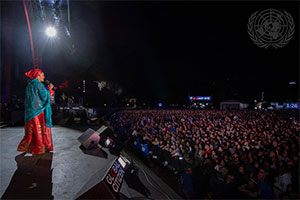 Global Citizen Festival in New York. Credit: UN Photo/Eskinder Debebe
Active citizens are committed to social change because they know that it is achievable. However, major political challenges face active citizens across the world. For example, in authoritarian regimes in Latin America where the hegemonic party has been in power for decades on end, protestors and human rights activists face enormous repression and struggle to materialize their advocacy into concrete results. The same can be said for Africans, where a shift towards elected government in recent decades has yet to translate into an effective voice in decision-making. Now, the Strengthening Citizen Demand for Good Governance, which uses evidence-based approaches – funded by DFID's Governance and Transparency Fund – seeks to raise their voices.
In 2025, the CIVICUS Monitor’s People Power Under Attack report revealed that civic freedoms are severely limited in 122 of 198 countries and territories, and only 7.2% of the global population now lives in countries where civic space is open. Through partnership with the Overseas Development Institute (ODI) and CIVICUS, IPS reporters across the continent will seek to define the extent and limits of state capability, government accountability and the responsiveness of leaders to the needs of citizens.

The Week with IPS

NEXT STOP - SDGs
Tracking global progress towards a sustainable world
Tracking global progress towards a sustainable world
