Languages
Sunday, November 8, 2026



News and Views from the Global South
Armed Conflicts

Child Soldiers Released, But Risk Remains
More than 200 child soldiers were released by armed groups in war-torn South Sudan, and help will be needed to ensure their safe and bright future, according to a UN agency. The release took place in Western Equatoria State and follows a similar release last month that saw 300 children freed.
A Child of War Dedicates Herself to Peace
“I was so angry, I felt like I wanted to blow up the whole world, but I didn’t. I decided I wouldn’t be pushed to become evil. I would choose peace.” Dalia Al-Najjar has crammed a great deal into her short life. At 22, the Palestinian refugee has already lived through three wars and has spent every spare moment between siege and ceasefire studying, volunteering, working, blogging, on the daily struggle to live in Gaza – and planning how to change the future.
Middle East: a Threat to World Peace & Security, Warns UN Chief
The situation in the Middle East is in chaos — to such an extent it has become a threat to international peace and security. The region is facing a true Gordian knot – different fault lines crossing each other and creating a highly volatile situation with risks of escalation, fragmentation and division as far as the eye can see with profound regional and global ramifications.
UN Cracks Down on Peacekeeping Troops over Human Rights Abuses
The United Nations, whose peacekeepers have come under increased scrutiny because of widespread charges of sexual abuse and human rights violations, claims it is now committed to ensuring that all personnel serving with the UN meet the “highest standards of conduct, competence and integrity, including respect for and commitment to human rights.”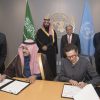
“International Solidarity” at Yemen Donor Conference
The international community has pledged over two billion dollars towards urgently needed humanitarian assistance to Yemen during a UN event.
Yemen the World’s Worst Humanitarian Crisis, Says UN Chief
Thank you all for being here today to show your solidarity with the women, men, girls and boys of Yemen. And I want to thank my co-chairs, the Governments of Sweden and Switzerland, for hosting this conference for the second year and for their continued humanitarian commitment.
I Am a Migrant: Integrating Through Syrian ‘Hummus’
Khaled left Syria in 2015, when his country was already in its fourth year of war. He is 27 years old and can clearly remember what his life was like then in Damascus: a happy life, with a happy family, in a happy country.
Trump Hurtles Toward Three Nuclear Crises
One year into the unorthodox presidency of Donald Trump, the United States faces an array of complex and dangerous foreign policy challenges that require principled leadership, pragmatism, patience, and smart diplomacy.
Conflicts Force Up Global Hunger Levels
Largely driven by conflict, the number of hungry people has dramatically increased around the world, reversing decades of progress, according to a new report.
Chemical Weapons in Syria? Time for Outrage
US Defense Secretary James Mattis dropped a political bombshell last week when he said the U.S. has no evidence to confirm reports that the Syrian government had used the deadly chemical sarin on its citizens.
The Dark Chapter of Zimbabwe’s History That Won’t Go Away
With Zimbabwe’s new President Emmerson Mnangagwa just concluding a 100-day timeline to address what he considered the country’s most pressing issues, which focused on economic revival, human rights activists have their own timeline.
A New Low for Security Council as Russia Takes Syrian Human Rights Off the Table
There is nothing controversial about saying the UN Security Council has failed Syria. Diplomats have openly admitted it, journalists have written about it, human rights organizations have declared it - several times over in the past seven years. But what happened this week was deplorable and unacceptable, even by the very low standards we now have for the Council when it comes to Syria.
Is UN’s Ambitious Global Compact the Last Word on the Migrant Crisis?
As the death toll keeps mounting and the humanitarian crises continue unabated, the life of the average migrant or refugee has largely turned out to be an unmitigated nightmare.
Water Stress Poses Greatest Threat to MENA Region
This year, World Water Day, celebrated annually on 22 March, is themed “Nature for Water”, examining nature-based solutions (NBS) to the world’s water problems.
Male Survivors of Sexual Violence Suffer in Silence Due to Stigma
In the Central African Republic, 45-year-old “Theodore” was captured by an armed group in February 2017 during an attack on his village of Mingala in the country’s southeast. He was taken with 21 other men to a nearby ad hoc rebel military base and locked up in a house-turned-prison guarded by six armed men.
Merchants of Death Ultimate Winners in Escalating Military Conflicts
In most military conflicts worldwide, the ultimate winners are not one of the warring parties-- but the world’s prolific arms traders, described by peace activists as “merchants of death”.
Three Ways the Global Compact Can Better Serve Refugees
The UN High Commissioner for Refugees has a tall task: deliver a “Global Compact for Refugees” to the United Nations’ General Assembly by the end of 2018.
The Politicization of Humanitarian Aid Through Budget Cuts
Ahead of the pending ‘list of shame,’ the Secretary-General’s Annual Report on Children and Armed Conflicts, child protection actors share concerns about the politicization of humanitarian aid putting child protection capacities at a disadvantage.
We Must Protect the Future for Palestinian Refugee Girls
As people across the globe marked International Women’s Day (IWD) on March 8, the safe and secure education and possibilities for the future of millions of young girls and women who are Palestinian refugees across the Middle East remained in danger.
Syria’s ‘Human Catastrophe’
Despite calls for a ceasefire, violent clashes have continued and humanitarian access remains limited in Syria’s Eastern Ghouta, leaving the international community extremely concerned. Since the Syrian government intensified its attacks in recent weeks, more than 700 civilians, many of them children, have been killed in Eastern Ghouta.
Fear and Uncertainty Grip Rohingya Women in India
In the semi-lit makeshift tent covered with strips of cardboard, five women sit in a huddle. As their young children, covered in specks of mud and soot, move around noisily, the women try to hush them down. Hollow-eyed and visibly malnourished, all the women also appear afraid.« Previous Page — Next Page »





Armed conflicts are a sad constant on daily front pages worldwide. Wars, civil wars, revolts, coups, genocides, ethnic and political violence, and global terrorism capture our attention for the geopolitical landslides, human suffering, food crises and streams of migration that follow in their wake. As in times of natural disaster, man-made crises claim frequent casualties among the poor, women and children. IPS examines emerging and ongoing armed conflicts around the world with an eye on the underlying social and political dynamics, and special focus on the lived experiences of those most affected by armed conflict.

The Week with IPS

NEXT STOP - SDGs
Tracking global progress towards a sustainable world
Tracking global progress towards a sustainable world
